



Beekeeping
The topic of this final section is beekeeping, especially related to the production of honey, which is the main product from the bees. For this, you will read a text explaining how honey is made. In the text, you will find many words related to beekeeping, which as usual is collected in a vocabulary list right after the text.
In the communication section, you will learn how to write a curriculum vitae and a cover letter in English. This is a practical aspect of the language that might be useful in case you wish to apply for a job or for an international organization in another country. As part of the application process, writing a CV and the accompanying cover letter are two basic skills. The final stage in the process is the job interview, so you will also learn about the best way of preparing a job interview.
Finally, in the grammar section you will study and practise two types of sentences: the relative sentences, which are used to explain a noun, and the conditional sentences, which say what happens if a condition becomes true. You will also learn about the relative pronouns, which are the most important words in a relative sentence.
Honey production
In order to start the business of honey production in ‘Can Jordà’, Jordi and Núria have bought some beehives to keep bees. They are not much familiarized with honey production, so they surfed the Internet to look for information. Jordi came across the following article:
How Honey is Made
Honey bees collect nectar to create honey and store as food because it provides the energy for bees’ flight muscles and provides heating for the hive in the winter. Fortunately, honey bees will make more honey than the colony needs, so it is necessary for beekeepers to harvest the excess, which they bottle.
Honey starts as flower nectar collected by bees, which gets broken down into simple sugars stored inside the honeycomb. The design of the honeycomb and constant fanning of the bees’ wings causes evaporation, creating sweet liquid honey. Honey’s color and flavor vary based on the nectar collected by the bees. For example, honey made from orange blossom nectar might be light in color, whereas honey from avocado or wildflowers might have a dark amber color.
On average, a hive will produce about 55 pounds of surplus honey each year. Beekeepers harvest it by collecting the honeycomb frames and scraping off the wax cap that bees make to seal off honey in each cell. Once the caps are removed, the frames are placed in an extractor, a centrifuge that spins the frames, forcing honey out of the comb.
After the honey is extracted, it’s strained to remove any remaining wax and other particles. Some beekeepers and bottlers might heat the honey to make this process easier, but that doesn’t alter the liquid’s natural composition.
After straining, it’s time to bottle, label, and bring it to you. It doesn’t matter if the container is glass or plastic, or if the honey is purchased at the grocery store or farmers’ market. If the ingredient label says “pure honey,” nothing was added from bee to hive to bottle.
From National Honey Board
Technical Vocabulary
| English | Catalan | English | Catalan |
|---|---|---|---|
| 55 pounds | 55 lliures (= 25 Kg) | surplus honey | excedent de mel |
| avocado | alvocat | to alter | alterar, canviar |
| bee | abella | to bottle | embotellar |
| beehive | rusc | to come across | trobar-se, topar-se |
| beekeeper | apicultor | to heat | escalfar |
| beekeeping | apicultrura | to keep bees | criar, mantenir abelles |
| bottler | embotellador | to label | etiquetar |
| cell | cel·la | to remove | treure, retirar |
| colony | colònia | to scrape off | rascar, treure |
| fanning | ventilació | to seal off | segellar |
| flavor (US), flavour (GB) | sabor, gust | to spin | fer girar |
| heating | calefacció | to store | emmagatzemar |
| honey | mel | to strain | pressionar, escórrer |
| honey bee | abella de la mel | to surf the Internet | navegar per internet |
| honeycomb | panal, bresca | wax cap | tap de cera, capa de cera |
| honeycomb frame | les vores del panal | wildflower | flor silvestre |
| orange blossom | flor del taronger |
Communication
It might happen that one day you decide to look for a job in another country or to join an international NGO or any other type of organization. To do so, you will most probably need to send your curriculum vitae (or CV), which is usually accompanied of a cover letter explaining why you are applying and summarizing the contents of your CV. Therefore, in this section you will get some advice to write a good CV and cover letter in English.
If you are lucky and go through the first part of the application process, they may call you for an interview to see if you are a good candidate for the job. These interviews may be online or face-to-face, or they may even ask you to send a video. In any case, you will need to clearly explain why you are a good candidate. In this section you will also receive some advice to go to a job interview.
Writing a CV
Nowadays, many companies and institutions offer online applications with CV templates which you can fill in and send with a simple click. However, it is still very common to write your curriculum vitae and send it in pdf format or hand it in on paper.
In the US, they use the term ‘resume’ or ‘résumé’ (with graphical accents) instead of ‘curriculum vitae’ or ‘CV’, which is preferred in British English.
Writing a CV is a very important step in the job search process. You must pay attention to details and be very accurate in your presentation to give a good impression on the employer. You have probably learnt that we must not judge people on first impressions. However, when an employer looks at a curriculum vitae, he does precisely that: to judge a person on the first impression produced by the CV, without even knowing the candidate personally.
This is the reason why a CV should be carefully elaborated. It must convince the employer that you might become an appropriate candidate for the job. With hundreds of other CVs waiting for an opportunity, the most important thing is that your own CV attracts the employer’s attention. To attract the employer’s attention, however, does not mean to write your CV in a variety of colours and/or spectacular font types. This will only distract the reader from the important information. Instead, you should use a conventional format and organize your information clearly.
There are many different models of curriculum vitae, but they all should include the following elements:
For samples and templates as well as advice about writing a CV, see the Europass website in the “Interesting links” of the Reference section in this unit.
- Contact information: your name and surnames should be prominent (usually centered and in bold type). Then add your telephone number, your address and your e-mail address.
- Summary: here you must express your good qualitities, your skills and your achievements for the job. Here is where the employers will look first of all and you need to impress them discreetly so they want to read more details about you.
- Work experience: your relevant job experience should be listed chronologically, starting with your most recent job. For each job, you should mention the company or instituion and your responsibilities in the job.
- Education: in this section, you must list the school, college or institution that you attended and the degree that you received.
- Specialized training: in this section, you must include any addtional diplomas or certificates which may be relevant for the job.
- Skills: this section summarizes your special skills and achievements for the job.
- References: in this section, just write the stardard text ‘Available upon request’, which means that you will provide any documents later on. Employers do not look for references until the end of the interview, so it is not necessary to include them in your CV.
Here is a list of things that should not appear in a CV:
- Errors: making grammatical and/or spelling errors in a CV is the worst thing that can happen to a candidate for a job. The employer will immediately relate the errors to the candidate’s carelessness and he/she will be obviously discarded.
- Salary: do not include your current salary or that which you expect to earn. Salary negotiations usually take place later on in the job seeking process, usually during the interview.
- Irrelevant information: you should only include the information which is relevant for the job and that which can benefit your interests. For example, do not include an average mark in a course if it is not a good one. Do not specify hobbies which have nothing to do with the job. They might probably tell about your character, but they will waste the reader’s time.
If you have no work experience, do not include this section in the CV. If this is the case, you can list your school and social activities and link them to the job you are applying for.
Equivalence between the academic degrees in the Spanish and the British school systems:
The Catalan/Spanish and the British academic degrees belong to different school systems. It is not possible to make a literal translation of your degrees. What we can do is to write the name of your studies in the Catalan school system and then say the equivalent degree in the British school system.
For your reference, the table shows the equivalence between the Spanish and the British academic degrees:
| Spanish school system | British school system |
|---|---|
| Educació Primària / Educació General Bàsica (EGB) | Primary Education |
| Educació Secundària Obligatoria (ESO) / Batxillerat Unificat Polivalent (BUP) | General Certificate of Secondary Education (GCSE) |
| Batxillerat / Curs d’Orientació Universitària (COU) | General Certificate of Education (GCE) |
| Cicle Formatiu de Grau Mitjà (CFGM) / Formació Professional de Primer Grau (FPI) | Vocational Education and Training (VET) |
| Cicle Formatiu de Grau Superior (CFGS) / Formació Professional de Segon Grau (FPII) | Certificate of Higher Education (CHE) |
| Diplomatura (3 anys) | Bachelor’s Degree (B) |
| Llicenciatura / Grau | University Degree |
| Enginyeria Tècnica | Diploma of Higher Education (DipHE) |
| Enginyeria Superior | Engineer’s Degree – Engineer Diploma (DI) |
| Postgrau (de 30 a 60 crèdits ECTS) | Graduate Certificate (PGCert) |
| Màster (de 60 a 120 crèdits ECTS) | Master’s Degree |
| Doctorat | Doctorate (PhD) |
Here is an example of a curriculum vitae based on the principles described above:
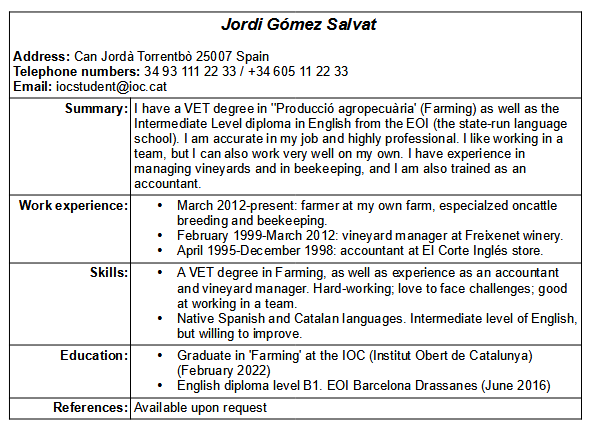
Notes:
- A VET (Vocational Education and Training) degree is the English equivalent degree to: ‘Títol de cicle formatiu de grau mitjà’.
- Like proper names, the names of studies are specific to each language. To refer to your studies, you can express them in your own language and then write an approximate translation in English: ‘Producció agroapecuària’ > Farming.
- Similarly, the names of institutions (EOI, IOC) have no equivalent forms in English. What you can do is to describe it briefly (EOI=state-run language school) or just write the full name without translating it (IOC = ‘Institut Obert de Catalunya’).
Writing a cover letter
The curriculum vitae must be accompanied by a cover letter, where you must select the aspects of the curriculum vitae that can contribute to raise the employer’s interest in your application. A cover letter is a formal written document in paper format that you attach to your curriculum vitae. You must pay attention to the layout, that is, the position of the different elements on the page.
To review the characteristics of the formal language, see “Formal and informal English” in the section “The farm”, in the unit called “A new life”.
The figure shows an example of the cover letter that corresponds to the CV above:
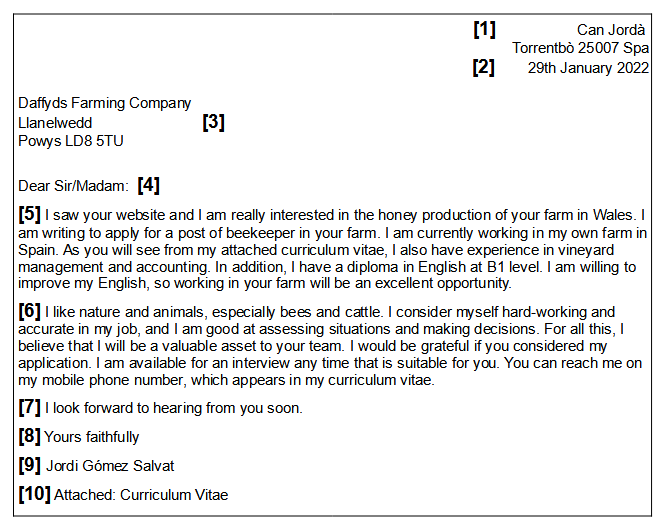
Notes:
- The sender’s address (your address), without the name.
- The date under the sender’s address.
- The receiver’s address.
- Standard heading: ‘Dear Sir/Madam’ if we don’t know the person’s name. Otherwise: ‘Dear Mr Smith’, ‘Dear Mrs Smith’ (Mr/Mrs + person’s surname).
- First paragraph: say the reason of your letter (you can say: ‘I saw your website and I am really interested in…’ or ‘I am writting to apply for the post/job of…’). Then summarize the contents of your CV.
- Second paragraph: write a summary of your character and skills for the job. Finish your letter with some standard phrases like: ‘I would be grateful if you considered my application’, ‘I am available for an interview any time that is suitable for you’, ‘You can reach me on my mobile phone number, which appears in my curriculum vitae’.
- Write this standard phrase after the last paragraph.
- Write an appropriate formal ending: ‘Yours faithfully’ if the heading is ‘Dear Sir/Madam’. If the heading is ‘Dear Mr Smith’, the ending is ‘Yours sincerely’.
- Don’t forget to sign with your name and surname(s). Don’t write ‘Jordi’. This is too informal. In handwritten letters, write your signature and then add your name and surnames clearly.
- This is a standard phrase to indicate that you attach a CV.
Here is a list of standard phrases that you can use in your cover letters, no matter what job you are applying for:
- ‘I saw your website and I am interested in…’
- ‘I saw your advertisement in The Times of 14 January and I am interested in…’
- ‘I am writing to apply for the post of…’
- ‘As you will see from my attached curriculum vitae, …’
- ‘I believe I can be a valuable asset to your team.’
- ‘I would be grateful if you considered my application.’
- ‘I look forward to hearing from you soon.’
Application emails
Nowadays, it is common to write an application email to which you attach your curriculum vitae. Although an email tends to be more informal than a business letter, you have to use the formal language in your application email and the same conventions of the cover letters, except than in an email you don’t need to write the addresses or the date.
The job interview
If you are lucky and the employer has considered your CV, you will be called for the job interview. This may take place in a face to face meeting or via Skype or some other communication device. The job interview is the time when you meet the employer so he or she can find more things about you and your skills. For this reason, it is very important to prepare the inteview carefully in order to give the interviewer a good impression.
Here is some advice to prepare a job interview:
- Prepare your answers in advance. Think about the questions that they may ask you and prepare your answers carefully. Here are some common questions in a job interview:
- What can you say about yourself?
- Why do you think you are a good candidate for this job?
- What are your weaknesses, according to you?
- Why do you want to work for us?
- What are your motivations for working for us?
- What makes a good team in your opinion?
- Have you got any questions?
- Make some research. Look at the employer’s website and check the details of the company or institution. Having the information can help you during the interview and will show that you are interested.
- Have a good appearance. First impressions are very important. Make sure that you have a nice appearance when you go to a job interview.
- Be ready. Go to the interview ahead of time. If you are late, you will get stressed and besides it will cause a bad impression. Also, make sure that you have everything that you may need, basically, a notebook, a pen and a copy of your CV, in case they ask you for one.
- Show your best character. Try to smile all the time. This will help you feel more relaxed and will contribute to establish a positive relationship. Look at the interviewer in the eyes, and concentrate on what he or she is saying.
- Ask questions. Do not tell the interviewer that you do not have any questions. Prepare some questions in advance, and be ready to ask them if they tell you to do so. Here are some questions that you may ask in a job interview:
- Why do you need to fulfill this position?
- What are the objectives of this post?
- How do you expect to meet your objectives?
- What can I expect in terms of development and support?
- What do you do to create a good atmosphere at work?
- Are there any plans for expansion?
- What do you expect from your employees?
- Take notes. This will give the impression that you are paying attention and that you are very interested in what the interviewer is saying.
An example of job interview
Jordi was lucky. After sending his CV and his cover letter to apply for a job as beekeeper in a farm in Wales, he received a call for a job interview via Skype. Jordi was very excited because he knew that the job interview was the last stage in the job search process. If the interview went well, he would probably get the job.
He was a little worried about his English, but he had practised a lot with Laura Smith and he could probably do the interview without any problems. He also checked his computer and Internet connection to prevent any technical issues during the interview.
On the day and time appointed for the interview, he was sitting in front of the screen, ready to answer the call. He was very nervous, but he knew that it was a very normal thing. He took a deep breath, and waited.
Here is part of Jordi's interview
Interviewer: Well, Mr Gómez, I see that you wish to work in our farm. Why do you think you can do that job?
Jordi: As you can see in my CV, I keep my own bees at my farm, so I’m used to looking after the bees and producing and selling honey. I’ve been a farmer for some time now, so I have some training in farm work, especially in cattle breeding and farm management. Apart from that, I’m very interested in bees. I’m aware of how important they are in the environment.
Interviewer: Yes, they are. In a post like this, team work is very important. Daffyds is a large farm and you will have to work with other beekeepers and farm workers. What makes a good team in your opinion, Mr Gómez?
Jordi: A strong leadership, of course, someone who can manage potential conflicts, and I think that all the members of the team should listen to the others and be ready to accept other points of view.
Interviewer: Do you think you could fit into a team then?
Jordi: Yes, of course! I’m not ready to lead a team yet, but I think I could easily integrate into one. Well, I’m sure of that.
Interviewer: Alright, Mr Gómez, would you like to ask any questions?
Jordi: Yes, what do you expect from the people that work in your farm?
When the interview was finished, Jordi was greatly relieved. His speech had been a little hesitant and he mispronounced a few words, but this is not important. He is not an English native speaker anyway, and he is still learning.
Grammar
In the grammar section, you will study the relative sentences. The relative sentences are mostly used to explain the characteristics of a noun, very much like adjectives do. On the other hand, you are also going to learn about the conditional sentences. The conditional sentences are composed of a conditional clause (also called ‘if-clause’) and a main clause that tells what happens if the condition becomes true. There are several types of conditional sentences.
The relative sentences
The relative sentences are composed of a main clause and a subordinate relative clause. All the relative clauses start with a relative pronoun, which refers to a noun in the main clause (called the antecedent).
See the Glossary for the definition of clause and sentence.
Here is an example of a relative sentence:
Jordi is a beekeper, who is the person that keeps bees and produces honey.
- Main clause: Jordi is a beekeeper.
- Subordinate relative clause: who is the person that keeps bees and produces honey.
- Relative pronoun: who
- Antecedent: beekeper
The relative clauses are mainly used to give information about a person or thing mentioned in the main clause. In the example, the relative clause gives some extra information about the noun beekeeper. In this case, we use the relative clause to explain what a beekeeper is.
There are two types of relative clauses:
- Defining relative clauses
- Non-defining relative clauses
We use defining relative clauses to give essential information about the noun. The relative clause is necessary to understand the message. Without the relative clause, the sentence would be incomplete. For example:
- He is shouting at us in a language that we can’t understand
- A farmer is a person who works and manages a farm
- The migrants are usually people whose countries are at war
On the other hand, we use non-defining relative clauses to add some extra information to the sentences. We can take out the relative clause without changing the meaning of the sentence. We must write the non-defining relative clauses after a comma. For example:
- James has taken an old lady to her house, which is in another city.
- Laura, who has a lot of experience, will give you some advice.
- Núria, whose family is quite rich, can lend you some money.
In speech, we can omit the relative pronouns that, whom and which, but only in defining relative clauses and when the relative pronoun is the object. We cannot omit it in non-defining relative clauses or when the pronoun is the subject. Here are some examples of sentences without the relative pronoun:
- He is shouting at us in a language we can’t understand.
- The people we met las night were all from different countries.
- The story you told me was very interesting.
The relative pronouns
All the relative clauses must start with a relative pronoun. The use of the relative pronoun depends on two things:
- The antecedent
- Their function in the relative clause.
The table shows the list of the most important relative pronouns:
| Relative pronoun | It is used when… |
|---|---|
| that | the antecedent is a person or a thing and the pronoun is the subject or an object of the relative clause |
| who | the antecedent is a person and the pronoun is the subject of the relative clause |
| whom | the antecedent is a person and the pronoun is the object of the relative clause |
| which | the antecedent is a thing or an animal |
| whose | the antecedent is a person, a thing or an animal and the pronoun has the function of a possessive adjective |
| where | the antecedent is a place and the pronoun is an adverb of place |
| when | the antecedent is a time word or expression and the pronoun is an adverb of time |
| why | the antecedent is the noun ‘reason’ |
Examples:
All the relative pronouns, except that, are the same as the interrogative pronouns.
- You need to find an activity that you like (Cat. ‘Necessites trobar una activitat que t’agradi’).
- I want a job that allows me to help people (Cat. ‘Vull una feina que em permeti ajudar la gent’).
- A farmer is a person who works and manages a farm (Cat. ‘Un granjer és una persona que treballa i gestiona una granja’).
- The people whom we met las night were all from different countries (Cat. ‘La gent amb les que ens vam trobar ahir al vespre eren totes de països diferents’).
- James is a person with whom I very often agree (Cat. ‘El James és una persona amb la qual estic d’acord molt sovint’).
- The story which you told me was very interesting (Cat. ‘La història que em vas explicar era molt interessant’).
- The migrants are usually people whose countries are at war(Cat. ‘Els migrants són sovint persones els països de les quals estan en guerra’).
- That’s the park where we met, do you remember? (Cat. ‘Aquest és el parc on ens vam conèixer, te’n recordes?’).
- There was a time when people used typewriters (Cat. ‘Hi va haver un temps en els quals la gent feia servir màquines d’escriure’).
- I can’t understand the reason why she left. (Cat. ‘No entenc el motiu pel qual va marxar’)
The relative pronoun that is mostly used in speech instead of who, whom and which.
The conditional sentences
The conditional sentences are composed of two clauses: the main clause and the subordinate conditional clause. Here is an example of a conditional sentence:
If the interview goes well, he will certainly get the job.
- Subordinate conditional clause: If the interview goes well… (the conditional clause is frequently introduced by if)
- Main clause: …he will certainly get the job.
The two clauses are separated with a comma. It is possible to change the order of the clauses and say:
He will certainly get the job if the interview goes well.
When the main clause comes first, there is no comma between the clauses. The order depends on the clause that we wish to emphasize: the clause that comes first is emphasized.
We can distinguish four types of conditional sentences:
- Zero conditional: If water reaches 100°C, it boils.
- First conditional: If the interview goes well, he will get the job.
- Second conditional: If it rained too much, the harvest would be spoilt.
- Third conditional: If I had applied for the job, I would have got it.
The structure of the conditional sentences is the same in all the types. The difference is in the verb tenses that we use in each clause. Their meanings are also different.
In this section we are going to study the first and the second conditionals in detail, with only a brief reference to the other two types.
The first conditional
The first conditional sentences are normally formed like this:
- IF…(PRESENT SIMPLE)…, …(WILL)…
But you can also use the imperative form and other modal verbs:
- IF…(PRESENT SIMPLE)…, …(IMPERATIVE)…
- IF…(PRESENT SIMPLE)…, …(CAN/MAY/MUST/SHOULD)…
For example:
- If you work hard, you will be promoted very soon (Cat. ‘Si treballes dur, et promocionaran molt aviat’).
- If you volunteer, you can get a lot of experience (Cat. ‘Si fas de voluntari, pots guanyar molta experiència’).
- If you speak English well, things may be easier for you (Cat. ‘Si parles bé l’anglès, les coses et poden resultar més fàcils’).
- If they call you, you must answer immediately (Cat. ‘Si et truquen, has de contestar de seguida’).
- If we do extra work, we should get a higher salary, shouldn’t we? (Cat. ‘Si fem hores extres, hauríem de cobrar més, no?’).
- If you have time, go out and enjoy yourself (Cat. ‘Si tens temps, surt i passa-ho bé’)
We use the first conditional sentences to express real conditions. From the speaker’s point of view, the result will probably happen if the condition is true.
The second conditional
The second conditional sentences are formed like this:
- IF…(PAST SIMPLE)…, …(WOULD)…
But we can also use other modal verbs:
- IF…(PAST SIMPLE)…, …(COULD/SHOULD)…
Examples:
In the second conditional sentences, the past tense of the verb ‘to be’ is were in all persons.
- If I were you, I would take a training course (Cat. ‘Si jo estigués en el teu lloc, faria un curs de formació’).
- What would you do if you had a lot of time? (Cat. ‘Què faries si tinguessis molt de temps?’)
- I would also join an NGO if I had the opportunity (Cat. ‘Jo també m’apuntaria a una ONG si tingués l’oportunitat’).
- Laira would be very happy if she could go Greece (Cat. ‘La Laura estaria molt contenta si pogués anar a Grècia’).
- If we didn’t meet, we should call each other (Cat. ‘Si no ens trobéssim, ens hauríem de trucar’).
We use the second conditional sentences to express unreal conditions, that is to say, when the speaker thinks that it is not very probable that the condition comes true. It is also used to describe hypothetical situations, as for example, when we say: if I were you…, if I were younger…, if I were rich…, if I were a king…, etc.
Comparison of the uses of the first and the second conditional sentences
Very often the use of the first and second conditional sentences depends on the situation or on the speaker’s point of view. Let’s see an example to illustrate the difference between both types of conditional sentences:
- First conditional: If it rains tonight, I will stay at home (Cat. ‘Si plou aquesta nit, em quedaré a casa’).
- Second conditional: If it rained tonight, I would stay at home (Cat. ‘Si plogués aquesta nit, em quedaria a casa’).
We see that the it is very cloudy and the weather forecast says that there will be rain tonight, so we think that it is very probable that it rains tonight. In this case, we would use the first conditional.
On the other hand, we see that it is sunny and the sky is blue. For these reasons, we think that it is not probable that it rains tonight. In this case, we must use the second conditional.
The other types of conditional sentences
1) The zero conditional: IF…(PRESENT SIMPLE)…, …(PRESENT SIMPLE)…
It is used basically to express scientific facts, or things that always happen in the same way if the condition is true. Examples:
- If you throw a stone into the water, it sinks (Cat. ‘Si tires una pedra a l’aigua, s’enfonsa’)
- If you all speak at the same time, I don’t understand anything (Cat. ‘Si parleu tots a l’hora, no entenc res’).
2) The third conditional: IF…(PAST PERFECT)…, …(WOULD HAVE + past participle)…
It is used to refer to the past (unlike the first and second conditional sentences, which refer to the future). It expresses the idea that an action never happened because the condition did not come true. Examples:
- If we had listened to Núria, things would have gone better (Cat. ‘Si haguéssim escoltat la Núria, les coses haurien anat millor’).
- If I had come later, I would have missed the show (Cat. ‘Si hagués vingut més tard, m’hauria perdut l’espectacle’)