



Poultry breeding
In this section we are going to speak about poultry breeding. The word poultry refers to farm birds like hens, chickens or ducks, which are usually bred for their meat and eggs. As usual, you will find a reading text to introduce specific words related to the topic. These words are all collected in the corresponding vocabulary list.
In the communication section, you will learn how to express opinions and use questions tags, which are small questions that we add to a statement when we speak to confirm that the other person has understood what we said. In this section, you are also going to learn some ‘false friends’. These are words that look like words in your mother tongue, but have different meanings.
In the grammar section, you are going to learn and practise the comparative and superlative sentences, which are used to compare two or more things. In the comparative and superlative sentences, the adjectives and adverbs have a special form.
Meat and egg production
Jordi and Núria have decided to breed poultry in their farm, primarily for producing eggs and meat. To know more about poultry farming, Núria reads an article that she found in an English specialized magazine. Here is part of the article:
“A carefully controlled environment that avoids crowding, chilling, overheating, or frightening is almost universal in poultry farming. Cannibalism, which expresses itself as toe picking, feather picking, and tail picking, is controlled by debeaking at one day of age and by other management practices. The feeding, watering, egg gathering, and cleaning operations are highly mechanized. Birds are usually housed in wire cages with two or three animals per cage, depending on the species and breed, and three or four tiers of cages superposed to save space. Cages for egg-laying birds have been found to increase production, lower mortality, reduce cannibalism, lower feeding requirements, reduce diseases and parasites, improve culling, and reduce both space and labour requirements.”
From: Encyclopaedia Britannica
Please note that the language of the article has not been adapted for students of English. Check if you can understand the main ideas without looking up the words.
However, if you need to undestand the meaning of new words, you will find them in the general vocabulary list.
Later in the day, Laura Smith talks to Núria:
Laura: Hi, Núria. Have you learned many things about poultry farming?
Núria: I don’t know. I’ve read this article, but it’s more difficult than I thought.
Laura: I’ll explain it for you, if you want. Can’t you find articles in your own language? They are much easier, aren’t they?
Núria: Yes, they are. But I’d like to practise my reading skills, and I think reading articles is a good way of learning new words.
Laura: You’re right! Which birds are you going to buy?
Núria: Chickens, of course! They are the most popular birds for eggs and meat in this country, but we may buy some ducks, too. Their meat is more expensive than chicken and I believe we could make some good money, couldn’t we?
Laura: Yes, you’re probably right.
Technical vocabulary:
| English | Catalan | English | Catalan |
|---|---|---|---|
| breed | raça | frightening | por, espant |
| cage | gàbia | labour | treball, feina |
| chilling | baixes temperatures | management | gestió |
| cleaning | neteja | overheating | altes temperatures |
| crowding | amuntegament | poultry farming | cria d’aus de corral |
| culling | sacrifici, matança | tail picking | (acte de) picar la cua |
| disease | malaltia | tier | grades, prestatgeria |
| egg | ou | to debeak | tallar el bec |
| egg gathering | recollida dels ous | to house | guardar, allotjar |
| egg-laying bird | au ponedora | to increase | augmentar |
| environment | entorn | to lower | reduir |
| feather picking | (acte de) picar les plomes | toe picking | (acte de) picar les potes |
| feeding | alimentació | watering | (acte de) donar aigua |
| feeding requirements | necessitats d’alimentació | wire | filferro |
| English | Catalan | English | Catalan |
|---|---|---|---|
| broody hen | lloca, cloca | hen house | galliner |
| chicken | pollet, pollastre (carn) | partridge | perdiu |
| crest | cresta | phaesant | faisà |
| down | plomissó, borrissol | poultry | aus de corral |
| duck | ànec | quail | guatlla |
| duck pond | estany pels ànecs | rooster | gall |
| duckling | aneguet, cria d’ànec | to brood | covar els ous |
| feather | ploma | to crow | cantar (el gall) |
| goose | oca | to hatch | sortir de l’ou |
| guinea fowl | pintada | to lay eggs | pondre ous |
| hen | gallina | turkey | gall dindi, indiot |
Language note:
- The noun goose has an irregular plural form: geese. We must say: one goose, two geese.
Communication
In this section, you will learn how to ask for people’s opinions, how to give your opinion about a particular topic and how to respond to other people’s opinions. As part of this topic, you will also learn to use question tags when speaking. Finally, you will learn how to use ‘false friends’ correctly. In this way, you can avoid making errors when speaking or writing in English.
Expressing opinions
In our daily lives, we often ask for people’s opinions and, of course, we also give our opinions. In the text ‘Meat and egg production’ above, Núria expresses her opinion when she says: I think reading articles is a good way of learning new words and I believe we could make some good money.
Asking for opinions:
These are the commonest ways of asking for people’s opinion:
- What do you think of…?
- Do you think (that)…?
- What’s your opinion about…?
In speech, the conjunction that is generally omitted. We say I think it’s good rather than I think that it’s good. In Spanish and Catalan, however, the equivalent word que is never omitted.
Here are some examples of questions to ask for opinions:
- What do you think of the new iPhone? (Cat. ‘Què opines del nou iPhone?’).
- Do you think that the electrical vehicles are useful? (Cat. ‘Creus que els vehicles elèctrics són útils?’).
- What’s your opinion about the job of the police? (Cat. ‘Quina és la teva opinion sobre la feina de la policia?’).
Expressing opinions:
Opinions are statements that explain our point of view. To indicate that we are expressing an opinion, and not a fact, we must use some specific words and expressions. For example:
- I think (that)…
- I believe (that)…
- I’m sure (that)…
- In my opinion,…
- From my point of view,…
- As I see it, …
Here are some examples of opinions:
- I think working in a farm is very rewarding (Cat. 'Crec/Opino que treballar en una granja és molt gratificant’).
- I believe we should think about people first (Cat. 'Crec que primer hauríem de pensar en les persones’).
- I’m sure they won’t listen to us (Cat. 'Estic segur que no ens escoltaran’).
- In my opinion, the climate change is a fact (Cat. 'Segons la meva opinió, el canvi climàtic és un fet’).
- From my point of view, people should decide what to do (Cat. 'Des del meu punt de vista, la gent hauria de decidir què fer’).
- As I see it, there are few young people interested in farming. (Cat. Tal com ho veig, hi ha pocs joves interessats en l’agricultura).
The verb think
The English verb think has two meanings:
- It describes a mental process (Cat. ‘Pensar’). We use it with the preposition about. In this sense, the verb can take the continuous tenses. For example: What are you thinking about? - I’m thinking about the holidays (Cat. ‘En què estàs pensant?’ - ‘Estic pensant en les vacances)'.
- It is used to express opinions (Cat. ‘Opinar’). We use it with the preposition of. In this sense, it cannot take the continuous tenses. For example: What do you think of your job? - I think it’s very rewarding (Cat. ‘Què opines de la teva feina?’ - ‘Crec/Opino que és molt gratificant’).
Responding to an opinion:
When we respond to an opinion, we can agree (Cat. estar d’acord) with the other person’s opinion or we can disagree (Cat. ‘Estar en desacord’) with the other person’s opinion.
If you agree with the other person, you can say:
- Yes, I agree (with you).
- Yes, you’re right.
- Yes, I think so.
On the other hand, if you disagree, you can say:
- No, I disagree (with you)
- No, (I’m afraid) I don’t agree.
- No, (I think) you’re wrong.
- No, I don’t think so.
Pay attention to the expression of the verbs agree and disagree. You must say: I agree (it is wrong to say: I am agree), I don’t agree (it is wrong to say: I’m not agree) and I disagree (it is wrong to say: I am disagree).
When we disagree with a person, we should give a reason for the disagreement. For example:
- The job is well paid - I don’t agree. I think it’s very badly paid (Cat. ‘La feina està ben pagada - No hi estic d’acord. Crec que està molt mal pagada’).
Another way of responding to an opinion is by saying yes or no and then adding a short answer. For example:
- It’s very cold - Yes, it is (Cat. ‘Fa molt fred’ - 'Sí, que en fa’).
- He speaks too low - Yes, he does (Cat. ‘Parla molt baixet’ - 'Doncs sí’).
- We can do it - No, we can’t. It’s too difficult (Cat. ‘Ho podem fer’ - 'No, no podem’. ‘És massa difícil’).
- We made a good job - No, we didn’t. We could have done much better (Cat. ‘Vam fer una bona feina’ - 'No, ho podíem haver fet molt millor)'.
Question tags
In English it is very common to use question tags when speaking. A question tag is a short question that we add at the end of a statement. We have seen some examples in the text above:
- They are much easier, aren’t they?
- We could make some good money, couldn’t we?
We use question tags:
- To ask a question (with a raising intonation, that is, our tone of voice raises).
- To check if the other person has heard or undestood our statement (with a falling intonation, that is, our tone of voice falls).
The question tag depends on the statement to which it is attached. The rules are these:
1. If the statement is positive, the question tag is negative:
- You’re English, aren’t you? (Cat. ‘Ets anglès, no?’).
- Mark is training to become an emergency medical technician, isn’t he? (Cat. ‘Mark està fent pràctiques tècnic d’emergències, oi que sí?’).
2. If the statement is negative, the question tag is positive:
- They aren’t in their office, are they? (Cat. 'Oi que no són al seu despatx?’).
- You didn’t come yesterday, did you? (Cat. ‘Ahir no vas venir, oi que no?’).
3. In the question tag, we always use an auxiliary or modal verb verb:
- Laura is from Wales, isn’t she? (Cat. ' La Laura és de Gal·les, no?’).
- I should stay at home, shouldn’t I? (Cat. ‘M’hauria de quedar a casa, no creus?’).
- David speaks English, doesn’t he? (Cat. ‘El David parla anglès, oi que sí?’).
- You arrived yesterday, didn’t you? (Cat. ‘Vas arribar ahir oi?’).
4. In a question tag, the subject is always the personal pronoun:
- Mark can swim very well, can’t he? (Cat. ‘El Mark neda molt bé, no?’).
- The people are waiting, arent they? (Cat. ‘La gent està esperant, oi?’).
5. Statements with negative words like never, nobody or nothing, for example, are treated as negative statements:
- Laura never speaks about her family, does she? (Cat. ‘La Laura no parla mai de la seva familia, oi que no?’).
- Nothing happened last night, did it? (Cat. ‘Ahir a la nit no va passar res, a que no?’).
6. If the statement is with the verb have, there are two possible questions tags:
- Mark has little experience, hasn’t he? (Cat. ‘El Mark té poca experiencia, oi que sí?’) (mostly in British English).
- Mark has little experience, doesn’t he? (Cat. ‘El Mark té poca experiencia, oi que sí?’) (mostly in American English).
There are some exceptions to these rules:
- The question tag that corresponds to I am is aren’t I?:
- I’m in your team, aren’t I? (Cat. ‘Estic al teu equip, oi que sí?’).
- I’m doing my job, aren’t I? (Cat. ‘Faig la meva feina, no?’).
- The question tag of a statement with Let’s is shall we?:
- Let’s go, shall we? (Cat. ‘Anem, no?’).
- Let’s be very careful, shall we? (Cat. ‘Anem molt en compte, d’acord?’).
- With there is (and all forms with there), the question tag is isn’t there?:
- There are many problems, aren’t there? (Cat. ‘Hi ha molts problemes, no?’).
- There wasn’t anything to see, was there? (Cat. ‘No hi havia res a veure, a que no?’).
Question tags in Catalan and Spanish
Question tags also exist in Catalan and Spanish. In these two languages, there are several ways of expressing a question tag, but, unlike English, a question tag does not depend on the statement. Here are some ways of expressing question tags in Catalan and Spanish:
- Catalan: oi?, oi que sí?, oi que no?, no?, no creus?, no és veritat?, a que sí?, a que no?, etc.
- Spanish: ¿verdad?, ¿no es cierto?, ¿no crees?, ¿a que sí?, ¿a que no?, ¿no?, etc.
False friends
Many English words, especially in the fields of business, commerce, science and technology, have a Greek or Latin origin, so we can easily understand them. For example, you do not need a dictionary to understand the meaning of words like information, university, computer, reality, family, television, history, hospital, ambulance, and many others.
However, there are some words that have a similar form in the two languages, but their meaning is different. These words are called ‘false friends’.
For further information about the false friends, see “False friends”, in the “Annexes” section of this unit.
There are not many English false friends, but they are very frequently used. You should know their meanings and use the correct word to avoid errors and misunderstandings.
The table below shows a list of some common false friends.
| English word | Meaning in Catalan | Similar Catalan word | Meaning in English |
|---|---|---|---|
| actually | de fet | actualment | currently, now |
| embarrased | avergonyit | embarassada | pregnant |
| embarrasement | ridícul,vergonya | embaràs | pregnancy |
| exit | sortida | èxit | success |
| lecture | xerrada, conferència | lectura | reading |
| library | biblioteca | llibreria | bookshop (BrE), bookstore (AmE) |
| sympathetic | solidari, compasiu, empàtic | simpàtic | nice, kind, agreeable |
| sensible | sensat, amb seny | sensible | sensitive |
Some words are only partial false friends. This means that the English and Catalan/Spanish words share some meanings, but they are different in other senses. Here are a few examples of words that are easily confused:
- Direction/address:
- Meaning 1: direction > Cat. ‘direcció, sentit/'
- Meaning 2: address > Cat. ‘adreça’, Sp. ‘dirección’
- Manifestation/demonstration:
- Meaning 1: manifestation > Cat. ‘manifestació, expressió’
- Meaning 2: demonstration > Cat. ‘manifestació, protesta’
- Note/mark:
- Meaning 1: note > Cat. ‘nota, anotació’
- Meaning 2: mark > Cat. ‘nota, qualificació’
- To approve/to pass:
- Meaning 1: approve > Cat. ‘aprovar, donar el vistiplau’
- Meaning 2: pass > Cat. ‘aprovar (un examen)'
- To assist/to attend (similarly: assistance/attendance):
- Meaning 1: to assist > Cat. ‘assistir, ajudar’
- Meaning 2: to attend > Cat. ‘assistir a, anar a’
- To present/to introduce (similarly: presentation/introduction):
- Meaning 1: to present > Cat. ‘presentar, ensenyar, mostrar’
- Meaning 2: to introduce > Cat. ‘presentar (una persona a una altra)'
- To pretend/to intend:
- Meaning 1: to pretend > Cat. ‘fer veure, aparentar’
- Meaning 2: to intend > Cat. ‘pretendre, voler, intentar fer’
Spanglish
There are a few English words that we frequently use in Catalan or Spanish, but they are not used in the same sense in English. For example:
- Cat. ‘Anar a fer footing’ > Eng. To go jogging, to go running.
- Cat. ‘Jugar al basket’ > Eng. To play basketball.
- Cat. ‘Hi ha un parking’ > Eng. There’s a car park.. We’ll
- Cat. ‘Dormir a un camping’ > Eng. To sleep at a camping site.
Grammar
Sometimes we need to take a decision, as for example, to buy a chickens or ducks, or to go on holiday to another country or stay at home. What we usually do in these cases is to compare the advantages and disadvantages of both options. To talk about this, we have the comparative and superlative sentences, which is the topic of this grammar section. We can compare two things, and then we use a comparative sentences. Sometimes, we may want to compare one thing with all the others. In this case, we use a superlative sentence.
The comparative and the superlative sentences
We are going to see how to make comparative and the superlative sentences.
The comparative sentences:
We use a comparative sentence when we want to compare two things, as in the following examples from the text above:
- Articles in Spanish are easier than articles in English (Cat. ‘Els articles en castellà són més fàcils que els articles en anglès’).
- Duck is more expensive than chicken (Cat. ‘L’ànec és més car que el pollastre’).
Let’s analyse sentence number 1:
- The two things that we are comparing are: articles in Spanish and articles in English.
- We use the adjective easy (Cat. ‘fàcil’) for the comparison. In this sentence, the adjective takes a special form called the comparative form: easier (Cat. ‘més fàcil’).
- We separate the two items of the comparison with the word than (Cat. ‘que’), which we place immediately after the adjective.
Sometimes, it is not necessary to say the two things that we are comparing because one is implied in the context, as for example:
- Why are you reading the article in Spanish? - Because it’s easier.
Notes:
- Sentence number 2 has the same structure as number 1, but the adjective has a different form (more expensive). We will see the reason of this difference when we study the comparative and superlative forms.
- The two examples above are comparative sentences of superiority because we say that one thing is superior to another. There are also comparative sentences of equality and comparative sentences of inferiority.
The superlative sentences:
We use a superlative sentence when we want to compare one thing with all the rest. In the text ‘Meat and egg production’, we can find an example of a superlative sentence:
- Chickens are the most popular birds for eggs and meat (Cat. ‘Els pollets són les aus més apreciades pels ous i la carn’).
Let’s look at the superlative sentence in detail:
- We are comparing chickens with all the other birds.
- In the comparison, we use the adjective popular (Cat. ‘apreciat/da, popular’)
- We say the most before the adjective: the most popular (Cat. ‘les més apreciades’). Sometimes, the adjective takes a special form, as we will see when we study the superlative forms.
Sometimes we may want to add some extra information to the superlative sentence. Here is a list of common expressions used in superlative sentences (with examples):
- …in the world: it’s the most expensive in the world (Cat. ‘És el més car del món’).
- …in the village: he’s the richest in the village (Cat. ‘És el més ric del poble’).
- …in my life: it’s the best experience in my life (Cat. ‘És la millor experiència de la meva vida’).
- …I’ve ever seen: it’s the biggest tomato I’ve ever seen (Cat. ‘És el tomàquet més gros que he vist mai’).
- …of all: she’s the nicest of all (Cat. ‘És la més simpàtica de tots’).
Note:we can distinguish between superlative sentences of superiority and superlative sentences of inferiority.
The comparative forms
As we mentioned above, there are comparative sentences of superiority, equality and inferiority. In each one, the adjective takes a special form or is accompanied by some specific words.
Comparative forms of superiority:
In the comparative sentences of superiority, the comparative adjectives are formed like this:
1) One-syllable adjectives: add -er to the adjective:
- small > smaller (Cat. ‘petit > més petit’)
- big > bigger (Cat. ‘gros > més gros’)
- warm > warmer (Cat. ‘calent > més calent’)
- cold > colder (Cat. ‘fred > més fred’)
2) Two-syllable adjectives ending in -y: add -ier to the adjective:
- happy > happier (Cat. ‘content > més content’)
- busy > busier (Cat. ‘enfeinat > més enfeinat’)
- easy > easier (Cat. ‘fàcil > més fàcil’)
- ready > readier (Cat. ‘preparat > més preparat’)
3) Two or more-syllable adjectives: add more before the adjective:
- boring > more boring (Cat. ‘avorrit > més avorrit’)
- competent > more competent (Cat. ‘competent > més competent’)
- expensive > more expensive (Cat. ‘car > més car’)
- real > more real (Cat. ‘real > més real’)
4) Irregular comparative adjectives:
- good > better (Cat. ‘bo > millor’)
- bad > worse (Cat. ‘dolent > pitjor’)
- far > farther (Cat. ‘llunyà > més llunyà’)
Here are some examples:
- Talking is easier than doing (Cat. ‘Parlar és més fàcil que actuar’).
- It’s warmer in spring than in autumm (Cat. ‘Fa més calor a la primavera que a la tardor’).
- A veterinarian is more competent than a doctor in giving assistance to a cow (Cat. ‘Un veterinari és més competent que un metge curant una vaca’).
- The weather is better than I thought (Cat. ‘El temps és millor del que em pensava’).
Comparative forms of equality:
We use the comparative sentences of equality to say that two things have the same qualities.
We express equality like this:
1) As + adjective + as (affirmative):
- as small as (Cat. ‘tan petit com’)
- as happy as (Cat. ‘tan content com’)
- as boring as (Cat. ‘tan avorrit com’)
- as good as (Cat. ‘tan bo com’)
2) Not so + adjective + as (negative):
We can also express the negative form with: NOT AS…AS
- not so small as (Cat. ‘no tan petit com’)
- not so happy as (Cat. ‘no tan content com’)
- not so boring as (Cat. ‘no tan avorrit com’)
- not so good ads (Cat. ‘no tan bo com’)
Here are some examples of comparative sentences of equality:
- Belgium is as small as Holland (Cat. ‘Bèlgica és tan petita com Holanda’).
- Laura is as happy as Jordi (Cat. ‘La Laura està tan contenta com el Jordi’).
- English is not so difficult as it seems (Cat. ‘L’anglès no és tan difícil com sembla’).
- In my opinion, running is not so good as walking (Cat. ‘En la meva opinió, córrer no és tan bo com caminar’).
Comparative forms of inferiority:
The comparative sentences of inferiority say that the qualities of one thing are inferior to the qualities of another thing. These sentences are little used. When we need to compare two things, we use the comparative of superiority.
We express the comparative adjectives of inferiority like this:
1) Less + adjective:
- less big (Cat. ‘menys gran’)
- less dangerous (Cat. ‘menys perillós’)
- less bad (Cat. ‘menys dolent’)
- less happy (Cat. ‘menys content’)
Examples:
- A bike is less expensive than a motorbike (Cat. ‘Una bici és menys cara que una moto’).
- The test was less difficult than I expected (Cat. ‘La prova vas ser menys difícil del que em pensava’).
- The experience was less bad than you said (Cat. ‘L’experiència va ser menys dolenta del que vas dir’).
- You are less busy than I am (Cat. ‘Tu estàs menys ocupat que jo’).
The superlative forms
As in the comparative adjectives of superiority, the superlative adjectives have a specific form. We can also distinguish between superlative sentences of superiority and superlative sentences of inferiority.
Superlative forms of superiority:
We form the superlative adjectives of superiority like this:
1) One-syllable adjectives: add the… -(e)st to the adjective:
- small > the smallest (Cat. ‘petit > el més petit’)
- big > the biggest (Cat. ‘gros > el més gros’)
- warm > the warmest (Cat. ‘calent > el més calent’)
- cold > the coldest (Cat. ‘fred > el més fred’)
2) Two-syllable adjectives ending in -y: add the… -iest to the adjective:
- happy > the happiest (Cat. ‘content > el més content’)
- busy > the busiest (Cat. ‘enfeinat > el més enfeinat’)
- easy > the easiest (Cat. ‘fàcil > el més fàcil’)
- ready > the readiest (Cat. ‘preparat > el més preparat’)
3) Two or more-syllable adjectives: add the most before the adjective:
- boring > the most boring (Cat. ‘avorrit > el més avorrit’)
- competent > the most competent (Cat. ‘competent > el més competent’)
- expensive > the most expensive (Cat. ‘car > el més car’)
- real > the most real (Cat. ‘real > el més real’)
4) Irregular superlative adjectives:
- good > the best (Cat. ‘bo > el millor’)
- bad > the worst (Cat. ‘dolent > el pitjor’)
- far > the farthest (Cat. ‘llunyà > el més llunyà’)
Here are a few examples of superlative sentences:
- For me, growing fruit is the most rewarding activity in the world (Cat. ‘Per a mi, cultivar fruita és l’activitat més gratificant del món’).
- This is the best meal I’ve ever eaten (Cat. ‘Aquest és el millor dinar que he menjat mai’).
- It’s the most interesting place I’ve ever been to (Cat. ‘És el lloc més interessant en el que he estat mai’).
- It’s the most expensive item he could find, isn’t it? (Cat. ‘És l’article més car que podia trobar, no?’).
- Here’s is the most important person in my life (Cat. ‘Aquí està la persona més important de la meva vida’).
Superlative forms of inferiority:
These forms are little used because we generally use the superlative forms of superiority.
We form the superlative adjectives of inferiority like this:
1) The least + adjective:
- the least big (Cat. ‘el menys gran’)
- the least dangerous (Cat. ‘el menys perillós’)
- the least bad (Cat. ‘el menys dolent’)
- the least happy (Cat. ‘el menys content’)
Here are some examples of superlative sentences of inferiority:
- I chose the least expensive of the two items (Cat. ‘Vaig triar el menys car dels dos productes’).
- I think it’s the least interesting film I’ve ever seen (Cat. ‘Crec que és la pel·lícula menys interessant que he vist mai’).
- Why do you always pick up the least good of all? (Cat. ‘Per què sempre esculls el menys bo de tots?’).
Use of the comparative and the superlative sentences
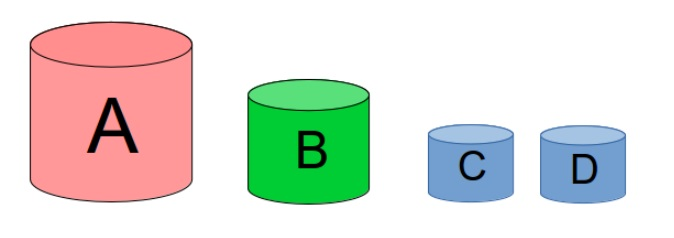
- Box A is bigger than boxes B, C and D.
- Box B is smaller than box A.
- Box B is less big than box A.
- Box C is as big as box D.
- Box A is the biggest of the four boxes.
- Boxes C and D are the smallest of the four boxes.
- Box A is the least small of the four boxes.
- Boxes C and D are the least big of the four boxes.
The comparison of adverbs
Apart from the adjectives, the adverbs can also take comparative and superlative forms. With the adjectives we compare the characteristics of two nouns. With the adverbs, we compare how or when the actions of the verb are performed. The rules for forming the comparative and superlative forms are the same as those for the adjectives.
Three adverbs have irregular comparative and superlative forms:
- well > better / the best
- badly > worse / the worst
- far > farther / the farthest
Here are some examples of comparative and superlative adverbs:
- Drive faster! (Cat. ‘Ves més de pressa’)
- You should come earlier (Cat. ‘Hauries de venir més d’hora’)
- You did well, but I did still better (Cat. ‘Ho vas fer bé, però jo encara ho vaig fer millor’)
- Don’t tell him, but I think Jordi did the worst (Cat. ‘No li ho diguis, però crec que el Jordi és el que ho va fer pitjor’)
- Can you speak more slowly, Laura? I can’t understand! (Cat. ‘Pots parlar més a poc a poc, Laura? No t’entenc!’)
- You should treat him more carefully tha before (Cat. ‘L’hauries de tractar amb més de compte que abans’)