



Activities
The English vowel sounds and diphthongs
The goal of this activity is to listen to and practise the pronunciation of the vowel sounds and the diphthongs in English.
Look at the chart and listen to the vowel sounds in English:

Note: image and audio file from the website Pronunciation Studio at Home
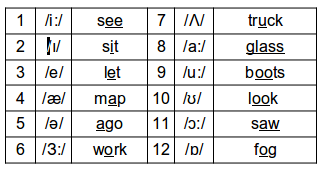
1. Now look at the IPA symbols of the following vowel sounds and pronounce the words in the chart:
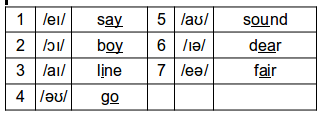
2. Look at the IPA symbols of the English diphthongs and pronounce the words in the chart:
The English consonant sounds
The aim of this activity is to learn and practise the English consonant sounds.
Look at the IPA symbols in the chart and listen how the English consonants are pronounced:
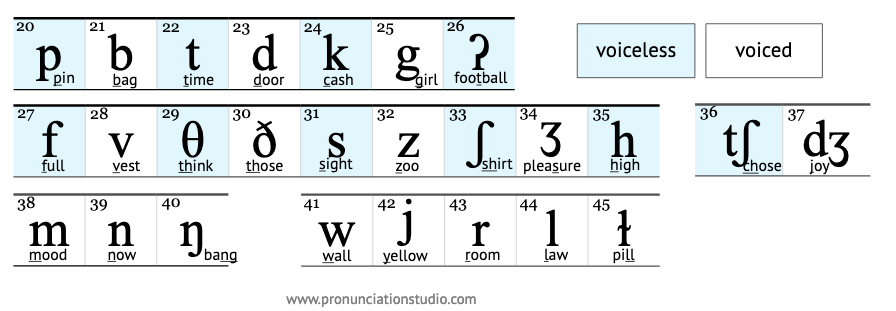
Note: image and audio file from the website Pronunciation Studio at Home
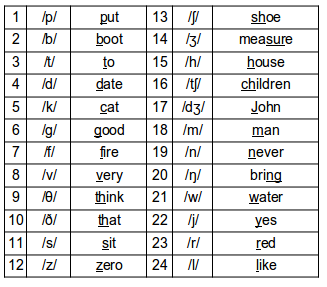
Now read the words in the following chart:
Word stress
The objective of this activity is to become aware of the rules of word stress and practise the pronunciation of the words.
Watch the following video explaining the rules of word stress in English:
On a separate document or piece of paper, mark the stressed syllable in these words. Say which rule applies in each case:
- Tuition
- Herself
- Heavy
- Window
- Reality
- Impress
- Employee
- Streetlamp
- Grass
- Legally
Sentence stress
The objective of this activity is to watch a video to practise the listening skills and learn more about sentence stress.
Watch the video and then answer the questions:
- Which words are usually stressed in a sentence?
- Which words would you stress in this sentence: ‘I usually drive to my hometown at the weekends’?
- Which words are not usually stressed in a sentence?
- What example of weak word does Tom give in the video?
- Why is stress important, according to the video?
Reading comprehension
The objective of this activity is to practise the reading comprehension skill and write the correct answers to the questions.
Read the following text and then answer the comprehension questions below with complete answers.
Cultural differences
Success in today’s global economy very often depends on the ability to establish international relationships. The great technological advances in the communications make the contact with other countries very easy, but we often find a great diversity of customs and points of view. For this reason, we must be flexible and well aware of our similarities and differences with other cultures. Different cultural backgrounds bring obstacles, challenges and difficulties that are evident in general areas such as language, values, etiquette, behaviour and non-verbal communication in general.
These cultural differences may create a lot of misunderstandings. The consequences of this lack of cultural knowledge may affect your performance at work if you ever have to deal with foreigners. Therefore, a certain knowledge of religion, politics, history, gender roles, business ethics, social institutions, humour, values and non-verbal communication will help you to understand people from other countries.
Of course, the most basic thing to be successful in international relationships is the knowledge of a foreign language, especially English. Learning foreign languages is important for two reasons. On the one hand, we need to use language to communicate with people from other countries. On the other hand, there are certain items, such as letters, brochures or leafleats, that must be translated for the benefit of others.
Apart from speaking a foreign language, it is also necessary to be aware of the differences in behaviour and values of the people. What is generally accepted in our country may not be acceptable in another. For example, if we are introduced to an English woman for the first time, we should not kiss her on the cheeks, as it is common in Spain and other countries. In Anglo-Saxon cultures, kissing a woman in a first meeting is not considered proper, so we must shake hands instead. Touching someone while speaking is also considered very rude in the Anglo-Saxon cultures, so we must keep a certain distance with the other person and avoid physical contact. Apart from physical contact, we should not ask personal questions to someone that we have just met. We might do that later on for the sake of conversation, but asking a person where he was born, where he lives, what he likes, etc. on the first meeting is seen as an intolerable interference into one’s personal life. However, we can safely talk about the weather, which is a favourite topic in England.
These examples can be applied to the Anglo-Saxon culture, which is the dominant culture in the mass media today. You are probably well acquainted with the English and American customs because we can often see them reflected in films and series. However, things are very different when we must deal with Japanese, Chinese or Arab people because their cultures are much more different from our own culture. When we need to establish contacts with people from those cultures, it is very important to be conscious of the cultural differences.
In conclusion, becoming aware of the differences between cultures and exploring cultural similarities are important skills when we learn a language because cultural knowledge will help us to communicate with others more harmoniously and establish a positive environment.
Comprehension questions:
- Why are international relationships so easy nowadays, according to the text?
- What are the main obstacles in our international relationships?
- What are the negative effects of the lack of cultural understanding?
- What must we do to be successful in our international relationships?
- Give two examples of cultural differences between the Latin and the Anglo-Saxon cultures.