Main Departments in a Company
A business or a company is an organization that produces or sells goods or provides a service. The internal structure of a business is the way it is structured to carry out its different activities.
This structure is not the same in every company,it depends on its size and the kind of industry. However, we usually find the Director, the Vice-President, and Corporate Officers, such as the CEO (Chief Executive Officer), or the COO (Chief Operating Officer).
Companies are usually divided into departments (marketing, production, etc.). This leads to lower costs and a greater efficiency. The following are the main departments in a company:
- Finance or Accounting Department: They provide a detailed record of the money coming in and going out of the business and prepare accounts as a basis for financial decisions.
- Human Resources Department: They deal with the recruitment, training, health and safety and pay negotiations with unions/workers.
- Production Department: They make sure that the production plans are met on time and products of the right quality are produced.
- Purchasing Department: They buy the raw materials and goods required for production.
- Sales and marketing Department: They deal with all aspects of selling to customers; the marketing function carries out marketing research, organises advertising and product promotion.
| Accounting department: departament comptable | Interview: entrevista (N) / entrevistar (V) |
| Accounting tasks: tasques comptables | Knowledge: coneixement |
| Advertising: publicitat | Payroll:nòmina |
| Avoid: evitar | Performance:rendiment |
| Board: la direcció (equip directiu) | Payroll: nòmina |
| Chairman: president | Pick up: recollir |
| Carry out: portar a terme | Post: lloc de treball |
| CEO (Chief Executive Officer): Director executiu | Production department: departament de producció |
| COO (Chief Operating Officer): Cap/Director d’operacions | Provide: proporcionar |
| Customers: clients | Purchasing department: departament de compres |
| Deal with: tractar amb, encarregar-se de | Qualifications: títols, certificats |
| Elicit: elicitar | Raw materials: matèries primeres |
| Employee: empleat, treballador | Record: registre |
| Eye contact: contacte visual | Research: recerca |
| Facilities: instal·lacions | Sales and Marketing department: departament de vendes i màrqueting |
| HR (Human Resources) department: departament de recursos humans | Skills: habilitats |
| Grow: créixer | To be in charge of: estar al càrrec de |
| In charge of: encarregat de | To be responsible for: ser responsable de |
Samantha
Samantha works in the purchasing department of a construction company, Evergreen Builders, which is based in Worcester. Read about her daily routine:

‘My name’s Samantha Oliver. I live in Birmingham, and I work for the company Evergreen Builders, which is a Construction company based in Worcester.
My normal commute time is 40 minutes each way with moderate traffic, although I sometimes use public transport if the weather is not good.
The train leaves at half past seven, so I normally wake up at a quarter past six. Then, I have a shower, and finish my breakfast before seven. I must leave home between five or ten minutes past seven if I want to be on time.
I always arrive at the office five minutes before, because I don’t like being late. I start work at a quarter to eight.
In the Purchase Department we procure goods and services to meet the operational needs of the company. We monitor supply chains, and search for the lowest prices and the best value.
Apart from that, we have other duties, we also purchase items such as office supplies or catering services. Furthermore, we handle the return of defective goods and the process of refund or replacement. We also manage operating inventories.
I usually work at the office, although I sometimes visit vendors’ manufacturing plants or distribution centres to understand their products. In addition, twice a year, I attend trade shows in order to learn about new products and vendors.
Deadlines are important to this position, so I need to be good at prioritizing tasks to make sure that deadlines are met. I’m in contact with all the departments in the company: ‘Does the Sales Department manager need a new phone to contact customers?’ or ‘Do our workers have the materials they need for the week?’. If I make any mistake, things don’t work.
Grammar: Present simple and present continuous
Read the following sentences in Samantha’s daily routine. All of them are in the present simple:
| I live in Birmingham | ‘Visc a Birmingham’ | ||
| I work for the company Everggreen Builders | ‘Treballo a l’empresa Evergreen Builders’ | ||
| I sometimes use public transport | ’A vegades faig servir el transport public’ | ||
| The train leaves at half past seven | ‘El tren marxa a dos quarts de vuit’ | ||
| We monitor supply chains | ‘Controlem/Supervisem les cadenes de proveïment’ | ||
| Does the Sales Department manager need a new phone? | ‘El cap del departament de vendes necessita un telèfon?‘ | ||
| Things don’t work | ‘Les coses no funcionen‘ |
The present simple
See the forms and uses of the present simple.
| Affirmative | Negative Long form | Negative Short form | Interrogative | |
|---|---|---|---|---|
| I | work | do not work | don’t work | Do I work…? |
| You | work | do not work | don’t work | Do you work…? |
| He/She/It | works | does not work | doesn’t work | Does he work…? |
| We | work | do not work | don’t work | Do we work…? |
| You | work | do not work | don’t work | Do you work…? |
| They | work | do not work | don’t work | Do they work…? |
Notice the following:
- The third person singular adds -s to the base form of the verb.
- The negative is formed with do not or does not in front of the base form.
- In the interrogative form, the auxiliary do/does is placed before the subject.
The main uses of the present simple are:
1) To express an habitual, regular action:
| I get up at seven everyday | ‘Em llevo a les set cada dia’ |
| David lives in London | ‘En David viu a Londres’ |
| We work in a big company | ’(Nosaltres) treballem en una gran empresa’ |
2) To express a permanent state, something that is always true:
| Australia is a very big country | ‘Austràlia és un país molt gran’ |
| The sun rises in the east | ‘El sol surt per l’est’ |
| Water boils at 100ºC | ‘L’aigua bull als 100ºC’ |
Adverbs of frequency
The adverbs of frequency express the frequency of an action. They are very common with the present simple because they indicate regular actions. Here is a list of the most important adverbs of frequency:
| Always | Sempre | Usually | Normalment |
| Often | Sovint | Sometimes | A vegades |
| Seldom | Gairebé mai | Never | Mai |
- The adverbs ‘always’, ‘usually’, ‘often’, ‘seldom’ and ‘never’ are placed in the middle of the sentence:
| He always arrives late | Sempre arriba tard |
| We are often tired in the evening | Sovint estem cansats al vespre |
- The adverb ‘sometimes’ is placed at the beginning, at the end or in the middle of the sentence:
| He sometimes calls me |
| He calls me sometimes |
| Sometimes he calls me |
- The expressions ‘every day’, ‘every week’, etc. are usually placed at the end of the sentence:
- We meet every day
- I see David twice a week
| Every day | Cada dia | Every week | ‘Cada setmana’ |
| Once a week | ‘Un cop per setmana’ | ||
| Twice a week | ‘Dos cops per setmana’ | ||
| Three times a week | ‘Tres cops per setmana’ | ||
| From time to time | ‘De tant en tant’ |
Expressing dates and clock times
There is a great difference in the way we write and say dates and clock times. In addition there is also a difference between British English and American English.
The table shows different ways of writing a date in British English and American English:
| British English | American English | |
|---|---|---|
| A | 9th June, 2020 | June 9th, 2020 |
| B | 9 June 2020 | June 9, 2020 |
| C | 9/6/2020 | 6/9/2020 |
| D | 9/6/20 | 6/9/20 |
| E | 09/06/20 | 06/09/20 |
When writing or interpreting a written date, we must be aware of the variety of English. Notice the following:
- For a British person, 9/6/2020 is 9th June 2020; for an American person, it is: 6th September 2020.
- For a British person, 6/9/2020 is 6th September 2020; for an American person, it is: 9th June 2020.
Independently of the format, we must say the dates like this:
- British English: the ninth if June two thousand and twenty
- American English: June (the) ninth two thousand and twenty
When we say a date, we must use the ordinal numbers (1st, 2nd, 3rd, 4th, etc.). In American English, we can eliminite the article the.
Saying the years in English
Both in British and American English, we can say the years like this:
- 1800: eighteen hundred
- 1906: nineteen hundred and six / nineteen oh six
- 1998: nineteen ninety eight
- 2000: two thousand / twenty hundred
- 2007: two thousand and seven / twenty oh seven
- 2018: two thousand and eighteen / twenty eighteen
- 2020: two thousand and twenty / twenty twenty
Here are some time expressions with dates. Notice that we use the preposition in with months and years and the preposition on with complete dates or expressions denoting dates:
- When did you arrive? (Cat. ‘Quan vas arribar?’)
- I arrived in June (Cat. ‘Vaig arribar el mes de juny’)
- I arrived in 2007 (Cat. ‘Vaig arribar l’any 2007’)
- I arrived on 9th June 2007 (Cat. ‘Vaig arribar el 9 de juny de 2007’)
- I arrived on the 9th (Cat. ‘Vaig arribar el dia 9’)
- What’s the date today? (Cat. ‘A quina data estem avui?’)
- It’s 9th June (Cat. ‘És el 9 de juny’)
Clock times
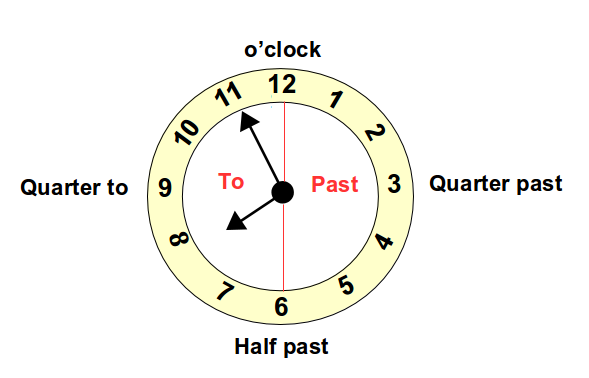
The figura shows the basic words that we need to tell the time:
Here are some examples of clock times in English:
| Time | In timetables | Normal use |
|---|---|---|
| 3:00 | three (o’clock) | |
| 3:05 | three oh five | five past three |
| 3:12 | three twelve | twelve minutes past three |
| 3:15 | three fifteen | a quarter past three |
| 3:30 | three thirty | half past three |
| 3:40 | three forty | twenty to four |
| 3:45 | three forty-five | a quarter to four |
| 3:56 | three fifty-six | four minutes to four |
| 4:00 | four (o’clock) |
Note:
- We use the word o’clock (en punt) only on the hour: three o’clock.
- For all the times between the hour and the half hour, we use past; for all the times between the half hour and the next hour, we use to.
- We use the word quarter (quarter past or quarter to). It is wrong to say:
fifteen pastorfifteen to. - We use Half half past and the previous hour.
- With the multiples of five, we say: ten past three. With all the others, we say the word minutes: twelve minutes past three
The figura shows the parts of the day and the times included in each one.
![[Parts of the day]](../media/parts_of_the_day.png "[Parts of the day]")
Here are some expressions related to clock times. They are placed in a sentence:
| What time is it? What’s the time? | ‘Quina hora és?' |
| It’s a quarter past four | ‘És un quart de cinc’ |
| It’s half past seven | ‘Són dos quarts de set’ |
| What time are you coming? | ‘A quina hora vindràs?' |
| I’ll come at ten | ‘Vindré a les deu’ |
| It’s three in the morning | ‘Són les tres de la matinada’ |
Note:
- With clock times we use the preposition at: at ten o’clock, at half past seven.
- With parts of the day, we use the preposition in: in the morning, in the afternoon.
- Other expressions related to clock times are:
| At noon / At midday | Al migdia |
| At sunset / At dusk | A la posta del sol |
| At midnight | A mitjanit |
| At sunrise / At dusk | A la sortida del sol |
The 12-hour-system
In English, it is not common to use the 24-hour-system. Instead, they use the 12-hour-system. To distinguish between the morning and the evening, they add:
- am (Latin: ante meridiam), meaning in the morning
- pm (Latin: post meridiam), meaning in the afternoon or in the evening
For example, 15:00h is three pm or three in the afternoon and 03:00h is three am or three in the morning.
The present continuous
Read Mr. Thomas Spencer’s email in Section ‘Evergreen Builders: Purchasing Department’ and note the words in bold, in the present continuous:
| I am writing | ‘Escric (estic escrivint)‘ |
| we are building | ‘Estem construint’ |
| you are organizing | ’(vostè) està organitzant’ |
See the different forms of the present continuous in the table below:
| Affirmative Long form | Affirmative Short form | Negative Long form | Negative Short form | Interrogative | |
|---|---|---|---|---|---|
| I | am working | ‘m working | am not working | ‘m not working | am I working…? |
| you | are working | ‘re working | are not working | aren’t working | are you working…? |
| he/she/it | is working | ‘s working | is not working | isn’t working | is he working…? |
| we | are working | ‘re working | are not working | aren’t working | are we working…? |
| you | are working | ‘re working | are not working | aren’t working | are you working…? |
| they | are working | ‘re working | are not working | aren’t working | are they working…? |
The present continuous is composed of two elements: the auxiliary verb be, conjugated in the present tense, and the gerund of the verb (working).
The gerund (-ing) form
The gerund is an invariable form of the verb. It always ends in -ing. It is mostly used (together with the auxiliary verb be) to form the continuous tenses of the verbs.
The main uses of the present continuous are:
1) For an action that is happening at the moment of speaking:
| Look! David is talking to the director | ‘Mireu! David està parlant amb el director’ |
| I am writing the report now | ‘Ara estic redactant l’informe’ |
| He is flying to London in this moment | ‘En aquest moment està volant cap a Londres’ |
2) For a temporary action, one that is not permanent:
| I am working at night this week | ‘Aquesta setmana treballo de nit’ |
| She is living with her sister | ’(Ella) viu/està vivint amb la seva germana)‘ |
| My car is in the garage so these days I am taking the bus to come to work | ‘El meu cotxe és al taller així que aquests dies agafo l’autobús per a venir a treballar’ |
Adverbs of time
Some adverbs and adverbial expressions of time are frequently used with the present continuous tense. For example:
| Now | We are going out now |
| At the moment | They are watching TV at the moment |
| This week | This week we are completing the inventory |
Verbs that do not take the continuous tenses
Some verbs are never expressed in the continuous tenses. Some of these verbs are:
| Believe | Creure | Love | Estimar |
| Doubt | Dubtar | Prefer | Preferir |
| Enjoy | Agradar, gaudir | Remember | Recordar |
| Hate | odiar, detestar | See | Veure |
| Have | Tenir | Think | Opinar |
| Know | Saber | Understand | Entendre |
| Like | Agradar | Want | Voler |
It is wrong to say: I am liking this film. We must say: I like this film.
But we can use the continuous tenses with two of these verbs when they have a different meaning:
- Have (Cat. prendre): I am having breakfast (Cat. 'Estic prenent l’esmorzar/Estic esmorzant’)
- Think (Cat. pensar): What are you thinking about? (Cat. ‘En què estàs pensant?’)
Communication: Evergreen Builders. Purchasing Department
In this section we are going to learn about Samantha’s day at work. She received an email from the leader of a builder’s team, Thomas Spencer, requesting her to place an urgent order for some materials. She replied to the email, and called one of their suppliers, BDL Supplies, to see if they could deliver the materials. Eileen Taylor requested her to send an email with the purchase order.
Example of email
Read Thomas Spencer’s email:
Dear Ms. Oliver,
I am writing this email to request some materials that we are going to need for our roofing job next week. Currently, we are building the perimeter walls and we are installing the beams of the new house.
Next week we are starting the roofing jobs, and we need insulating material, and some safety equipment.
I know that these days you are very busy because you are organizing the visit to the next tradeshow. However, we need the following material asap.
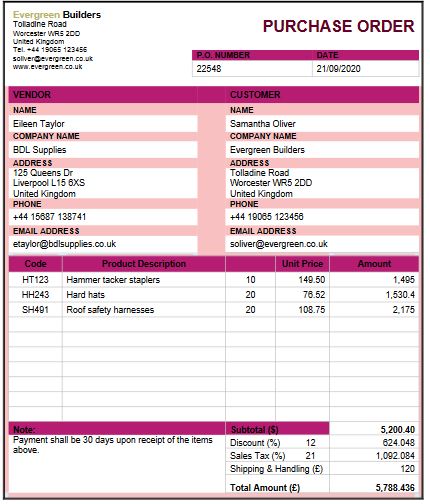
- 10 Hammer tacker staplers
- 20 Hard hats
- 20 Roof safety harnesses
I apologize for the short notice and I hope that you will do your best to get the material and send it to us. Thank you for your help.
Sincerely,
Thomas Spencer
Now, read Samantha’s reply:
Hello,
I have received your mail requesting an urgent order for next week. I will do it immediately, although I cannot assure that you will have it on Monday.
As always, I remind you that the provision for material should be done at least two weeks in advance, but I will do my best to place your order asap.
Please, send me a message if you need my assistance.
Best regards,
Samantha Oliver
Speaking on the phone
Speaking on the phone is a very common activity, both in a working environment and in our daily life. We may do so with customers, colleagues or friends, but in all the cases speaking on the phone requires the use of specific words and expressions. A clear pronunciation is very important when speaking on the phone, so it is a good idea to practise the expressions carefully before attempting to make a call or answering the phone. It is also necessary to have good listening skills because in a telephone conversation you cannot see the other person and therefore you will not have the help of the body language.
Example of telephone conversation
Read the following telephone conversation between Samantha Oliver and Eileen Taylor. In the conversation, Samantha calls the company BDL Suppliers to place the urgent order Mr. Thomas Spencer requested her. Ms. Taylor agrees and asks her to send an email with the purchase order.
Receptionist: Good morning, BLD Supplies. How can I help you?
Ms. Oliver: Good morning. This is Samantha Oliver, with Evergreen Builders. May I speak to Ms. Eileen Taylor?
Receptionist: Hold on a minute, please. I’ll pass you through.
Ms. Oliver:* Thank you.
Ms. Taylor: Good morning, Eileen Taylor speaking, how can I help you?
Ms. Oliver: Good morning Ms. Taylor. This is Samantha Oliver. I’m calling to place an urgent order for some safety equipment.
Ms. Taylor: All right. What do you need exactly?
Ms. Oliver: I need 10 hammer tacker staplers, 20 hard hats and 20 roof safety harnesses. I need it for next week.
Ms. Taylor: Ok, Ms. Oliver. There is no problem. We have them on stock. Please, send me an email with the purchase order.
Ms. Oliver: Thank you. I will send it right away. When will we receive the order?
Ms. Taylor: The goods will be delivered on Monday morning.
Ms. Oliver: Thank you for your help.
Ms. Taylor: You’re welcome. We are always pleased to do business with you.
Here are some common expressions used in telephone conversations. They are divided in categories according to their purpose and they all include an equivalent expression in Catalan.
Answering the telephone:
- Hello? (Cat. Digui?)
- Commercial Department, hello? (Cat. ‘Departament comercial, digui?’)
- Joan Alsina speaking (Cat. ‘Joan Alsina, diguim?’)
- Customer service, can I help you? (Cat. ‘Servei al client, en què el puc ajudar?’)
Asking for the other person’s identification:
- Who’s calling? (Cat. ‘Qui és?, de part de qui?, qui el truca?’)
- Where are you calling from? (Cat. ‘D’on truca?’)
- May I have your name please (formal) (Cat. ‘Em pot dir el seu nom si us plau?’)
- Is that Mr Peter Bramwell? (Cat. ‘Parlo amb el Sr. Peter Bramwell?’)
- Is that the Commercial Department? (Cat. ‘És el departament comercial?’)
Identifying yourself:
- This is Joan Alsina (Cat. ‘Sóc Joan Alsina’)
- My name’s Joan Alsina (Cat. ‘Em dic Joan Alsina’)
- I’m calling from Zara (Cat. ‘Truco de Zara’)
Requesting to speak to someone:
- Can I speak to Mr Peter Bramwell please? (Cat. ‘Puc parlar amb el Sr. Peter Bramwell si us plau?’)
- May I speak to Mr Peter Bramwell please? (formal) (Cat. ‘Podria parlar amb el Sr. Peter Bramwell si us plau?’)
- Is Mr Peter Bramwell there? (Cat. ‘Està el Sr. Peter Bramwell?’)
- I’d like to speak to Mr Peter Bramwell (Cat. ‘Voldria parlar amb el Sr. Peter Bramwell’)
- Could you put me through to Mr Peter Bramwell? (Cat. ‘Em podria passar amb el Sr. Peter Bramwell?’)
If Mr Peter Bramwell answers the phone himself, the answer could be:
- Speaking! (Cat. ‘El mateix, sóc jo mateix’)
If someone else answers the phone, see below:
Requesting the other person to wait:
- One moment please (Cat. ‘Un moment si us plau’)
- Hold on please (Cat. ‘No pengi si us plau’)
- Just a minute (Cat. ‘Un minut’)
Connecting with other people:
- I’ll put you through (Cat. ‘Li passo’)
- I’l put you through to Mr Bramwell (Cat. ‘Li passo al Sr. Bramwell’)
- I’ll put you through to his office (Cat. ‘Li passo al seu despatx’)
Explaining that the other person is not available:
- I’m afrain Mr Bramwell is not in his office right now (Cat. ‘Em temo que el Sr. Bramwell no és al seu despatx en aquest moment’)
- Mr Bramwell is in a meeting at the moment (Cat. ‘El Sr. Bramwell és a una reunió en aquest moment’)
- I’m afraid the line’s busy at the moment (Cat. ‘Està comunicant’)
Asking about the reason of the call:
- What does it concern? (formal) (Cat. ‘De què es tracta’)
- What’s it about? (Cat. ‘Sobre què és?’)
Offering solutions:
- Can you call back later? (Cat. ‘Pots trucar més tard?’)
- Could you call back later? (formal) (Cat. ‘Pot trucar més tard?’)
- Could I take a message? (Cat. ‘Vol que li doni algun missatge?’)
- Would you like to leave a message? (Cat. ‘Vold deixar-li algun missatge?’)
- Can I help you in anything? (Cat. ‘El puc ajudar en alguna cosa?’)
- Ok, I’l call back later, thanks (Cat. ‘D’acord, trucaré més tard’)
- I’ll try again, thanks (Cat. ‘Ho tornaré a intentar, gràcies’)
Leaving a message:
- Could I leave a message please? (Cat. ‘Puc deixar un missatge si us plau?’)
- I’d like to leave a message for Mr Bramwell (Cat. ‘Voldria deixar un missatge pel Sr. Bramwell’)
- Could you please tell Mr Bramwell that Joan Alsina called? (Cat. ‘Li pot dir al Sr. Bramwell que l’ha trucat Joan Alsina si us plau?’)
- Please tell Mr Bramwell that… (Cat. ‘Si us plau, digui al Sr Bramwell que…’)
Explaining the reason of the call:
- I’m calling on behalf of Inés Fernández (Cat. ‘Truco de part de la Inés Fernández’)
- I’m calling about… (Cat. ‘Truco en relació a…’)
- I’m calling to… (Cat. ‘Truco per a…’)
Saying goodbye:
- Well, thanks for your help (Cat. ‘Bé, gràcies per la teva ajuda’)
- I’ll call you back in a few days (Cat. ‘Et truco d’aquí uns dies’)
- Goodbye (Cat. ‘Adéu’)
- Bye (Cat. ‘Adéu’)
Leaving recorded messages
Sometimes we may need to leave a recorded message in an answering machine (Cat. contestador automàtic) or in a voicemail (Cat. bústia de veu). These messages must be as short as possible and they should include at least the following information:
- The person to whom we address the message
- Our name
- The message
- Closing expressions
Here are two examples of recorded messages:
- Hello. This is a message for Mr Peter Bramwell. This is Joan Alsina from Zara. I’m calling about an order for 30 male shirts we made two weeks ago. We are still expecting the shirts. Could you please call me back and tell me if there’s any problem with the order? Thank you. Good Bye!
- Hi. This message is for Eric Smith. I’m calling from a hospital in Barcelona. I’m sorry to inform you that your mother had an accident. It’s not serious, but you should come as soon as possible. Could you please call me back at this number? Thank you, good bye!
Writing: Characteristics of written language
Unlike the oral language, which makes use of non-verbal language to transmit the message, a written text is what we see. When we speak we can leave some sentences unfinished or change the volume or the tone to express emotions, but we cannot do that in a written text. That is why in a written text, sentences must be complete, they tend to be longer, with subordinate clauses and we use punctuation to organize and structure our writings.
Some of the characteristics of written language are:
- Use of long forms:
Example: when introducing the reason for writing: “I am writing to inform you…”. We use the long form “I am” instead of “I’m”. - Some grammatical constructions are only used in writing, as are some kinds of vocabulary.
Example: the closing sentence in formal letters: “We are looking forward to your reply.” - Use of a particular layout depending on the type of text (descriptions, reports, business letters, invoices, forms…)
- Organization in paragraphs. It is very important to organize the ideas in different paragraphs and leave a blank space between them.
- Use of connectors and punctuation.
- Use of correct sentence structure. The structure of the sentence is very important in English.
- Use of formal language, except in informal writing (informal emails, notes, etc.)
A formal email: example
You can find useful phrases and formulas used in formal emails in the annexes.
Example of email
Read the email below, where Samantha Oliver places an order for some safety material:
Dear Ms. Taylor,
As we agreed on our phone conversation today, I am writing this email in order to place an urgent order for some safety material. Please, see the purchase order attached.
I really appreciate your effort in providing this material at such short notice. We are expecting the goods to be delivered on Monday morning.
Regarding the payment terms, you will receive the payment 30 days upon receipt of the items, as usual. Please, confirm that everything is correct.
We are looking forward to your reply.
Yours sincerely,
Samantha Oliver