



The fruit orchard
This section is called “The fruit orchard” because it deals basically with the production of fruit. As in all the sections, there is a text for practising your reading skills. In this case, you will read a dialogue between Jordi and Laura about the type of fruit they should grow in the farm. The text is followed by a vocabulary list of words related to the topic.
In the communication section, you will learn how to write a good text, especially emails and letters. There is a chapter devoted to explain the use of connectors and punctuation, which are two important aspects in a text, as well as the English spelling, especially the use of capital letters.
In the grammar section of this unit, you will continue studying the verb tenses. On this occasion, you will learn the forms and the use of the three past tenses, which are the past simple, the past continuous and the present perfect. In this section you will learn how to use each tense correctly.
Reading: Growing fruit
Núria and Laura were walking around the farm when Laura pointed at a fruit orchard in the distance.
Laura: Are those apple trees over there?
Núria: Yes, they are. We didn’t plant them, though. They were there when we bought the farm.
Laura: What do you do with the apples?
Núria: Oh, they are mostly for home consumption, but we sell the surplus in the local market.
Laura: What about the empty land next to the orchard?
Núria: We want to plant more fruit trees there. Pears or perhaps peaches, we don’t know yet, but I’d like to grow pears. Peach production is quite high around here and it’s hard to put your product into the market.
Laura: You know, I grew up in my grandparents’ farm in Wales. They mostly grew berries there. Strawberries, blackberries, raspberries and the like. These are the traditional crops in Wales. They also grew apples, but they sold all the production to the local cider producers. Unfortunately, the climate in Wales doesn’t allow to grow such a great variety of fruit as you’ve got here.
Núria: Well, our climate isn’t too good for dry fruits or citrics, for example. They are produced further south.
Laura: Have you planned to grow cereals? I heard they are in great demand now.
Núria: Yes, especially barley for the beer industry and wheat for the bread, of course, but we don’t have land for cereals, I’m afraid.
Technical vocabulary:
| English | Catalan | English | Catalan |
|---|---|---|---|
| apple tree | pomer | home consumption | consum propi |
| barley | civada | production | producció |
| beer industry | industria de la cervesa | surplus | excedent |
| bread | pa | and the like | i coses per l’estil, coses semblants |
| cereal | cereal | to be in great demand | tenir molta demanda |
| cider producer | productor de sidra | to point at | assenyalar |
| empty | buit/da | to walk around | passejar, caminar per |
| fruit tree | arbre fruiter | wheat | blat |
| further south | més al sud |
| Catalan | English | Catalan | English |
|---|---|---|---|
| albercoc | apricot | magrana | pomegranate |
| alvocat | avocado | mandarina | tangerine |
| ametlla | almond | meló | melon |
| avellana | hazelnut | móra | blackberry |
| castanya | chestnut | nou | nut |
| cirera | cherry | pera | pear |
| coco | coconut | pinya | pineapple |
| cítric | citric | pistatxo | pistachio |
| dàtil | date | plàtan | banana |
| figa | fig | poma | apple |
| fruit del bosc, baia | berry | pomelo | grapefruit |
| fruit sec | dry fruit | préssec | peach |
| gerd | raspberry | pruna | plum |
| grosella | blackcurrant | raïm | grape |
| kiwi | kiwi | síndria | watermelon |
| llima | lime | taronja | orange |
| llimona | lemon | mandarina | tangerine |
| maduixa | strawberry |
Language notes:
- Spoken English: in the text ‘Growing fruit’ above, you can read a dialogue between Núria and Laura. Dialogues reproduce the spoken language, so there are some words that are very much used in oral English, as for examples: though, oh, you know, well, I’m afraid. Try to use them in your speech.
- When we speak, we can add the word though to a sentence. In this case, it has the same meaning as but (Cat. ‘però’), as when we say: I’d like to go jogging. it’s very hot, though.
- Grow up and grow. These two verbs, both used in the text, look the same, but they have different meanings:
- Grow up (Cat. ‘créixer’, ‘criar-se’) is an intransitive verb that refers to people. For example: I was born in York, but I grew up in Manchester (Cat. ‘Vaig néixer a York, però em vaig criar a Manchester’).
- Grow (Cat. ‘conrear’) is a transitive verb, which means that it must have a direct object. The direct object is typically a piece of fruit or a vegetable. For example: I grow apples and pears (Cat. ‘Conreo pomes i peres’).
- The word fruit is uncountable. You must say, for example: oranges and bananas are both fruit or fresh fruit is very healthy. In these sentences, you must not say:
fruits. To refer to an individual orange, etc., we must say: an orange is a piece of fruit or we must eat five pieces of fruit every day.
To review the concepts countable and uncountable nouns, see the chapter “Quantifiers”, in the section called “Starting a new life” in the unit “A new life”.
Communication
In this section, you will learn about the techniques for writing a good text in English. You will see how to organize your ideas in paragraphs and how to give internal coherence to the text to facilitate the reading.
You will apply the technique to the writing of emails and letters, which are two types of text that you will probably need to write if you use English in your working and/or personal life.
Finally, you will learn and practise three key elements in a text: connectors, punctuation and spelling. Connectors are used to link ideas and add some clarity to the text whereas punctuation is used to separate sentences and mark the pauses in the text. On the other hand, spelling tells us how to write a word.
The writing skills
At work or in your daily life, you will need to write emails and (perhaps) formal business letters, for example. As in all the skills, the only way of improving the writing skills is by writing as much as you can.
Here are some general guidelines to write a text:
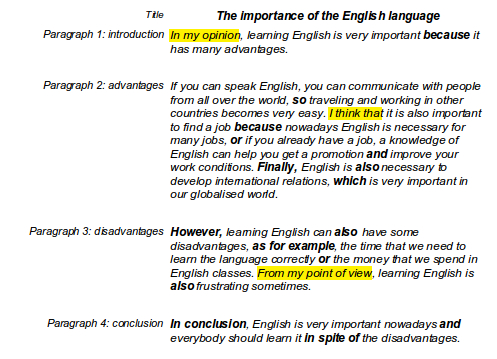
a) Think about the objective of the text. The objectives may be varied: to describe facts (for example, your daily routine), to express your opinion (for example, about the importance of English), to give advice (for example, to do well in your job), or to persuade a person (for example, when you must explain why you are a good candidate for a job). When you write a text, you must think about the type of language required for each objective (for example, when you give your opinion, you can say: I think that…, in my opinion, …, etc.)
b) Think about the contents (what you want to say). You can write down your ideas in note form and then develop these ideas in the text. For example, imagine that you must write your opinion on the topic: The importance of the English language. You could write down the following ideas:
- Introduction: Learning English very important
- Advantages: speaking with other people; find a job, get a promotion, international relations …
- Disadvantages: expensive, needs time, frustrating…
- Conclusion: necessary to learn.
c) Organize the text. Write an appropriate title, divide the text into paragraphs and write clear and simple sentences. Use one paragraph for each idea. For example, one for the introduction, one for the advantages of English, one for the disadvantages and a final one for the conclusion.
d) Think about the following aspects:
- Appropriate vocabulary: use the right words to express your ideas (use a dictionary if you have any doubts) and the specific words and expressions used for giving opinions (see them in yellow in the example text below).
- Appropriate syntactical structures: correct use and forms of the verb tenses, word order, etc.
- Correct spelling: many spelling mistakes are due to typewriting errors; if in doubt about the correct spelling of a word, look it up in a dictionary.
- Use of connectors (see them in bold type in the model text below) and punctuation (stops, commas, etc.).
In the image below, you can see a model text:
Please note:
- Remember to ‘think’ in English. You will logically think in your own language and, when writing (and also when speaking), you will mentally translate your thoughts into English. You know you language very well, so you tend to use colloquial words and complex grammatical structures. For this reason, your mental translation into English is often complicated and full of errors. You must be conscious of your limitations in English and try to use simple language and simple syntactical structures at first. As you advance in your English, you will come to express more and more complex ideas.
- The use of automatic translators is not appropriate for writing a text. They are useful for understanding a short text in English, but automatic translators are not appropriate tools for writing because you can only develop your skills by practising. On the other hand, you need to introduce a text without any mistakes (including punctuation, graphical accents, etc.) to obtain a correct text in English. We strongly recommend you to write a text by following the guidelines above.
Writing emails and letters
If you ever need to write a text in English, you will most probably write an email or a letter. In both cases, it is very important to think about the receiver of your message because you must use the appropriate language style: formal or informal. Nowadays, we generally send emails because they are much faster and comfortable than traditional letters, but in some cases you may still need to write a formal letter, so in this section you are going to learn the characteristics of formal and informal emails and formal business letters.
All the emails (formal and informal) have four basic elements:
- The heading
- The body
- A closing phrase
- The signature
In addition, in formal letters you must also add the date and the sender and receiver’s address.
Informal emails
You send informal emails to family, friends and colleagues. The text must have the characteristics of the informal style, as explained in the corresponding section of this course. Some of these characteristics are the use of colloquial words and contracted forms, for example.
Here is an example of an informal email. It is written by Núria and it is addressed to Laura Smith, who is spending the Christmas holidays with her family in Wales:
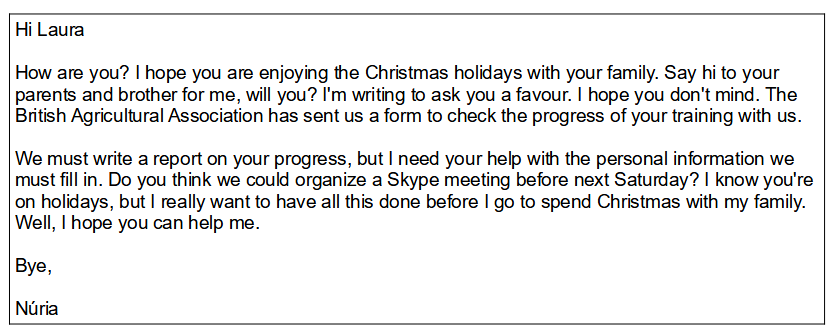
Note the four necessary elements in the email. They are all in informal style:
- The heading: Hi Laura. Other possible informal headings: Hello Laura, Dear Laura.
- The body: two paragraphs where you give the information.
- The closing phrase: Bye. Other possibilities: Love, Cheers, See you.
- The signature: Núria (generally with the first name; you can also use short forms to sign informal emails: Pep, Cesc, Pili, etc.).
Formal emails
You usually send formal emails to people you do not know, usually companies. Typical reasons for writing formal emails are: to ask for or give information, to apply for a job or to make a complaint about a product or service.
Although the formal emails are not as formal as business letters, you must still use the formal conventions and the formal language. Here is an example of a formal email in which Núria sends a report about Laura’s progress in her training:
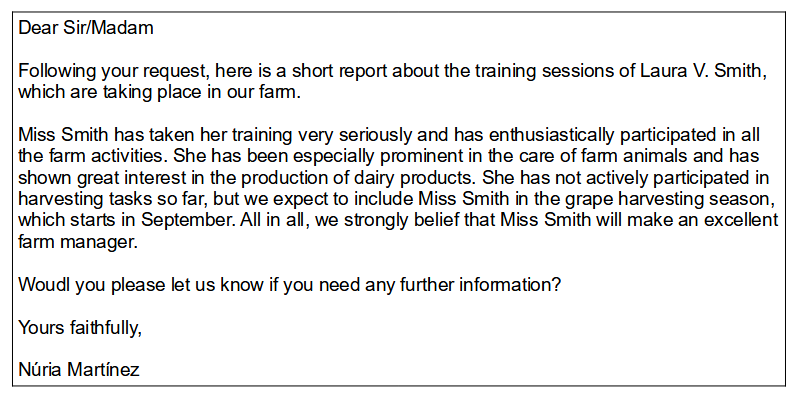
Note the differences with the informal email above:
- The heading: Dear Sir/Madam, which is used when you do not know the receiver’s name. If you know the other person’s name you can say: Dear Mr Jackson, Dear Ms Wilson, etc., but always using the person’s title (Mr, Mrs, Ms, Miss) and the person’s last name (Jackson, Wilson).
- The body: here make sure that you use formal language and the conventions of the formal style.
- The closing phrase: Yours faithfully (you use this closing phrase if you do not know the person’s name, that is, if the heading is Dear Sir/Madam. If you know the person’s name, you must say: Yours sincerely.
- The signature: Núria Martïnez. Always write your first and second name. In formal emails, you must not use short names or nicknames.
Formal business letters
Business letters tend to be rather formal, more than formal emails. They are usually printed and sent in paper format, so you must pay attention to the layout of the letter, that is, the way in which the different elements are organized on the paper. Business letters include the date and the sender and receiver’s address. Here is an example of a business letter in which Jordi Gómez thanks the British Agricultural Association for a seminar:
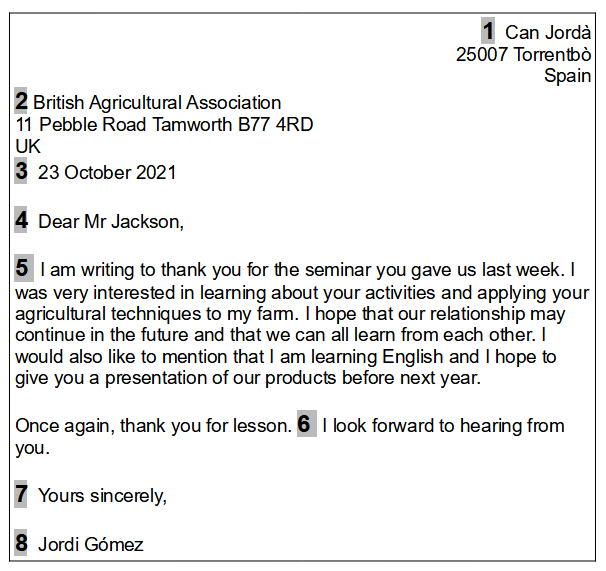
These are the standard elements of the letter:
- Writer’s address (usually without the name).
- Recipient’s address.
- Date: usually under the recipient’s address, but the position is flexible.
- The heading: here we know the person’s name, so we say: Dear Mr Jackson.
- Body of the letter (in formal style).
- Closing phrase: this is a standard phrase that you can use in most business letters.
- Closing salutation: here we say Yours sincerely because we have started with Dear Mr Jackson.
- Writer’s full name (name + surname).
To review the characteristics of the formal and informal styles see: “Formal and informal English”, in the section called “The farm” in the unit “A new life”.
Connectors, punctuation and spelling are very important because they bring clarity and coherence to a text and facilitate the reading. When you write, you must think about these three elements and use them in your writings.
Connectors
Connectors are the words that we use to link (connect) the different ideas in a text. They say if two sentences are in contrast, if one is the consequence of the other, etc.
Here is a list of some basic English connectors. We include the ideas that they express as well as their Catalan equivalent forms and examples of their use:
Expressing addition:
- and (Cat. ‘i’): I like reading and listening to music (Cat. ‘M’agrada llegir i escoltar música’).
- or (Cat. ‘ni’) (in negative sentences): I don’t like reading or listening to music (Cat. ‘No m’agrada llegir ni escoltar música’)
- also (Cat. ‘també’) (formal): I also like reading (Cat. ‘A mi també m’agrada llegir’).
- too (Cat. ‘també’) (informal): I like reading too (Cat. ‘A mi també m’agrada llegir’).
Expressing alternatives:
- or (Cat. ‘o’): You can go or wait a little longer (Cat. ‘Pots marxar o esperar-te una estona més’).
Expressing contrast:
- but (Cat. ‘però’): It’s late, but I will wait a little longer (Cat. ‘És tard, però esperaré una estona més’).
- however (Cat. ‘malgrat tot’): It’s late. However, I will wait a little longer (Cat. ‘És tard. Malgrat tot, m’esperaré una estona més’).
- although (Cat. ‘encara que’, ‘tot i que’ ): Although it’s late, I will wait a little longer (Cat. 'Encara que sigui tard, m’esperaré una estona més’).
- on one hand… on the other hand (Cat. ‘per una banda… per una altra banda’): On one hand it is raining. On the other hand, it is very cold (Cat. 'Per una banda, està plovent. Per una altra banda, fa molt de fred’).
Explaining ideas:
- in other words (Cat. ‘amb altres paraules’): It’s crystal clear. In other words, it is very clear (Cat. ‘Està clar com el cristall. En altres paraules, està molt clar’).
- for example (Cat. ‘per exemple’). There are many things to do. For example, bring water and take out the chairs (Cat. ‘Hi ha moltes coses per fer. Per exemple, portar aigua i treure les cadires’).
Listing ideas:
- firstly…; secondly… (Cat. ‘en primer lloc…’; ‘en segon lloc…’): Firstly, bring water; secondly, take out the chairs (Cat. 'En primer lloc, porta aigua; en segon lloc, treu les cadires’).
- and then (Cat. ‘i aleshores’): Bring water and then take out the chairs (Cat. ‘Porta aigua i aleshores, treu les cadires’).
- next (Cat. ‘després’): Bring water. Next, take out the chairs (Cat. ‘Porta aigua. Després, treu les cadires’).
- finally (Cat. ‘finalment, per acabar’): Bring water, take out the chairs and finally check the computer (Cat. ‘Porta aigua, treu les cadires i finalment comprova l’ordinador’).
Expressing purpose:
- to (Cat. ‘per a’, ‘per tal de’): Use a dictionary to look up the meaning of a word (Cat. ‘Utilitza un diccionari per a consultar el significat d’una paraula’).
Expressing the reason:
- because (Cat. ‘perquè’): I study English because it is very important (Cat. ‘Estudio anglès perquè és molt important’).
- because of (Cat. ‘degut a’, ‘a causa de’): I study English because of its great importance (Cat. ‘Estudio anglès degut a la seva gran importància’).
Expressing the result:
- so (Cat. ‘així que’, ‘per tant’) (informal): I need money so I work extra hours (Cat. ‘Necessito diners així que faig hores extres’).
- therefore (Cat. ‘així que’, ‘per tant’) (formal): I need money. Therefore I work extra hours (Cat. ‘Necessito diners. Per tant, faig hores extres’).
Summarizing ideas:
- in conclusion (Cat. ‘en conclusió’): We have no money and we do not work. In conclusion, we cannot give you anything (Cat. ‘No tenim diners i no treballem. En conclusió, que no et podem donar res’).
- Summing up (Cat. ‘resumint’). We have no money and we do not work. Summing up, we cannot give you anything (Cat. ‘No tenim diners i no treballem. Resumint, que no et podem donar res’).
To see the importance of connectors, compare these two texts:
Text without connectors
The Internet has some advantages. It is useful to broaden your knowledge and meet new people. It has some disadvantages. Its free access to pages which show violence and crimes. There are people who think that the Internet should be a free space to express ideas. Some people consider that the Internet can be dangerous if it is not controlled. The Internet has both advantages and disadvantages. People must learn to use it for positive aims.
Text with connectors (in bold type)
The Internet has some advantages because it is useful to broaden your knowledge and meet new people, but it also has some disadvantages, as for example, its free access to pages which show violence and crimes. On the one hand, there are people who think that the Internet should be a free space to express ideas. On the other hand, some people consider that the Internet can be dangerous if it is not controlled. In conclusion, the Internet has both advantages and disadvantages, but people must learn to use it for positive aims.
Punctuation
Punctuation refers to the use of commas (,), periods (.), questions marks (?), exclamation marks (!), etc. Punctuation is often considered unimportant, but it is actually very important in a text. Be very careful with the use of punctuation when you write a text:
Here are the most common uses of the punctuation marks:
For further information about the English punctuation, see the document ‘Use of English punctuation’ in the Annexes of this section.
- Do not write a comma (,) between the subject and the verb.
- Write a full stop (.) at the end of a sentence.
- The adverbials and connectors are usually separated from the sentence by a comma. For example: in the mornings , I usually check my mail.
- Write a colon (:) to introduce a list of items or an explanation. For example: the continents are: Europe, Asia, Africa, America and Oceania.
- Write a comma to separate the elements in a list. For example: I visit customers on Monday , Wednesday , Thursday and Friday.
- Use a semi-colon (;) to separate the groups of items in a list. For example: in computing, we must distinguish between hardware and software. Hardware refers to the material parts of a computer ; software refers to programming and includes operating systems, compilers, editors, etc.
- Use brackets () to add extra information. For example: in writing, we must use connectors (also called ‘linking words’).
- Write a capital letter at the beginning of a sentence or after a full stop.
- Write a question mark (?) at the end of a sentence. For example: what’s your name ?.
- Write an exclamation mark (!) at the end of a sentence with the imperative form. For example: Come in !.
Spelling
Spelling refers to the way in which we write a word. English words are usually spelt very differently from the way we pronounce them, so we must learn the meaning of a word together with its spelling. However, there are a few basic spelling rules:
- Changing y to ies: when we add -s to a word ending in vowel+y, we just add -s (play > plays, delay > delays); when the word ends in consonant+y, the ending is -ies (company > companies, baby > babies).
- Adding -es to words ending in -s, -ss, -z, -ch, -sh, -x (wish > wishes, box > boxes, business > business).
- Doubling up: when we add an ending to words in vowel + final consonant, we double the consonant (big > bigger, begin > beginning).
- Drop the ‘e’: we drop the final '-e’ when we add suffixes starting with a vowel (write > writing, hope > hoped, sense > sensible); we keep the '-e’ if the word ends in '-ce’ or '-ge’ and the suffix is '-able’ or '-ous’ (courage > courageous, notice > noticeable).
- Changing ‘y’ to ‘i’: if a word ends in a consonant + ‘y’, the ‘y’ changes to ‘i’ (beauty + ful > beautiful, happy + ness > hapinnes).
- Changing '-f’ to '-ves’ or '-s’: most words ending in '-f’ or '-fe’ change their plurals to '-ves’ (half > halves, life > lives, yourself > yourselves).
Capitalization
Capitalization is the use of capital letters (Cat. ‘lletres majúscules’). In English, capitalization is sometimes different from Spanish or Catalan.
In English, capital letters are used:
- with the pronoun ‘I’.
- with adjectives derived from proper names: English, Spanish, Londoner, etc.
- with days of the week and months of the year: Monday, Tuesday, February, April, etc.
- with names of personal and job titles: Mr, Miss, Sales Manager, Director, etc.
- at the beginning of a sentence.
Grammar
In the grammar section, you will learn about the past tenses. There are three verb tenses that can refer to the past: the past simple, the past continuous and the present perfect. The past simple and continuous describe finished actions in the past. The present perfect also describes past actions, but with strong links with the present. When you express the past simple and the present perfect, you will need to review the irregular verbs. You will also learn to distinguish between the three verb tenses, especially between the past simple and present perfect. The difference between these two tenses is very important because they are often confused and generate errors.
The past simple
In the text called ‘Growing fruit’, Laura and Núria say the following:
Laura: Are those apple trees over there?
Núria: Yes, they are. We didn’t plant them, though. They were there when we bought the farm.
Further on, Laura rememorates her life as a child at her grandparents’ farm in Wales. She says:
Laura: You know, I grew up in my grandparents’ farm in Wales. They mostly grew berries there. Strawberries, blackberries, raspberries and the like. These are the traditional crops in Wales. They also grew apples, but they sold all the production to the local cider producers. Unfortunately, the climate in Wales doesn’t allow to grow such a great variety of fruit as you’ve got here.
Núria and Laura use different verbs in the past simple tense:
- didn’t plant: negative form of ‘to plant’.
- were: irregular form of ‘to be’.
- bought: irregular form of ‘to buy’.
- grew up: irregular form of ‘to grow up’.
- grew: irregular form of ‘to grow’.
- sold: irregular form of ‘to sell’.
As you can see, the verbs ‘to be’, ‘to buy’ ‘to grow up’, ‘to grow’ and ‘to sell’ express the past simple tense with a different word because they are irregular verbs:
- In irregular verbs, the past simple form in the affirmative cannot be deduced from the infinitive, so you must learn the past forms of the most common verbs. For example: buy > bought.
- In regular verbs, the past simple form in the affirmative adds -d or -ed to the infinitive, as in plant > planted.
The table below shows the past simple forms of a regular verb (work):
For a list of the most common irregular verbs in English, see the document “List of irregular verbs” in the “Annexes” section of this unit.
| Affirmative | Negative | Interrogative | |
|---|---|---|---|
| I | worked | did not work | did I work…? |
| you | worked | did not work | did you work…? |
| he/she/it | worked | did not work | did he work…? |
| we | worked | did not work | did we work…? |
| you | worked | did not work | did you work…? |
| they | worked | did not work | did they work…? |
Here are the past simple forms of an irregular verb (go):
| Affirmative | Negative | Interrogative | |
|---|---|---|---|
| I | went | did not go | did I go…? |
| You | went | did not go | did you go…? |
| He/She/It | went | did not go | did he go…? |
| We | went | did not go | did we go…? |
| You | went | did not go | did you go…? |
| They | went | did not go | did they go…? |
The past simple is used:
1) To express finished actions or states in the past:
- I worked in a factory 20 years ago (Cat. ‘Fa 20 anys vaig treballar a una fàbrica’).
- Did you watch the film on TV last night? (Cat. 'Vas veure la pel·lícula de la tele ahir a la nit?’).
- Mr Green didn’t come to his office yesterday. (Cat. ‘Ahir Mr Green no va venir al seu despatx’).
- Marcia met her husband at a party when they were both 15 (Cat. ‘La Marcia va conèixer el seu marit a una festa quan tots dos tenien 15 anys’).
- It was very hot last summer, do you remember? (‘L’estiu passat va fer molta calor, te’n recordes?’).
- We felt happy when he left (Cat. 'Ens vam alegrar quan (ell) va marxar’).
Adverbs of time
As the past simple expresses finished actions in the past, the time adverbials associated with the past simple must refer to the past. For example:
- Yesterday (Cat. ‘Ahir’)
- Last (Monday) (Cat. ‘El [dilluns] passat’)
- Last week (Cat. ‘La setmana passada’)
- Last month (Cat. ‘El mes passat’)
- Last year (Cat. ‘L’any passat’)
- Last century (Cat. ‘El segle passat’)
- in (1980) (Cat. ‘L’any [1980]')
- (two days) ago (Cat. ‘Fa [dos dies]')
- When I was (a child) (Cat. ‘Quan jo era [un nen/una nena]')
These words and expressions are usually placed at the end of the sentence:
- I arrived yesterday (Cat. ‘Vaig arribar ahir’).
- We left two hours ago (Cat. ‘Hem marxat fa dues hores’).
- I liked painting when I was younger (Cat. 'Quan era més jove, m’agradava pintar’).
The past continuous
Like the present continuous, the past continuous is a complex form composed of two elements: the auxiliary verb ‘to be’ (conjugated in the past tense) + the present participle of the verb (-ing form). In the past continuous, there is no difference between regular and irregular verbs.
Here are the forms of the past continuous:
To review the verb ‘to be’, see the unit called “A new life”, section “Starting a new life”, “Grammar review: the auxiliary verbs’to be’, ‘to have’ and ‘to do’”.
| Affirmative | Negative | Interrogative | |
|---|---|---|---|
| I | was working | was not working | was I working…? |
| you | were working | were not working | were you working…? |
| he/she/it | was working | was not working | was he working…? |
| we | were working | were not working | were we working…? |
| you | were working | were not working | were you working…? |
| they | were working | were not working | were they working…? |
We use the past continuous tense:
1) To express an activity that was in progress at a specific time in the past:
To see the verbs that do not take the continuous forms, see the box in the section “The present continuous” > “The vineyard” in this unit.
- I was eating my dinner at 8 o’clock last night (Cat. ‘Ahir a les vuit estava sopant’).
- At this time yesterday, I was still working in my office (Cat. ‘Ahir a aquesta hora encara estava treballant al meu despatx’).
- I was looking for a job at this time last year (Cat. ‘Ara fa un any estava buscant feina’).
2) In combination with the past simple, to express an interrupted action in the past:
- I was sleeping when he called last night (Cat. 'Estava dormint quan (ell) va trucar ahir a la nit’).
- The computer crashed while I was writing the email (Cat. ‘L’ordinador es va penjar mentre estava escrivint l’email’).
- While I was waiting at the bus stop, I saw your father (Cat. ‘Mentre estava esperant a la parada de l’autobús, vaig veure el teu pare’).
3) To express two or more parallel actions in the past:
- I was walking in the park, the sun was shining, the birds were singing… (Cat. ‘Jo passejava pel parc, el sol brillava, els ocells cantaven’…)
- I wasn’t listening while he was talking to me (Cat. ‘No estava escoltant mentre em parlava’).
Note: the equivalent forms of the English past continuous tense in Catalan and Spanish are: Cat. 'estava treballant’, Sp. 'estaba trabajando’. However, we can also translate the past continuous tense with the imperfet (Cat. ‘treballava’) and pasado imperfecto (Sp. ‘trabajaba’).
Adverbs of time
With the past continuous, we can use the same time adverbials that we use with the past simple, but there is a difference in meaning:
- Past simple: I had lunch one hour ago (=I started the action one hour ago).
- Past continuous: I was having lunch one hour ago (=one hour ago the action was taking place: it had started before and would continue for some time afterwards).
Two adverbs of time are very frequently used with the past continuous:
- While (Cat. ‘mentre’), as in: While I was driving home, I felt sick (Cat. Mentre anava cap a casa, em vaig trobar malament).
- When (Cat. ‘quan’), as in: When you are working in the fields, make sure you wear a hat (Cat. Quan estiguis treballant al camp, assegura’t que portes un barret).
The present perfect
In the dialogue in the text ‘Growing fruit’, Laura asks Núria the following question:
- Laura: Have you planned to grow cereals?
The verb ‘to plan’ is conjugated in the present perfect.
Like the present continuous and the past continuous, the present perfect tense is composed of two elements: the auxiliary verb ‘have’ (conjugated in the present) + the past participle of the verb.
The present participle and the past participle
Remember:
The present participle always ends in -ing. Sometimes it is called ‘the -ing form’. It is used:
- To form the continuous tenses.
- As an adjective (as in: a boring person).
The past participle ends in -ed (in regular verbs). In irregular verbs, the past participle is irregular. It is used:
- To form the perfect tenses.
- As an adjective (as in: a finished report).
Note: the present participle can also have the function of a noun. In this case, it is called a gerund. For example:
- Decision-taking is not easy.
- I like trekking.
As the past participle has irregular forms, you must know if the verb is regular or irregular. As in the past simple, the regular forms of the past participle end in -d or -ed, as in: plant > I have planted. In irregular verbs, it has a different form, as in: see > I have seen.
For a list of the most common irregular verbs in English, see the document “List of irregular verbs” in the “Annexes” section of this unit.
The following table shows the forms of the present perfect of a regular verb (work):
| Affirmative | Negative | Interrogative | |
|---|---|---|---|
| I | have worked | have not worked | have I worked…? |
| you | have worked | have not worked | have you worked…? |
| he/she/it | has worked | has not worked | has he worked…? |
| we | have worked | have not worked | have we worked…? |
| you | have worked | have not worked | have you worked…? |
| they | have worked | have not worked | have they worked…? |
Here is the conjugation in the present perfect of an irregular verb (go):
| Affirmative | Negative | Interrogative | |
|---|---|---|---|
| I | have gone | have not gone | have I gone…? |
| you | have gone | have not gone | have you gone…? |
| he/she/it | has gone | has not gone | has he gone…? |
| we | have gone | have not gone | have we gone…? |
| you | have gone | have not gone | have you gone…? |
| they | have gone | have not gone | have they gone…? |
We use the present perfect:
1) To express unfinished actions or states that started in the past and continue to the present. We usually need the prepositions for (Cat. ‘durant’) and since (Cat. ‘des de’):
- I have been a farmer for two years (Cat. ‘Fa dos anys que soc pagès’).
- I have worked at the farm since July (Cat. ‘Porto treballant a la granja des del juliol’).
- Mark has lived in Barcelona for only three months (Cat. ‘Mark només porta tres mesos vivint a Barcelona’).
- Laura has wanted to work in the agricultural sector since she was a little girl (Cat. ‘La Laura ha volgut treballar al sector de l’agricultura des de que era petita’).
For/since
We very often use these two words with the present perfect.
- We use for with a period of time (for one week, for three hours, for 20 years, etc.)
- We use since with a specific point in the past (since 2017, since March 19th, since last week, etc.). The specific point can also be a clause in the past simple (since I was a child, since they arrived, etc.).
In the examples of use 1) above, note the Catalan translation of the clauses with for and since. In Catalan, we express an unfinished action with certain sentence structures ('Fa dos anys que…’, 'porto reballant des de…’, 'porta tres mesos vivint a…’).
2) To express finished actions in the past, actions or events that happened during a person’s life. The person must be alive (if not, we use the past simple). We do not say when the action happened (if we do, we must use the past simple). We usually use the words never (Cat. ‘mai’) and ever (Cat. ‘alguna vegada’):
- Have you ever been in Ireland? (Cat. 'Has estat alguna vegada a Irlanda?’).
- They have never participated in rescue tasks (Cat. ‘No han participat mai en tasques de rescat’).
- We have rescued more than 50 people so far (Cat. ‘Fins ara hem rescatat a més de 50 persones’).
3) With a time word that has not finished yet (today, this week, this month, etc.):
- I have started at 8:30 today (Cat. ‘Avui he començat a les 8:30h’).
- He has changed his shift six times this year (Cat. ‘Aquest any ha canviat el seu torn sis vegades’).
- There have been many accidents this summer (Cat. ‘Aquest estiu hi ha hagut molts accidents’).
4) To express an action that happened in the recent past that is still true or important in the present:
- I have lost my keys (so I can’t get into the house) (Cat. 'He perdut les claus [i per tant no puc entrar a casa]')
- He has had an accident (so he can’t come to work today) (Cat. 'Ha tingut un accident [i per tant avui no pot venir a treballar]').
- They have learnt English (so they can speak the language now) (Cat. 'Han après anglès [i per tant ara saben parlar l’idioma]').
Adverbs of time
There are certain adverbs of time and time adverbials that are frequently used with the present perfect. Some of them are only used with this tense:
- never (Cat. ‘Mai’)
- ever (in questions) (Cat. ‘Alguna vegada’)
- just (Cat. — )
- already (Cat. ‘Ja’)
- yet (in questions) (Cat. ‘Ja’)
- not…yet (in negatives) (Cat. ‘Encara…no’)
- today (Cat. ‘Avui’)
- this week, etc. (Cat. ‘Aquesta setmana’, etc.)
These words are generally placed in the middle of the sentence, between the auxiliary and the past participle form:
- I have never seen anything like this (Cat. ‘No he vist mai una cosa semblant’).
- Have you ever spoken to Mr Rogers? (Cat. ‘Has parlat alguna vegada amb el Sr Rogers?’).
- I have just met Laura (Cat. ‘Acabo de trobar-me amb la Laura’).
- I have already finished my report (Cat. 'Ja he acabat el meu informe’).
The adverb just has no equivalent meaning in Spanish and Catalan. It is used to indicate that the action of the verb has finished very recently. In Spanish and Catalan, we use the form acabar de + verb.
Yet, today and this week are placed at the end:
- Have you had lunch yet? (Cat. 'Ja has dinat?’).
- I haven’t had lunch yet (Cat. 'Encara no he dinat’).
- I haven’t seen Josep today (Cat. 'Avui no he vist el Josep’).
- She has called this week (Cat. ‘Ha trucat aquesta setmana’).
Apart from the adverbials of time, the past continuous is often used with the prepositions for and since (see the box for/since above).