



Farm management
The reading text of this section is basically about farm management. In the vocabulary list that comes after the text, you will find many words related to common tasks in a farm, from general management to everyday tasks.
The communication section is entirely devoted to the oral skills. You will find some advice to practise the listening and the speaking skills. You will also learn to speak about time, more especifically, about the correct ways of speaking about the dates and the clock times.
In the grammar section, you will learn how to use the questions tags. Question tags are short question that we add to a statement to ask for confirmation or to get some information from the other person. You will also review the prepositions of time and the prepositions of place.
Reading: Working on the farm
Can Jordà is a medium-sized, family-owned farm. It has about 90 Ha, nothing to do with the large commercial farms that produce at a large scale for the international market. Although they produce at a small scale, they have a wide range of products, including fruits, vegetables, dairy products, eggs, poultry, wine and honey. All these products are sold in the local markets.
Jordi Gómez and Núria Martínez are the owners and farm managers. They have to decide which kind of products they grow in their farm, to buy seeds, fertilizer, tools and machinary to keep the farm going. They must also be constantly updated on the latests innovations in farming, so they try to participate in international conferences and fairs. Managing a farm also implies keeping an eye on the prices of the farming market, finding buyers for their products and managing the employees’ salaries and working conditions.
Jordi and Nuria have hired an overseer for each area of production and a number of hands to do the daily duties, which include tasks like sowing, watering, fumigating, harvesting, feeding the animals, milking or cleaning, for example.
They are also very interested in applying modern technology to the management of their farm. They use special software that helps them to keep track of units of production, pending orders and outstanding expenses. They find it very useful to simplify the managerial tasks. In addition, they like to know the latest equipment for cultivation, harvesting and maintenance to enhance the productivity of their farm.
Managing a farm is very hard work, but Núria and Jordi would not change their job for any other because this is what they like to do. Now they also have the help of Laura Smith to manage their farm.
Technical vocabulary:
| English | Catalan | English | Catalan |
|---|---|---|---|
| at a large/small scale | a gran/petita escala | poultry | aus de corral |
| commercial farm | granja comercial | price | preu |
| dairy products | productes làctics | product | producte |
| egg | ou | seed | llavor |
| employee | empleat, treballador | to be updated | estar al dia |
| fair | fira | to clean | netejar |
| family-owned | familiar | to enhance | millorar, augmentar |
| farm manager | administrador de la granja | to feed | alimentar |
| farming market | mercat agrícola | to fumigate | fumigar |
| fertilizer | fertilitzant | to harvest | recollir, recol·lectar |
| fruit | fruita | to keep (something) going | tirar endavant (una cosa) |
| Ha | ha, hectàrea | to keep an eye on | estar a l’aguat de, vigilar |
| hands | treballadors | to keep track | fer el seguiment |
| honey | mel | to manage | gestionar, dirigir |
| machinery | maquinària | to milk | munyir |
| managerial task | tasca de direcció | to produce | produir |
| medium-sized | de tamany mitjà | to sow | sembrar |
| outstanding | rellevant | to water | regar |
| overseer | encarregat, supervisor | tool | eina |
| owner | propietari/ària | vegetables | verdures |
| pending | pendent, que està per finalitzar | wine | vi |
Language notes:
- Ha (hectare) is a widely used land measure, but in England and the US they also use the non-metrical measure, the acre. 1 Ha is equivalent to 2’47 acres, so 90 Ha would be approximately 222 acres.
- Note that the nouns milk (Cat. ‘llet’) and water (Cat. ‘aigua’); can also be verbs: to milk and to water.
Communication
If you ever need to use English in your job or in your daily life, you will most probably need to use the oral language, that, is you will need to understand an oral message (listening) and speak in English (speaking). Listening and speaking are skills, which means that you cannot learn the theory and then you know the skill, as you do, for example, with vocabulary or the passive voice, for example. In order to understand an oral message, you must listen to a lot of English. In order to speak correctly, you must speak a lot and improve gradually. Theory can help, but the most important thing is that you practise a lot. Therefore, in the communication section, you will find some ideas for practising the oral skills.
The focus in this section is on the correct expression of the dates and the clock times. The dates are sometimes confusing because the British and the Americans write them differently. In some cases, it is necessary to know the context to understand a date. Clock times are used in the same way in the two varieties of English, but saying and understanding the times correctly requires a little practice.
The oral communication
The two oral skills are listening and speaking. Listening means understanding what other people say and speaking means producing an oral message. Both skills are very important because they allow you to communicate with other people. The speaking skill is especially important when you give a speech or participate in a conversation. On the other hand, listening is also an essential skill in a conversation, but also when you watch a film or a video, for example.
The combination of both skills is necessary to have a conversation with other people. When we use a foreign language, we generally need to speak rather than write, so it is very important to develop the oral skills. As in all the skills, the only way of improving speaking and listening is by practising as much as possible. However, getting enough practice is often difficult, especially in distance learning, where students usually learn a foreign language on their own.
The best thing that you can do to improve the oral skills is to speak with another person, preferably a native speaker. If you have time, you may join a conversation group in English or hire a teacher to speak with you, or you may want to travel to an English-speaking country and put all your knowledge into practice. These activities are often difficult to achieve, so here are some tips for practising the oral skills on your own:
This is what you can do to practise the listening skills:
For a list of websites with listening and speaking activities, see the ‘Interesting links’ in the ‘References’ section.
- Watch films, TV series or TV documentaries in their original English language. Documentaries are the easiest to understand because the speech is more formal and does not include conversations. Use subtitles in Spanish to help you understand, if you wish.
- Listen to songs in English and read the lyrics at the same time. Do not worry about the meaning of the words; just listen to the sounds and enjoy the music.
- Watch videos of your interest in YouTube, Vimeo, etc. There are thousands of videos especially created for practising the English listening skills.
- Surf the Internet. You will find many websites with listening texts, usually with exercises to check your comprehension.
Here are some tips for practising the speaking skills:
- Practise your pronunciation: there are websites (like ‘Text-to-Speech’) where you can listen to the texts that you introduce; then you can repeat what you hear. Many online dictionaries (like ‘Wordreference.com’) also include the pronunciation of the words.
- Surf the Internet: there are several websites that offer speaking practice via Skype to students of English from all over the world.
There are some words and expressions that are frequently used in conversations.Try to use them when necessary. Here are some examples (with equivalent expressions in Catalan):
To start a conversation:
- Hello! (informal) (Cat. ‘Hola!’).
- Excuse me (formal) (Cat. ‘Perdoni’).
To ask people to repeat:
- Pardon? (informal) (Cat. ‘Perdoni?’)
- Can you repeat please? (informal) (Cat. ‘Pots repetir si us plau?’).
- Could you repeat please? (formal) (Cat. ‘Podria repetir si us plau?’).
- Could you say that again please? (formal) (Cat. ‘M’ho podria tornar a dir si us plau?’).
- Sorry, but I didn’t understand. What did you say? (formal) (Cat. ‘Perdoni, però no l’he entès. Què ha dit?’).
To finish a conversation:
- Well, I must go I’m afraid (formal/informal) (Cat. ‘Bé, hauria d’anar marxant’).
- OK, it was a pleasure talking to you (formal) (Cat. ‘Bé, ha estat un plaer’).
Here is some final advice to help you improve your oral skills:
To practise your pronunciation, see “English pronunciation, stress and intonation” in the section called “Starting a new life” in this unit. You may want to do the activities in the web section of this material too.
- Do not try to understand all the words that you hear. You must learn gradually: at first, you will understand very little; later on, you will understand more and more things.
- Do not be afraid of making mistakes. People will understand that you are not a native speaker. You will improve only after making mistakes and correcting them with your practice.
- Be patient. It can take a long time to see the results of your practice: this depends on your previous experience, on the frequency of your practice, on your natural disposition, on the people’s accent, etc.
- Do not abandon. You must practise all the time, or you may lose the skills that you have gained. Your practice must continue throughout your life to maintain your skills at a good level.
A correct pronunciation is very important in the speaking skills. For many students, it is the most difficult aspect of learning a foreign language. The English pronunciation may seem difficult at first because it is very different from the spelling of a word, but, with practice, you can speak fairly well. The best way of learning pronunciation is by listening. In this way, you will get used to the sounds of English. Then you should put your pronunciation into practice by speaking as much as you can. The more you speak, the more you will improve.
Speaking about dates
The ways of expressing the dates in English are different from Spanish or Catalan. On the other hand, in English there are differences in the ways of saying the dates in British English and American English.
The following table shows different ways of writing a date in British English and American English:
| British English | American English |
|---|---|
| 9th June 2007 | June 9 2007 |
| 9/6/2007 | 6/9/2007 |
| 9/6/07 | 6/9/07 |
| 09/06/07 | 06/09/07 |
When we write a date, we must be aware of the variety of English. Note:
- For a British person, 9/6/2007 is 9th June 2007; for an American person, it is: 6th September 2007.
- For a British person, 6/9/2007 is 6th September 2007; for an American person, it is: 9th June 2007.
Independently of the written format, we must say the dates like this:
- British English: the ninth of June, two thousand and seven
- American English: June the ninth, two thousand and seven (in the written form, Americans do not add ‘th’ to the number, but we must still say it).
When we say a date, we use the ordinal numbers (1st, 2nd, 3rd, 4th, etc.).
For a list of ordinal numbers , see ‘The numbers in English’, in the “Annexes” of the section called “Starting a new life”, in this unit.
We say the ordinal numbers like this:
- 1st - first (Cat. ‘primer/a’)
- 2nd - second (Cat. ‘segon/a’)
- 3rd - third (Cat. ‘tercer/a’)
- 4th - fourth (Cat. ‘quart/a’)
- 5th - fifth (Cat. ‘cinquè/ena’)
- 6th - sixth (Cat. ‘sisè/ena’)
- Etc.
We say the years like this:
BC = Before Christ
AD = Anno Domine (after Christ)
- 6 BC: the year six before Christ
- 6 AD: the year six after Christ
- 763: seven sixty three
- 1800: eighteen hundred
- 1906: nineteen oh six
- 1998: nineteen ninety eight
- 2000: two thousand
- 2007: two thousand and seven
- 2018: two thousand and eighteen / twenty eighteen
- 2020: two thousand and twenty / twenty twenty
We write and say the decades like this:
- The 50s: the fifties (Cat. ‘els anys cinquanta’)
- The 80s: the eighties (Cat. ‘els vuitanta’, ‘els anys vuitanta’).
We write and say the centuries like this:
In English, we write the centuries in Arabic numerals (19th), not in Roman numerals (XIX), as in Spanish and Catalan.
- The 19th century: the nineteenth century
- The 20th century: the twentieth century
Here are examples with dates:
- When did you arrive? (Cat. ‘Quan vas arribar?’)
- I arrived in June (Cat. ‘Vaig arribar el mes de juny’)
- I arrived in 2007 (Cat. ‘Vaig arribar l’any 2007’)
- I arrived on 9th June 2007 (Cat. ‘Vaig arribar el 9 de juny de 2007’)
- I arrived on the 9th (Cat. ‘Vaig arribar el dia 9’)
- What’s the date today? (Cat. ‘A quina data estem avui?’)
- It’s 9th June (Cat. ‘És el 9 de juny’)
- What day is it today? (Cat. ‘A quin dia estem avui?’)
- It’s the 9th (Cat. ‘Estem a 9’).
- I’ll stay here from 25th November to 8th December (Cat. ‘Em quedaré aquí des del 25 de novembre fins el 8 de desembre’)
- We’ll finish around the 16th (Cat. ‘Acabarem pel voltant del dia 16’)
Notice the use of these prepositions:
For further details about the prepositions of time, see the grammar in this section.
- in with months and years: in June, in 2016 (Cat. ‘al juny, al 2016’)
- on with dates: on 24th June (Cat. ‘el dia 24 de juny’)
Speaking about clock times
To tell the time in English, we must know a few basic words. The following figure illustrates the basic vocabulary for speaking about the time:

Notes:
- We use the word o’clock (Cat. ‘en punt’) only on the hour: three o’clock.
- For all the times between the hour and the half hour, we use the adverb past; for all the times between the half hour and the next hour, we use the adverb to.
- We must always use the word quarter (quarter past or quarter to). It is wrong to say:
fifteen pastorfifteen to. - The half hour is expressed with half past + the previous hour.
- With the multiples of five, we say: ten past three. With all the others, we must add the word minutes: twelve minutes past three
Here are some examples of clock times in English. We distinguish between:
- A written form, as we find it in timetables.
- A formal use, as we say the time in formal situations, as for example, when speaking about the times in a timetable.
- An informal use, as we say the time in informal situations, as for example, when talking to a friend about our activities.
| Written form | Formal use | Informal use |
|---|---|---|
| 3:00 | three (o’clock) | three |
| 3:05 | three oh five | five past three |
| 3:12 | three twelve | twelve minutes past three |
| 3:15 | three fifteen | a quarter past three |
| 3:30 | three thirty | half past three |
| 3:40 | three forty | twenty to four |
| 3:45 | three forty-five | a quarter to four |
| 3:56 | three fifty-six | four minutes to four |
| 4:00 | four (o’clock) | four |
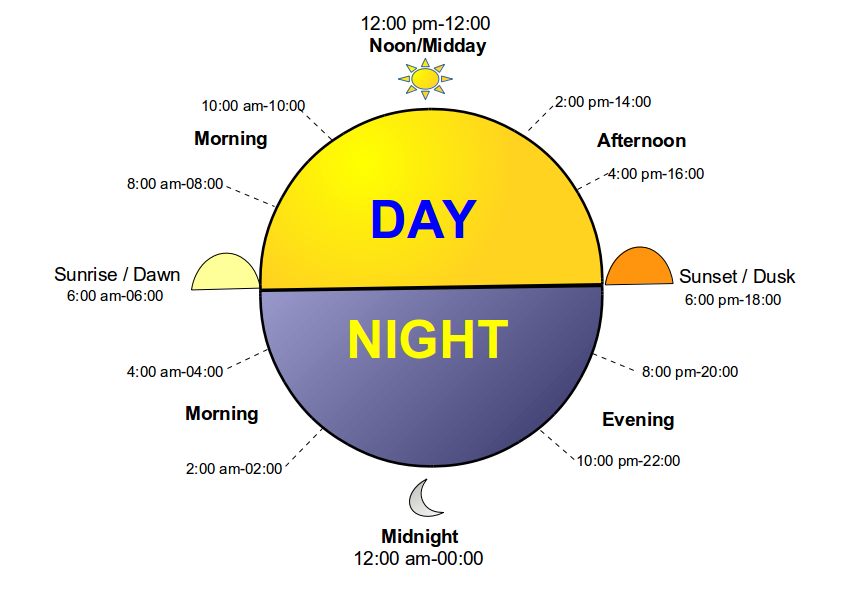
We can add the parts of the day to the clock times to make the time more specific.
In the formal written form, we say:
- am (ante meridiam): in the morning (3 am = three in the morning)
- pm (post meridiam): in the afternoon/evening (3 pm = three in the afternoon)
In the informal oral form, we generally say:
- In the morning (from 00:00 to 12:00)
- In the afternoon (from 12:00 to 18:00)
- In the evening (from 18:00 to 00:00)
- At midday (=12:00; Cat. ‘migdia’)
- At midnight (=00:00; Cat. ‘mitjanit’)
The following image illustrates the meanings of the parts of the day:
Here are some expressions related to clock times:
- What time is it? / What’s the time? (Cat. ‘Quina hora és?’)
- It’s a quarter past four (Cat. ‘És un quart de cinc/Són les quatre i quart’).
- It’s half past seven (Cat. ‘Són dos quarts de set/Són les sis i mitja’).
- What time will you come? (Cat. ‘A quina hora vindràs?’).
- I’ll come at ten (Cat. ‘Vindré a les deu’).
- It’s three in the morning (Cat. ‘Són les tres de la matinada’).
- The day starts at midnight (Cat. ‘El dia comença a la mitjanit’).
- We have lunch at midday (Cat. ‘Dinem al migdia’).
- We’ll start at sunrise (Cat. ‘Ens posarem en marxa a la sortida del sol’).
- Wait until sunset (Cat. ‘Espera’t fins a la posta de sol’).
- I’ll meet you around six (Cat. ‘Ens trobem cap a les sis’).
Notes:
- To say the time when something happens, we must use the preposition at: I’ll come at ten, but we do not use the preposition in questions. We say: what time will you come?. It is wrong to say:
At what time will you come? - To say the approximate time, we can use the prepositions about or around: I’ll meet you around six.
The 12-hour-system
In English, it is not common to use the 24-hour-system, as in Catalan and Spanish. Instead, they use the 12-hour-system:
- 1 am is 01:00h
- 11 am is 11:00h
- 1 pm is 13:00h
- 11 pm is 23:00h
In a formal situation, we say: one a-m; in an informal situation, we must say: one in the morning.
Grammar
In the grammar section, you are going to study the ‘question tags’. These are small questions that we add to a statement to introduce a variety of meanings, as for example, to ask for confirmation that the other person understands what we say or simply to ask a question. Question tags are very much used in speech, especially in British English. You are also going to review the correct use of the prepositions of time and prepositions of place, especially in, on and at, which are often confused.
Question tags
When we speak, it is common to add a question tag. A question tag is a short question that we add at the end of a statement. We use question tags for two purposes:
- To ask a question (with a raising intonation).
- To check if the other person has heard or undestood our statement (with a falling intonation).
The question tag depends on the statement to which it is attached. The rules are these:
1. If the statement is positive, the question tag is negative:
- You’re English, arent you? (Cat. ‘Ets anglès, no?’).
- Mark is training to become an emergency medical technician, isn’t he? (Cat. ‘Mark està fent pràctiques tècnic d’emergències, oi que sí?’).
2. If the statement is negative, the question tag is positive:
- They aren’t in their office, are they? (Cat. 'Oi que no estan al seu despatx?’).
- You didn’t come yesterday, did you? (Cat. ‘Ahir no vas venir, oi que no?’).
3. If the main verb in the statement is an auxiliary verb or a modal verb, in the question tag we use the same verb:
- Laura is from Cornellà, isn’t she? (Cat. ' La Laura és de Cornellà, no?’).
- I should stay at home, shouldn’t I? (Cat. ‘M’hauria de quedar a casa, no creus?’).
4. If the main verb in the statement is not an auxiliary or a modal verb, in the question tag we use the correct form of do:
- David speaks English, doesn’t he? (Cat. ‘El David parla anglès, oi que sí?’).
- You arrived yesterday, didn’t you? (Cat. ‘Vas arribar ahir oi?’).
5. In a question tag, the subject is always the corresponding personal pronoun:
- Mark can swim very well, can’t he? (Cat. ‘El Mark neda molt bé, no?’).
- The people are waiting, arent they? (Cat. ‘La gent està esperant, oi?’).
6. Statements with negative words like never, nobody or nothing, for example, are treated as negative statements:
- Laura never speaks about her family, does she? (Cat. ‘La Laura no parla mai de la seva familia, oi que no?’).
- Nothing happened last night, did it? (Cat. ‘Ahir a la nit no va passar res, a que no?’).
7. If the statement is with the verb have, there are two possible questions tags:
- Mark has little experience, hasn’t he? (Cat. ‘El Mark té poca experiencia, oi que sí?’) (mostly in British English).
- Mark has little experience, doesn’t he? (Cat. ‘El Mark té poca experiencia, oi que sí?’) (mostly in American English).
There are some exceptions to these rules:
- The question tag that corresponds to I am is aren’t I?:
- I’m in your team, aren’t I? (Cat. ‘Estic al teu equip, oi que sí?’).
- I’m doing my job, aren’t I? (Cat. ‘Faig la meva feina, no?’).
- The question tag of a statement with Let’s is shall we?:
- Let’s go, shall we? (Cat. ‘Anem, no?’).
- Let’s be very careful, shall we? (Cat. ‘Anem molt en compte, d’acord?’).
- With there is (and all forms with there), the question tag is isn’t there?:
- There are many problems, aren’t there? (Cat. ‘Hi ha molts problemes, no?’).
- There wasn’t anything to see, was there? (Cat. ‘No hi havia res a veure, a que no?’).
Question tags in Catalan and Spanish
Question tags also exist in Catalan and Spanish. In these two languages, there are several ways of expressing a question tag, but, unlike English, a question tag does not depend on the statement. Here are some ways of expressing question tags in Catalan and Spanish:
- Catalan: oi?, oi que sí?, oi que no?, no?, no creus?, no és veritat?, a que sí?, a que no?, etc.
- Spanish: ¿verdad?, ¿no es cierto?, ¿no crees?, ¿a que sí?, ¿a que no?, ¿no?, etc.
The prepositions of time
The three basic prepositions of time are: in, on and at. We use them to say when an action happens. There are no specific rules to use these three prepositions of time, so we must learn the preposition + the noun.
These are the basic uses of the prepositions of time:
We use IN…
- With years, centuries and historical periods:
- In 2010
- In the 19th century
- In the Middle Ages
- In modern times
- In the present
- In the past
- In the future
- With the names of the months and seasons of the year:
- In April
- In September
- In Winter
- In Summer
- With the parts of the day:
- In the morning
- In the afternoon
- In the evening
- In the night
- With a period of time, to indicate the beginning of an action in the future:
- In a moment
- In five minutes
- In one week
- In three years
We use ON…
- With the days of the week:
- On Monday
- On Tuesday
- On Sunday
- On Fridays
- On weekdays
- With dates and nouns denoting specific dates:
- On 16th June
- On 4th November, 2005
- On the 23rd
- On Christmas Day
- On New Year’s Eve
We use AT…
- With clock times and nouns denoting clock times:
- At 6 o’clock
- At a quarter past eight
- At 2 pm
- At midnight
- At midday
- At sunset
- At dawn
- At night
- With names of holidays and with the noun ‘weekend’:
- At Christmas
- At Easter
- At the New Year
- At the weekend
Some differences between the prepositions of time
At vs On:
- At is used to speak about holidays and weekends in general:
- We usually stay at home at Christmas (Cat. ‘Normalment ens quedem a casa per Nadal’).
- On is used to speak about a special day or weekend:
- We usually stay at home on Christmas Day (Cat. ‘Normalment ens quedem a casa el dia de Nadal’).
- The meeting took place on the last weekend of June (Cat. ‘La reunió va tenir lloc el darrer cap de setmana de juny’).
In vs On:
- In is used to speak about parts of the day:
- I work in the morning (Cat. ‘Treballo pel matí’).
- On is used to speak about a part of the day in particular:
- I arrived on the morning of the ninth of November (Cat. ‘Vaig arribar el matí del nou de novembre’).
- It happened on a cold winter morning (Cat. ‘Va passar un fred matí d’hivern’).
At vs In:
- At is used to speak about any night in general:
- I don’t like working at night (Cat. ‘No m’agrada treballar de nit’).
- In is used to speak about one particular night:
- I met him in the night of the tenth (Cat. ‘El vaig conèixer la nit del dia 10’).
- I couldn’t sleep in the night because I was very nervous (Cat. ‘No vaig poder dormir per la nit perquè estava molt nerviosa’).
Apart from the prepositions in, on and at, there are other prepositions of time:
- Before (Cat. ‘Abans de’):
- Before 1980 (Cat. ‘Abans de l’any 1980’)
- Before Christmas (Cat. ‘Abans del Nadal’)
- Before going to work / Before you go to work (Cat. ‘Abans d’anar a la feina’)
- After (Cat. ‘Després de’):
- After the meeting (Cat. ‘Després de la reunió’)
- After the holidays (Cat. ‘Després de les vacances’)
- After listening to him / After you listen to him (Cat. ‘Després d’escoltar-lo’)
- Between (Cat. ‘Entre’):
- Between the 7th and the 10th May (Cat.'Entre el 7 i el 10 de maig’)
- Between 9 and 10 (Cat. ‘Entre les 9 i les 10’)
- Between the time you arrive and lunchtime (Cat. ‘Entre l’hora que arribis i l’hora de dinar’)
- During (Cat. ‘Durant’):
- During the week (Cat. ‘Durant la setmana’)
- During the holidays (Cat. ‘Durant les vacances’)
- During the meal (Cat. ‘Durant el dinar’)
- Until (Cat. ‘Fins a’):
- Until 8:30 this evening (Cat. ‘Fins aquesta tarda a les 8:30h’)
- Until next Winter (Cat. ‘Fins el proper hivern’)
- Until you finish your work (Cat. ‘Fins que acabis la feina’)
- From…to/until (Cat. ‘Des de…fins a…’):
- From 2003 to 2006 (Cat. ‘Des del 2003 fins al 2006’)
- From the morning until the evening (Cat. ‘Des del matí fins a la tarda’)
- From May to July (Cat. ‘Des de maig fins a juliol’)
- From 6 to 7 (Cat. ‘Des de les sis fins a les set’)
- For (Cat. ‘Durant [tot el període]'):
- For ten days
- For more than one year
- For one moment
- Since (Cat. ‘Des de’):
- Since yesterday
- Since last week
- Since I was younger
We generally place the prepositions before a noun, but there are two exceptions:
- They can also go before a clause:
- Before you leave (Cat. ‘Abans de marxar’)
- After you meet Mr Smith (Cat. ‘Després de conèixer el Sr Smith’)
- Until you see the new office (Cat. ‘Fins que vegis el nou despatx’)
- Since I met you (Cat. ‘Des de que et conec’)
- Or before a verb (always in present participle):
- Before speaking (Cat. ‘Abans de parlar’)
- After talking to Mr Smith (Cat. ‘Després de parlar amb el Sr. Smith’)
There might be some confusion between the prepositions for and during:
For the difference between for and since, see “The present perfect”, in the grammar of the section called “The fruit orchard” in the unit “Agricultural production”.
- During expresses something that happened in the middle of a period of time. For example: I wrote the article during the holidays (Cat. ‘Vaig escriure l’article durant les vacances’).
- For expresses something that happened throughout the whole period of time, that is, from the beginning to the end of the period. For example: Yesterday I worked for 10 hours (Cat. ‘Ahir vaig treballar durant 10 hores/Ahir vaig treballar 10 hores seguides’).
The prepositions of place
We can distinguish two types of prepositions of place: prepositions indicating position and prepositions indicating movement.
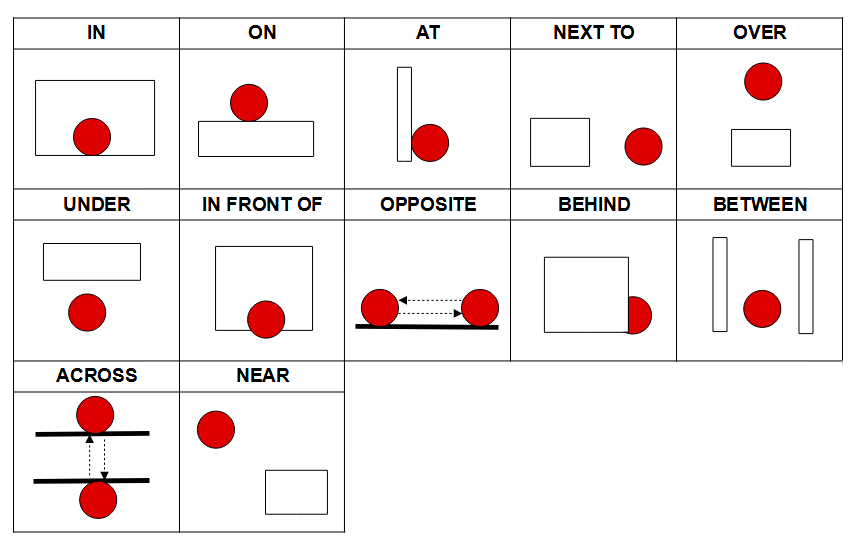
Prepositions of place (position):
We use them with static verbs, that is, verbs that do not denote movement (for example: be, stay, live, sit, work…). They are placed before a noun phrase.
The image below illustrates the meaning of the most common prepositions of place (position):
Some prepositions are easily confused:
Prepositions can be very confusing. You must learn the preposition + the noun as a whole rather than learning the meaning of a preposition alone.
IN / ON / AT:
In means inside (Cat. ‘a’, ‘dintre de’). Examples:
- in the street (Cat. ‘al carrer’)
- in the house (Cat. ‘dins de casa’)
- in the office (Cat. ‘al despatx’, ‘a l’oficina’)
- in the forest (Cat. ‘al bosc’)
- in London (Cat. ‘a Londres’)
- in the corner (Cat. ‘al racó’)
- in an armchair (Cat. ‘en una butaca’)
On means on top of (Cat. ‘a’, ‘al damunt de’). For example:
- on the table (Cat. ‘damunt la taula’)
- on the wall (Cat. ‘a la paret’)
- on the floor (Cat. ‘a terra’)
- on the corner (Cat. ‘a la cantonada’)
- on a chair (Cat. ‘a una cadira’)
- on a sofa (Cat. ‘en un sofà’)
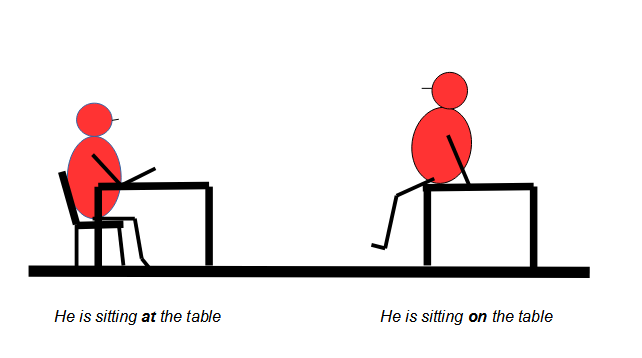
At has a general sense (Cat. ‘a’). For example:
- at the table (Cat. ‘a la taula’)
- at the window (Cat. ‘a la finestra’)
- at the door (Cat. ‘a la porta’)
- at the cinema (Cat. ‘al cinema’)
- at home (Cat. ‘a casa’)
- at work (Cat. ‘a la feina’)
- at school (Cat. ‘a l’escola’)
Note that we can say: on the table and at the table. The image below illustrates the difference between both phrases:
IN FRONT OF / OPPOSITE:
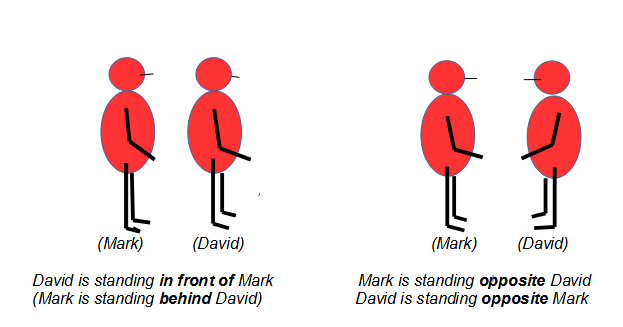
In front of (Cat. ‘davant de’) has a general sense. It means that a person or thing is on a frontal position. The opposite of in front of is behind (Cat. ‘darrera’). For example:
- There are two people in front of me (I’m behind them) - Hi ha dues persones davant meu (jo estic al seu darrera).
- There’s a car parked in front of the building - Hi ha un cotxe aparcat davant de l’edifici.
- I don’t like speaking in front of a large audience - No m’agrada parlar davant de molta gent.
Opposite (Cat. ‘davant de’) means that a person or thing is on the other side of a place, facing each other. We often use opposite to speak about places on the other side of the street (the same as across). For example:
- We were sitting opposite each other - Estavem asseguts l’un al davant de l’altre.
- The bank is opposite the park (also: the bank is across the park) - El banc està al davant del park.
The image below shows the basic difference between the prepositions in front of and opposite:
Prepositions of place (movement):
The prepositions of place can indicate position (where something is situated), but they can also indicate movement towards a place (where something is going). Here is a list of the prepositions used to indicate movement:
- To (Cat. ‘a’, ‘cap a’)
- Into (Cat. ‘cap a dins de’)
- Onto (Cat. ‘cap el damunt de)
- Along (Cat. ‘per’, ‘al llarg de)
- From (Cat. ‘de’, ‘des de’)
- In front of (Cat. ‘cap al davant’)
- Behind (Cat. ‘cap el darrera’)
- Across (Cat. ‘a través de’)
The image below represents the prepositions of place that indicate movement:
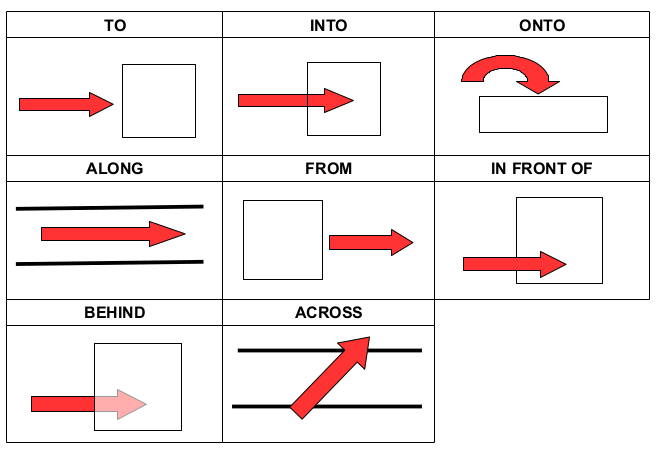
We obviously use these prepositions with verbs that indicate movement, for example: go (Cat. ‘anar’), drive (Cat. ‘conduir’), walk (Cat. ‘caminar’), run (Cat. ‘córrer’), fly (Cat. ‘volar’), put (Cat. ‘posar’), etc. Here are some examples:
- I am flying to London (Cat. ‘Estic volant cap a Londres’).
- He is running into the room (Cat. ‘Entra corrents a l’habitació’).
- Put the boxes onto the table (Cat. ‘Posa les caixes sobre la taula’).
- I am coming from the office (Cat. ‘Vinc de l’oficina’).
- They are walking behind the house (Cat. ‘Estan caminant cap a darrera de la casa’).
But we do not use a preposition with the noun home: I am going home (Cat. ‘Vaig cap a casa’). It is wrong to say: I am going to home.
Other prepositions
Other important prepositions are:
- With (Cat. ‘amb’)
- Without (Cat. ‘sense’)
- Of (Cat. ‘de’)
- For (Cat. ‘per a’)
- By (Cat. ‘per’)
Examples:
- I work with very interesting people (Cat. ‘Treballo amb gent molt interessant’).
- He left without saying goodbye (Cat. ‘Va marxar sense dir adéu’).
- February is the second month of the year (Cat. ‘El febrer és el segon mes de l’any’).
- Is this present for me? (Cat. ‘Aquest regal és per a mi?’).
- The job was finished by Peter (Cat. ‘La feina va ser acabada per en Peter’).