



Non-verbal communication
Communication is the process by which information is exchanged through the use of sounds, which properly arranged form what is usually called a language. Verbal communication, then, refers to the use of words, which are organised in sentences in accordance to the syntactical rules of a particular language. On the other hand, non-verbal communication refers to the communicative process in which the information is transmitted by means of what is called body language, which includes gestures, body position, face expressions and specific behaviour. In our daily life, we normally use a combination of verbal and non-verbal communication.
When we speak of communication, we usually think of language, that is, we think of verbal communication. However, non-verbal communication is often more important than language itself, especially when we have to deal with other people, where you often have to transmit or understand more things than language can express. When we communicate with another person, non-verbal communication adds a lot of things to the message that we hear or that we transmit.
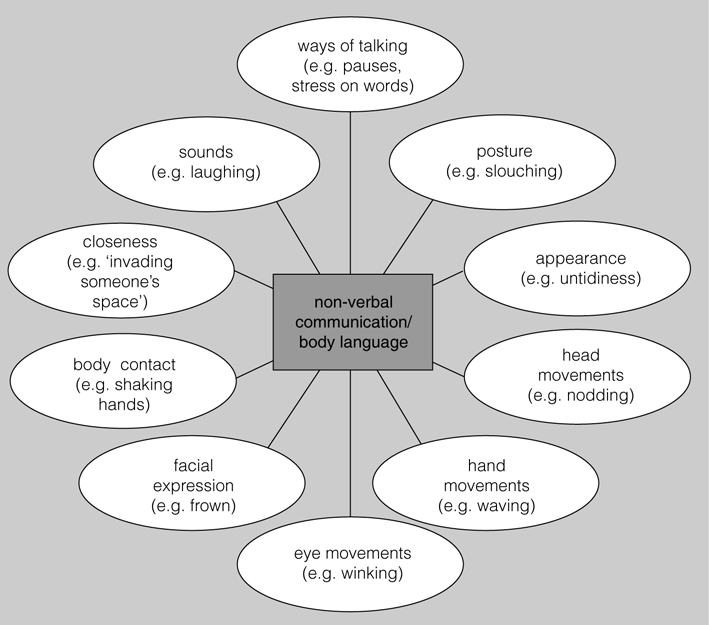
For this reason, understanding non-verbal communication is very important when we have to deal with other people in our daily work. This type of communication can reinforce our messages or it can conceal the messages that we do not want to transmit. Non-verbal communication covers a range of factors, which may include body language, tone, appearance and the physical surroundings.
Body language is very much used in the sales field, for example. Salespeople are trained to observe and interpret the body language of potential customers in order to understand their non-verbal signals and so increase the probability of sales success. As you can see in the figure above, there are many examples of body language.
In sales, the careful control of body position, eye contact and hand movements will contribute to a better communication with the public. For this reason, it is very important to control your non-verbal communication skills.
Some behaviours are considered positive, as they are generally considered to encourage communication, whereas others show anxiety, aggression, boredom and other negative feelings. Direct eye contact, scratching your nose, arms crossed on chest, standing with hands on hips, sitting with your legs apart, placing your hand on your cheek, open palms, drumming fingers, tilted head …. these are all examples of negative and positive feelings transmitted by body language. Therefore, it is very important to control such language and use it consciously to transmit the appropriate message in each specific situation. However, focusing on body language alone can cause some misinterpretations.
There are other aspects which we should consider, as for example personal space. When two people are talking to each other, they tend to stand at a specific distance apart. The average personal distance may vary from one culture to another and depending on the relationship between the people. In general, Americans tend to require more personal space than in other cultures, whereas in Latin cultures the distance is smaller and people tend to feel more comfortable standing close to each other.
Another issue to take into account when we want to communicate effectively is trying to avoid physical contact while you are speaking, as this may lead to discomfort for the person with whom you are talking. In Anglo-Saxon cultures, touching the other person while speaking is considered a bit too intimate for casual acquaintances, whereas in Latin cultures there is a greater tendency to touching.
In conclusion, learning a language does not only mean to learn the grammar rules and the vocabulary and then practice the different skills. Learning a language also means to control the body language that applies to.
Grammar: the present tenses
The verbs are the parts of the speech that describe the action, the existence or the state of the subject. The verbs are usually inflected. This means that they can take different forms, depending on the person of the subject (first, second or third person), the number (singular or plural) and the tense, which describes how and when the action takes place.
The present tenses are those which are used to refer to the present. There are two present tenses: the present simple and the present continuous.
The present simple
The present simple is used to express a regular, habitual action. It also describes permanent states and universal truths. The present simple usually appears in the sentence with adverbials of time that indicate regular actions, like “everyday”, “once a week”, “on Sundays”, etc. The verbs in present simple are also used with the adverbs of frequency.
Unlike Catalan and Spanish, and the Romanic languages in general, the conjugation of the English verbs is very simple. The verb “to be” has three different forms in the present simple, but the greatest majority of the other verbs only have two forms. If you compare the conjugation of any English verb with all the different forms of the Catalan verbs, you will see the simplicity of the English verb system.
The following table shows the conjugation of the verb “work” in present simple:
| Affirmative | Negative Long form | Short form | Interrogative | |
|---|---|---|---|---|
| I | work | do not work | don’t work | Do I work …? |
| You | work | do not work | don’t work | Do you work …? |
| He / She / It | works | does not work | doesn’t work | Does he work…? |
| We | work | do not work | don’t work | Do we work …? |
| You | work | do not work | don’t work | Do you work…? |
| They | work | do not work | don’t work | Do they work…? |
Notice the following:
The base form of a verb is the form without any inflections. For example, “go”, “be”, “speak”, etc. It is the form which we find in the dictionary entries.
- In the third person singular, that is, when the subject is “he”, “she” or “it” (or a noun in the third person singular), the verbs in present simple add an -s. All the other forms are the same as the base form.
- The present simple forms the negative and the interrogative with the auxiliary “do”, which takes the form “does” in the third person singular. With the auxiliary “do”, the verb is always in the infinitive.
Now let’s see some examples of the use of the present simple.
- Habitual actions:
- I get up at seven o’clock everyday. (Cat: Em llevo a les set cada dia)
- John plays tennis on Sundays. (Cat: John juga al tennis els diumenges)
- We never smoke at work. (Cat: No fumem mai a la feina)
- My friend always helps me (Cat: El meu amic sempre m’ajuda)
- Permanent states:
- Australia is a very big country. (Cat: Austràlia és un país molt gran)
- Poor Mary has got a serious problem. (Cat: La pobra Mary té un problema seriós)
- Universal truths:
- The sun rises in the east. (Cat: El sol surt per l’est)
- Water boils at 100ºC. (Cat: L’aigua bull als 100ºC)
The present continuous
The present continuous form is used to express an action that is taking place at the moment of speaking. It is also used for temporary actions, that is, actions that take place only for a certain period of time. Compare this use with the present simple, which expresses permanent actions. For all this, the present continuous usually appears with adverbials like “now”, “at this moment”, “at present”, “this week”, etc., adverbials which indicate that the action is either taking place at the moment or is temporary.
The present continuous is a compound verb. The structure is:
- AUXILIARY “BE” (in present) + VERB ENDING IN -ING
The table below shows the conjugation of the verb “work” in the present continuous.
| Affirmative | Negative Long form | Short form | Interrogative | |
|---|---|---|---|---|
| I | am working | am not working | ‘m not working | am I working …? |
| you | are working | are not working | aren’t working | are you working …? |
| he, she, it | is working | is not working | isn’t working | is he working …? |
| we | are working | are not working | aren’t working | are we working …? |
| you | are working | are not working | aren’t working | are you working …? |
| they | are working | are not working | aren’t working | are they working …? |
Here are some examples of the use of the present continuous:
- Actions taking place at the moment of speaking:
- Look! It is snowing. (Cat: Mira! Està nevant)
- I think that they are speaking Russian. (Cat: Crec que estan parlant rus)
- We are not doing anything now. (Cat: Ara no estem fent res)
- Temporary actions:
- Sarah usually lives in London, but she is living in Boston this month. (Cat: Sarah normalment viu a Londres, però aquest mes està vivint a Boston)
- I always go to work by car, but I am taking the bus this week. (Cat: Sempre vaig a treballar amb cotxe, però aquesta setmana agafo l’autobús)
Notice the contrast between the present simple and the present continuous in the two last examples. The sentence in present simple indicates what the subject does regularly whereas the sentence in the present continuous indicates a temporary action, one which only takes place that month or that week.
In English the present continuous is more widely used than in Catalan. Notice how in the last example above, the present continuous tense is translated with the present simple.
There are some verbs which are not used in the present continuous although they indicate an action that is taking place at the moment of speaking or a temporary action.
Some of these verbs are: love, like, enjoy, hate, prefer, want, think, remember, doubt, understand, know, believe, see, have (in the sense of possession), own.
Vocabulary: frequency adverbs
Frequency adverbs are those which indicate the frequency of an action. They answer questions with the interrogative pronoun “How often…?” (Cat: Amb quina freqüència…?)
Here is a list of the most important frequency adverbs in descending order of frequency (from highest to lowest):
- Always (Cat: sempre)
- Usually (Cat: normalment)
- Often (Cat: sovint)
- Sometimes (Cat: algunes vegades)
- Seldom (Cat: poques vegades)
- Never (Cat: mai)
Apart from these adverbs, there are some adverbial expressions which are also used to indicate the frequency of an action. For example:
- Once, twice, three times a week (Cat: una, dues, tres vegades a la setmana)
- Everyday (Cat: cada dia)
- Every year (Cat: cada any)
- From time to time (Cat: de tant en tant)
All these adverbs and adverbial expressions usually appear in sentences with the verb in the present simple because they express the idea that the action takes place at regular intervals.
When using a frequency adverb it is very important to place them in their right position within the sentence. In general, the frequency adverbs are placed after the modal and auxiliary verbs and before all the other verbs. The adverbial expressions are placed at the beginning or at the end of the sentence.
The only exception to the rule is the adverb “sometimes”, which can go at the beginning, in the middle (after modal verbs and before all the other verbs) or at the end of the sentence. For example:
Sometimes he speaks very fast / He sometimes speaks very fast / He speaks very fast sometimes (Cat: De vegades parla molt de pressa)
Notice that in Catalan the position of the adverbs is much more flexible than in English.
Here are some more examples of the use of frequency adverbs and adverbial expressions:
- He always arrives late (Cat: Sempre arriba tard)
- He can never do the shopping (Cat: no pot fer mai la compra)
- He is usually at home in the mornings (Cat: Normalment és a casa als matins)
- They seldom use the typewriter (Cat: Poques vegades utilitzen la màquina d’escriure)
- Frank works at home twice a week (Cat: Frank treballa a casa dues vegades a la setmana)
- From time to time, I like eating out (Cat: De tant en tant m’agrada menjar a fora)
Connectors and punctuation
In writing, it is very important to use connectors in order to link the different sentences together and give internal cohesion to the text. A text without connectors is sometimes hard to read and does not transmit the ideas clearly because without connectors the ideas are not related to each other and, therefore, part of the information is missed. However, an excessive use of connectors may alter the fluency of a text. We can combine connectors and punctuation marks to link the different ideas and create fluent, well-written texts.
Connectors
Connectors are words that link ideas and show how these ideas are related to one another in the text. They help you organize your written texts and make them easy for the reader to understand them.
Next you will find a list of English connectors and their Catalan equivalents. They are classified according to the logical relationship between sentences or parts of a sentence. We have also added an example of their use.
Positive addition:
- And - i (‘I like reading and listening to music’)
- As well as - així com (també) (‘I play football as well as handball’)
- Also / too / as well - també (‘He likes music. - I also like music / I like music, too. / I like music as well’.)
- Besides / Moreover / In addition - a més a més (‘It rained all the time. Besides, it was cold. / Moreover, it was cold. / In addition, it was cold’.)
Negative addition:
- Or - ni (‘I don’t like getting up early or going out at night’)
- Neither … nor - ni … ni (‘We neither went to work nor stayed at home’)
- Either - tampoc (‘He doesn’t like music - I don’t like it either’)
Disjunctive conjunctions
- Or - o - (‘Do you prefer red or green?’)
- Either … or - o… o (‘I like it either red or green, but not blue’)
Condition:
- If - si (‘I will help you if you want’)
- Unless - a menys que, si no (‘We can eat outside unless it’s very cold’)
Contrast:
- But - però (‘It’s quite good but very cheap’)
- However - malgrat tot, no obstant (‘It’s quite good. However, it’s very cheap’)
- Although / even though - tot i que, encara que (‘It’s quite good although/even though it’s very cheap.’)
- In spite of - malgrat (‘In spite of the rain, we had a great time’)
- While / whereas - mentre que (‘In the morning it was fine whereas/while in the evening it rained very hard’)
- On the other hand - per altra banda (‘I was tired. On the other hand, I had not eaten anything’)
- On the one hand … on the other hand - per una banda … i per l’altra ('On the one hand, I was tired. On the other hand, I had not eaten anything’)
- On the contrary - Al contrari (‘It was not cold. On the contrary, we were very hot all the time’)
Exception:
- Except for - excepte, llevat de (‘I finished them all except for two or three / Except for two or three, I finished them all’)
- Apart from - a part de (‘Apart from Tom, nobody came to the party / Nobody came to the party apart from Tom’)
Explaining ideas:
- That is to say / That is - és a dir (‘It was snow white, that is to say, very white’)
- In other words - en altres paraules (‘It was snow white. In other words, it was very white’)
Giving examples:
- Like - com (‘We saw many wild animals like foxes and rabbits’)
- Such as - com ara (‘We saw many wild animals such as foxes and rabbits’)
- For example - per exemple (‘We saw many wild animals. For example, foxes and rabbits.’)
- As for example - com per exemple (‘We saw many wild animals as for example foxes and rabbits’)
Describing similarity:
- Similarly - de manera semblant (‘I wrote a report. Similarly, John wrote all the letters we had to send.’)
- In the same way - de la mateixa manera (‘I wrote a report. In the same way, John wrote all the letters we had to send.’)
Listing ideas:
- At first / firstly / In the first place / to begin with / first of all - primerament, en primer lloc, per començar, abans de res (At first, /Firstly, /In the first place, /To begin with, /First of all, I got up.)
- Secondly / After this / Next / Then - en segon lloc, després d’això, a continuació, aleshores (Secondly, /After this, /Next, /Then, I had breakfast.)
- Finally / in the end - finalment, al final (Finally, /In the end, I went to work.)
Time:
'After' and 'Afterwards'
Do not confuse the meaning of these two connectors: “after” is a preposition and must be followed by a noun: after the class. “Afterwards” is an adverb and is followed by a sentence, from which it is separated by a comma in the written language: Afterwards, I went out. The meaning of “afterwards” and “then” is the same.
- When - quan (‘He called me when I wasn’t at home.’)
- Whenever - sempre que (‘You can come whenever you want.’)
- As soon as - tan aviat com, així que (‘Please call me as soon as you arrive home.’)
- While - mentre (‘I was trying to concentrate while he was playing the drums.’)
- Meanwhile - mentrestant (‘He was playing the drums. Meanwhile, I was trying to concentrate.’)
- Before - abans de (‘Please turn off the lights before leaving the office/…before you leave the office.’)
- After (prep.) - després de (‘We went out after the rain.’)
- Afterwards (adv.) - després, a continuació (‘It stopped raining. Afterwards, we went out.’)
- Then - aleshores (‘It stopped raining. Then, we went out.’)
- Since - des que (‘I’ve been waiting since I arrived this morning’)
- until - fins a (‘I’ll wait until you come.’)
Purpose:
- To / in order to - per tal de, per a (‘I went out to / in order to see the Carnival parade.’)
- In order not to - per a no (‘I didn’t go to work in order not to meet Jane.’)
Reason and cause:
- As - com que, ja que (‘As it was raining, we stayed at home.’)
- Because - perquè (‘We stayed at home because it was raining.’)
- Because of / Due to - a causa de, degut a (‘We stayed at home because of / due to the rain.’)
- As a result of - Com a conseqüència de (‘As a result of the rain, we stayed at at home / We stayed at home as a result of the rain’.)
Result:
- So - per tant, així que, de manera que (‘It was raining so we stayed at home.’)
- Therefore - en conseqüència, per tant (‘It was raining. Therefore, we stayed at home.’)
- For this reason - per aquesta raó (‘It was raining. For this reason, we stayed at home.)
Summarising:
- In conclusion - en conclusió (‘We spent everything we had. In conclusion, we have no money for you.’)
- In short - en resum, en poques paraules (‘We spent everything we had. In short, we have no money for you.’)
- To sum up / summing up - resumint (‘We spent all the money we had. To sum up,/Summing up, we have no money for you.’)
All these connectors are used much in the same way as their Catalan equivalents. As you read a text in English, you should study the connectors carefully and see how they are used.
Now read an example of a short text with some connectors (in bold):
Although the Internet has some advantages because it is useful to broaden your knowledge and meet new people, it also has some disadvantages due to, for example, its free access to pages which show cruel violence and crimes. On the one hand, there are people who think that the Internet should be a free space to express ideas. On the other hand, some people consider that the Internet can be dangerous if its use is not controlled. In conclusion, the Internet has both advantages and disadvantages, but people must learn to use it for positive aims.
Next read that same text without connectors and compare:
The Internet has some advantages. It is useful to broaden your knowledge and meet new people. It has some disadvantages. Its free access to pages which show cruel violence and crimes. There are people who think that the Internet should be a free space to express ideas. Some people consider that the Internet can be dangerous. Its use is not controlled. The Internet has both advantages and disadvantages. People must learn to use it for positive aims.
Punctuation marks
Apart from connectors, when you are writing a text it is also important to consider the punctuation marks and use them correctly. You should remember that punctuation also includes the use of capital letters, which in English are used differently from Catalan and Spanish. Punctuation marks seem unimportant and we do not usually pay much attention to writing commas or stops, but they contribute to give cohesion to the text, so we should use them carefully and combine them with the connectors. We are going to give some tips to produce a coherent text and to explain the most important uses of the punctuation marks.
First of all, try to write short sentences in order to keep the word order more easily. As you advance in your knowledge of English, you can write longer and more sophisticated sentences, but at first it is advisable to write simple sentences. You should organise your text into different paragraphs to separate the different blocks of information. As with sentences, you should avoid long paragraphs. Each paragraph should refer to the same idea or to secondary ideas related to the main one.
As for punctuation, remember the following:
Other uses of capital letters
Apart from its common use in punctuation, a capital letter is always used with the pronoun “I”, the adjectives derived from proper names (English, Londoner, etc.) and with days of the week (Monday, Tuesday, etc.). As in Catalan, capital letters are also used in all the proper names.
- Do not write a comma (,) between the subject and the verb although the subject is very long.
- Write a full stop (.) at the end of a sentence. If the sentence ends with a question mark (?) or with an exclamation mark (!), then you must not write the full stop.
- Adverbials and connectors at the beginning of a sentence are usually separated from the sentence by a comma. Example: Nowadays, computers are very fast. / In the first place, click on the program icon.
- Write a colon (:) to introduce a list of items or an explanation. Example: the continents are: Europe, Asia, Africa, America and Oceania.
- Write a comma to separate the elements in a list, except those separated by “and” or “or”. Example: the days of the week are Monday, Tuesday, Wednesday, Thursday, Friday, Saturday and Sunday.
- Use the semi-colon (;) to separate the groups of items in a list. Example: In computing we must distinguish between hardware and software. Hardware refers to the material parts of a computer (keyboard, monitor, printer, loudspeakers, etc.); software refers to programming and includes operating systems, compilers, editors, etc.
- Use the brackets to add some extra information to a sentence. Example: Websites usually have a home page (a beginning page).
- Write a capital letter at the beginning of the sentence or after a full stop.
Writing a summary
We write a summary to explain the main ideas of a text in a few sentences.
When writing a summary, we should remember the following:
- Only include the most important information.
- Do not include information that is not important, as for example, details, direct speech, examples to illustrate the ideas, etc.
- Do not express your own opinion or add information that is not in the text.
As in everything else, writing a good summary requires some practice. Here are some ideas to help you:
- First of all, read the text to get a general idea of its contents.
- Read the text again and underline the three or four most important ideas.
- Without looking at the text again, write a few sentences about the text from memory. Try to use alternative words.
- Read the text again and check your summary. Make sure that you have included all the important information and that you have not copied from the text.
- If you think that the summary is too long, cut out the unnecessary details.
Here is some useful language that you can use in your summaries:
- Connectors to express contrast: In spite of, despite, although, however.
- Connectors to add information: In addition, also, too.
- Connectors to express reason and result: This is so because, because, so, therefore.
- Relative clauses: The film, which is about a safari, shows that… The statement that he gave in March is no longer true.
Here is an example of a summary.
Text
The Island
In recent years, we have seen significant developments in cloning. Sheep, cows, cats and, more recently, dogs that have been cloned in the name of scientific progress. One of the potential uses of cloning is to ‘grow’ replacement organs in human clones for people who are ill. It is this subject that is portrayed in a new film released this week in the USA called ‘The Island’.
The film features Ewan McGregor and Scarlett Johansson and it raises awareness of this highly controversial moral issue. However, in spite of excellent performances from both main actors and spectacular special effects, the film received a disappointing reaction from American audiences. It is possible that the subject is too difficult and that some audiences prefer thrillers without the moral dilemmas. The film opens in the UK next week and it will be interesting to see how the British audiences react.
Summary
The new film ‘The Island’, which deals with the controversial subject of cloning people, has not been received well in the USA. Although the acting and effects are very good, some audiences may have been disappointed by the moral message of the film.