



Human Resources Department
The Human Resources Department is the division of a company focused on activities related to employees. These activities normally include recruiting and hiring of new employees, orientation and training of current employees, employee benefits (health, medical and life insurance), and retention. Furthermore, they act as intermediaries in dispute resolution. It is the job of the human resources department to handle all employees’ complaints against other workers at the company.
Another function of this department is risk management, including workers’ compensation or safety inspection. They are also in charge of payroll administration, dealing with sick leaves and vacation time.
The Hiring Process
-

- Employees access door. Source: Unsplash - Olivier Collet.
With so many people looking for a job, finding people to work for a company might seem very easy. However, finding and recruiting the best quality candidates is not an easy task. This is one of the jobs of the Human Resources Department (HR), they recruit the best people for the organization.
Large companies usually have a formal hiring process which involves different steps. First, the decision is made whether recruitment is necessary, then the job description is prepared. The needs of the organization should be described in the job advertisement. In general, a job announcement should include: a brief description of the organisation, a description of the position, the duties and responsibilities, the qualifications required for the post, the salary and benefits attached to the post, the application deadline, the start date and a request for references. Once the description is prepared, plans are made on how and when this will be advertised.
After receiving the applications, candidates are usually invited for interviews and selection tests. Psychometric tests help to assess an individual’s character and abilities, and they are often used to ensure that a candidate is suitable for a specific role. The most frequent kinds of psychometric tests measure cognitive abilities, e.g. numerical and verbal reasoning tests. In addition, many test batteries evaluate personality traits and decision making, e.g. personality questionnaires and Situational Judgement Tests (SJT).
See the translation of some words from the text:
| Application deadline: termini de sol·licitud | Need:necessitat |
| Assess: avaluar | Outstanding: remarcable |
| Available: disponible | Payroll: nòmina |
| Cognitive ability: habilitat cognitiva | Personality trait: tret personal |
| Complaint: queixa | Psychometric test: test psicomètric |
| Current: actual | Recruit: contractar |
| Duties: deures | Reduce: reduir |
| Employee: treballador, empleat | Request references: demanar referències |
| Health: salut | Retain: retenir |
| Hire: contractar, llogar | Reward: recompensar |
| Human Resources: recursos humans | Risk management: gestió de riscos |
| Investment: inversió | Role: paper, funció |
| Job advertisment: anunci de feina | Sick leave: baixa (de la feina) |
| Job-seeker: persona que busca feina | Suitable: adequat |
| Life insurance: assegurança de vida | Vacation time: període vacacional |
| Look for: buscar | Wider range: gamma més àmplia |
Diana Thompson works for the Human Resources Department of “New Creations”. She gives us some details about her job:
Diana Thompson

“My job consists of getting the best candidate for the different posts of the company. It means that I need to have a good knowledge of every department of the company, the members that compose them, and the tasks performed in each of them.
When I interview someone, I always have my notebook with me. Taking notes is vital, specially when the number of people you interview grows. Things that we look at are the body language; non-verbal language gives you more information about the person who is in front of you than you might expect. I may, for example, write, “Seemed most enthusiastic about this job” or “Avoided eye contact at this point; seemed nervous.” However, it could represent a 60% of the analysis. Of course, qualifications and skills will help you to make the final decision.
I would advise an interviewer to strike a balance between active note-taking and active listening. While taking good notes is important, so is maintaining eye contact and engaging in a conversation that will elicit the information you need to learn.
Interviewing potential candidates is one of my tasks, but apart from this, I make all the arrangements for receiving visitors, I plan their picking up, the reception, the agenda of the meeting, I take them around the company, show them the facilities and do presentations.
I know that in some small companies, human resources clerks are also in charge of issuing the employees’ payrolls, and some other accounting tasks, but this is not my case. I must say I love my job.“
Grammar: Passive sentences
Read the following passivesentences:
| The employees’ payrolls have been issued | S’han emès les nòmines dels empleats |
| The visitors will be shown the facilities | Se’ls mostraran les instal·lacions als convidats |
| Conflicts at work are dealt with by the HR manager | Els conflictes de la feina són tractats pel director de recursos humans |
Passive voice occurs when the person or thing performing the action in a sentence is the object rather than the subject. Compare these two sentences:
- Active sentence: Diana organized the welcoming party
- Passive sentence: The welcoming party was organized by Diana
Structure of passive sentences
Let’s see the structure of the passive sentences. Here is our example:
- The welcoming party was organized by Diana
The basic elements are three:
- The subject: The welcoming party… is the object of the active sentence. In the passive sentences, the subject receives the action of the verb.
- The verb: …was organized…. The passive form of the verb is composed of two elements: BE (in the appropriate verb tense) + PAST PARTICIPLE (invariable).
- The agent: …by Mary: the agent is the person who does the action of the verb. It is introduced by the preposition by. It can often be omitted.
Like the past simple, the past participle of the regular verbs ends in -ed. For the irregular verbs, see the forms in a list of irregular verbs.
Negative and interrogative passive sentences
To express a passive sentence in the negative or the interrogative, we use the verb ‘be’:
- Negative: The welcoming party was not organized by Diana - La festa de benvinguda no va ser organitzada per la Diana
- Interrogative: Was the welcoming party organized by Mary? - La festa de benvinguda va ser organitzada per la Diana?
Use of the passive voice
We use the passive voice in these cases:
- When we don’t know who did the action or when it is obvious:
| English is required to work in an international team | Per a treballar en un equip internacional, es requereix l’anglès |
| The fire has not been extinguished yet | El foc encara no s’ha apagat |
| English is spoken in many countries | L’anglès es parla a molts països |
- When we want to give more importance to the action than to the person who did the action:
| The company was founded in 2002 | L’empresa es va fundar/va ser fundada l’any 2002 |
| The victim was taken to hospital | La víctima va ser portada a l’hospital |
Changing from an active sentence to a passive sentence
The change from the active voice to the passive voice will help you understand the differences between these two types of sentences. Here is an example to illustrate the changes:
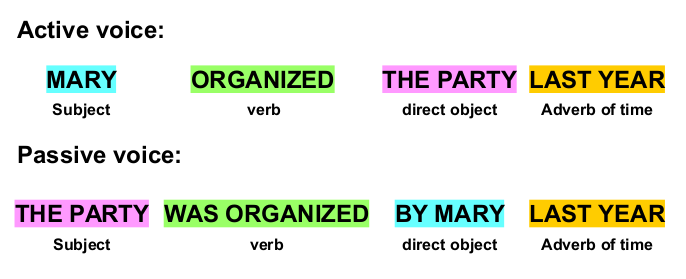
Notice the following:
- The subject in the active sentence becomes the agent in the passive sentence.
- The direct object in the active sentence becomes the subject in the passive sentence.
- The verb changes from the active voice to the passive voice.
Notes:
- When the subject of the active sentence has an impersonal meaning like people, someone/somebody or no one/nobody, we do not usually express the agent in the passive voice.
- When the subject of the active sentence is a subject pronoun (I, you, he, etc.), the agent corresponds to the object pronoun: by me, by you, by him, etc.
The table shows the passive voice of some common tenses of an irregular verb (do, in the 3rd person singular):
| Verb tense | Active voice | Passive voice |
|---|---|---|
| Present simple | does | is done |
| Present continuous | is doing | is being done |
| Past simple | did | was done |
| Past continuous | was doing | was being done |
| Present perfect | has done | has been done |
| Future | will do | will be done |
| Infinitive | (to) do | (to) be done |
Passive sentences with two objects
Some sentences have an indirect object and a direct object. When this happens, the two objects can become the subject of the passive sentence. For example:
- Active: Mary asked me (= indirect object) two questions (= direct object)
- Passive: I was asked two questions by Mary
- Passive: Two questions were asked to me by Mary
Job Search
When looking for a job, it is essential to write a good curriculum vitae (or CV). The CV is called resumé (with the graphical accent) in American English. As part of the job searching procedure, it will also be necessary to write a cover letter, which usually accompanies the CV. Both the CV and the cover letter say a lot of things about the writer, so in order to cause a good impression on your potential employer, it is necessary to be very accurate and follow the conventions of this type of texts.
The final and most important stage in the job search is the interview, where you must show your oral skills and control your body language. The job interviews are often carried out in English, even if you are applying for a job in your own country, because a knowledge of English is one of the most important skills for many jobs.
Writing a curriculum vitae
You have probably learned that we must not judge people on first impressions. However, when an employer looks at a curriculm vitae (CV), he does precisely that: to judge a person on the first impression produced by the CV, without even knowing the candidate personally.
Curriculum vitae vs. resumé
The term curriculum vitae (or CV) is mostly used in BrE whereas AmE prefers the term resumé (spelt with the graphical accent).
This is the reason why you should be very careful when you write a CV. It must convince the employer that you are the appropriate candidate for the job. With hundreds of other CVs waiting for an opportunity, the most important thing is that your own CV attracts the employer’s attention. However, to attract the employer’s attention does not mean to write your CV in a variety of colours and/or spectacular font types. This will only distract the reader from the important information. Instead, you should use a conventional format and organize your information clearly.
There are many different models, but the basic elements of all the CVs are:
- Contact information: your name and surnames should be prominent (usually centered and in bold type). Add your telephone number, your address and your e-mail address.
- Work experience: your relevant job experience should be listed chronologically, starting with your most recent job. For each job, you should mention the company and your job position.
- Skills: this section summarizes your personal skills and relevant achievements for the job. Here you should include your language and computer skills.
- Education: you must list your degrees, the school where you obtained them and the years you were in that school in reverse chronological order.
You may also include any additional information that you think is important for the job (for example, courses you have attended). Except for the contact information, you must include the title of each section, in bold type or capital letters.
Here is a list of things that should not appear in a CV:
- Errors: making grammatical and/or spelling mistakes in a CV is the worst thing that can happen to a candidate for a job. The employer will immediately relate the mistakes to the candidate’s carelessness and he/she will be obviously discarded.
- Salary: do not include your current salary or that which you expect to earn. Salary negotiations usually take place during the interview.
- Irrelevant information: you should only include the information that is relevant for the job and that can benefit your interests. For example, do not include an average mark in a course if it is not a good one or hobbies that have nothing to do with the job.
If you have little or no work experience, you can list your school and social activities and link them to the job you are applying for.
Here is an example:
Curriculum Vitae
Name and surnames: Guinadell Soler Tor
Address: Av. Paral·lel s/n 08004 Barcelona
Telephone Number: 666 222 333
Objective:
To work in a position that will allow me to use my work experience in the administration field.
Experience:
- Administrative assistant. February-August 2017, FOB Creations, Barcelona (7-months to cover maternity leave):
- Composing correspondence and other materials
- Drafting, proofreading, editing and reformatting reports
- Coordinating meetings and events
- Handling multiple routine assignments
- Front desk administrator. January 2014-September 2016, Despico, St Joan Despí:
- Answering multi-line telephone system; transfer calls, take messages, and assist customers
- Greeting incoming visitors
- Processing sales orders and invoices, shipping labels, and assisting with order fulfilment
- Customer Service representative. June 2012-November 2013, Linen SL, Barcelona:
- Handling customer service support calls and emails related to orders
- Answering and handling all inquiries
- Answering multi-line phones and supporting the management team
- Following up of customers who submitted complaints
Education:
- Certificate of Secondary Education (CSE) at “Institut Emperador Carles”, Barcelona, 2009
- Diploma of Technician in Administrative Management, at “Institut Obert de Catalunya” (IOC), (distance learning), 2011
Skills:
- Social media and website management skills
- Outstanding communication and interpersonal skills
- Comfortable working in a fast paced environment
- Self-motivated, punctual, and well organized
- Driving license and reliable vehicle
| Achieve: aconseguir | Hint: consell, pista |
| Applicant (job): persona que sol·licita (una feina) | Internship: (fer) pràctiques |
| Apply for (a job): sol·licitar (una feina) | Interview: entrevista |
| Attach: adjuntar | Invoice: factura |
| Complaint: queixa | Maternity leave: baixa de maternitat |
| Drafting: redactar esborranys | Order: comanda |
| Draw a search action plan: dissenyar un pla d’acció de recerca | Outstanding: destacat |
| Driving license: permís de conduir | Qualifications: títols, certificats |
| Evidence: prova | Report: informe |
| Front desk administratior: recepcionista | Shipping label: tarjeta d’enviament |
| Greet: donar la benvinguda, saludar | Skills: habilitats |
| Handle: gestionar | Suit (to one’s needs): adaptar-se (a les necessitats) |
| Highlight: remarcar | Team: equip |
Writing a cover letter
A CV should always go with a cover letter. A cover letter is a formal letter where you explain why you are the ideal candidate for the job. Cover letters have no special format. They follow standards applied to all the other formal letters.
In a cover letter, you should include the most relevant aspects of your experience and education for the post. To do that, select the aspects from the CV that can contribute to raise the company’s interest in your application. Make the reason you are writing clear and highlight your more remarkable achievements. Focus on those skills that make you a good candidate for the position. Pick up the top qualities the employer is requesting for in the job advert and then revise your CV to make sure they are included there.
Do some research into the company or the organization. Include information about them and tell them what attracts you to the company. Finally, revise your letter, make sure that it has the correct layout with no typing or spelling mistakes.
Here are some useful expressions which you can use in a cover letter:
- I am writing to you in response to your advertisement for the post of…
- As you can see from my enclosed CV, my experience and qualifications match this position’s requirements
- I would like to point out that…
- I look forward to an opportunity to speak with you in person
- You will see from my CV that I have worked in…
- I have worked in the … industry for over XX years
- During…, I improved (extended, etc.) my knowledge of…,
Equivalence between the academic degrees in the Spanish and the British school systems
The Spanish and the British academic degrees belong to different school systems. Therefore, it is not possible to make a literal translation of your degrees. We must find the equivalent degree in the foreign school system.
The following table shows the equivalence between the Spanish and the British academic degrees.
| Spanish school system | Brititsh school system |
|---|---|
| Educació Primària / Educació General Bàsica (EGB) | Primary Education |
| Educació Secundària Obligatoria (ESO) / Batxillerat Unificat Polivalent (BUP) | General Certificate of Secondary Education (GCSE) |
| Batxillerat / Curs d’Orientació Universitària (COU) | General Certificate of Education (GCE) |
| Cicle Formatiu de Grau Mitjà (CFGM) / Formació Professional de Primer Grau (FPI) | Vocational Education and Training (VET) |
| Cicle Formatiu de Grau Superior (CFGS) / Formació Professional de Segon Grau (FPII) | Certificate of Higher Education (HNC) |
| Diplomatura (3 anys) | Bachelor’s Degree (B) |
| Llicenciatura / Grau | University Degree |
| Enginyeria Tècnica | Diploma of Higher Education (DipHE) |
| Enginyeria Superior | Engineer’s Degree / Engineer Diploma (DI) |
| Postgrau (de 30 a 60 crèdits ECTS) | Graduate Certificate (PGCert) |
| Màster (de 60 a 120 crèdits ECTS) | Master’s Degree (M) |
| Doctorat | Doctorate (PhD) |
You can use a general term to describe the vocational studies (VET). For example:
- Business Administration and Finance - Administració i finances
- Secretarial Studies - Secretariat / Assistència a la direcció
- Sales Management and Commercial Spaces - Gestió de vendes i espais comercials
- International Trade - Comerç Internacional
Case study
The company G&A has published a job advert (ref. 078) on the website FindyourJob.co.uk. Guinadell (see her CV above) decided to apply for the job. She has prepared her curriculum and cover letter and is going to send it to the company. She has been looking for information on the web, and has seen that Mr Gordon Graham is the head of the Human Resources (HR) department.
Job advert
Personal Assistant (PA)
Salary: £2,000
Location: Liverpool
Date Posted: 14 Apr-2021
Description post:
We are currently recruiting for an experienced PA/Business Support Officer for a busy department in Liverpool. This is a temporary position to start asap* on an ongoing basis.
Responsibilities: Diary management, arranging meetings and prioritising workloads. To provide high calibre secretarial services in the drafting and production of business letters, reports, agendas, papers, minutes, spread sheets and presentations.
* asap: as soon as possible
Add to My Shortlist
This is Guinadell's cover letter:
15 Buttermarket Street
Warrington WA1 2NH
15 April 2021
Mr. Gordon Graham
G&A
Anfield Road
Liverpool, L4 0TH
Dear Mr. Graham,
I am writing in reference to the job advert (ref. 078) posted on the website Findyourjob.co.uk on 14 April. I would like to apply for the position of Personal Assistant in your company. As you can see from my CV, I have experience in similar posts, providing secretarial services in various companies.
Currently, I am studying a Masters degree on Business Management in order to broaden my knowledge of this field. I believe that I am perfectly qualified for the post and I that have the knowledge and skills required.
I would be grateful if you could consider my application, and I would welcome the opportunity of an interview.
I look forward to hearing from you soon.
Yours sincerely,
Guinadell Soler
Preparing your job interview
-

- Job interview. Source: Unsplash - tim gouw.
If the employer has considered your CV, he/she will call you for the job interview. This is the time when you meet the employer so he/she can find out more things about you. The interview may take place in a face to face meeting or online via Skype or any other videoconference program. In any case, the interviewer will ask you about your experience and qualifications, and you will also need to show your skills for the job.
Here are some tips to help you before going to a job interview.
1. Prepare your answers in advance. Think about the questions they employers frequently ask in a job interview and prepare your answers in advance.
Some frequent questions in job interviews
These are commonly-asked questions in job interviews:
- What can you say about yourself?
- Why do you think you are good for this job?
- What are your weaknesses?
- Why do you want to work in our company?
- What salary do you expect to earn?
- What are your motivations?
- What makes a good team, according to you?
- Have you got any questions?
2. Make some research. Before going to the interview, look at the potential employer’s website and check the company’s details. Having the information will help you in the interview.
3. Have a good appearance. First impressions are very important, so make sure that you wear smart clothes and have a nice appearance.
4. Be ready. Try to get to the interview with plenty of time. If you get late, you will be doubly stressed and, besides, it will cause a very bad impression. Make sure that you have everything that you need: notebook, pen and a copy of your CV.
5. Show your good character. Although you will probably feel nervous, try to smile all the time. This will help you feel more relaxed and will give a good impression. Make sure that you look your interviewer directly in the eye, and concentrate on what he/she is saying.
6. Ask questions. Do not tell the interviewer that you do not have any questions. You should prepare some questions in advance and be ready to ask them if they tell you so.
Questions that you may ask in a job interview
Here are some questions that you may safely ask in a job interview:
- Why do you need to fulfill this position?
- What are the objectives of this position?
- How do you expect to meet the objectives?
- What can I expect from you in terms of development and support?
- What do you do to create a good atmosphere at work?
- Are there any plans for expansion?
- What does the company expect from the employees?
7. Take notes. Taking notes will give the impression that you are paying attention and that you are very interested in what the interviewer is saying.
The job interview is one of the significant factors in hiring, which will help the employer to determine if the candidate’s qualifications, experience, workplace preferences, and salary needs are congruent with the position and the organization.
Before going for a job interview, candidates should prepare for it. First, they should conduct a research about the company or organization and read the job description thoroughly. They should also locate the place for the interview and plan the trip to reach there on time. They should dress properly, and feel confident. Previously, they should review common interview questions and prepare responses. See an example below:
Read the information about Guinadell, and the job interview below:
Guinadell's information
Guinadell is 29 years old and lives in Barcelona. She is responsible and hardworking. She always studies hard and likes facing challenges. She is good at computers and adapts to new software easily, though she hates data loss. She considers that her bad side is that she is too talkative and she likes to gossip. In the future she would like to become an efficient PA in a big company. Her plans are to study for a Masters degree on Business Management. She plans to finish her degree and apply for a job as PA. She does not like travelling far to go to work, but she can adapt if the job meets her expectations. She wants to work with friendly people. She likes to work alone because she works harder. Her hobby is rockclimbing. She expects a salary between 1500 and 2500 pounds per month. She is willing to work extra hours if there is the need. She can handle stress very well. She has experience with very tight schedules.
Job Interview
Mr Graham: Tell me about yourself.
Guinadell: My name’s Guinadell, I’m 29 years old and I’m from Barcelona. I’m a responsible and a hardworking person.
Mr Graham: What are your strengths? Best skills?
Guinadell: Well, I always study hard and I like facing challenges. I’m good at computers, and I adapt to new software easily.
Mr Graham: What is your major weakness?
Guinadell: Maybe I’m a bit too talkative, and I like gossiping, but I always try to stop it.
Mr Graham: What are your career goals? Future plans?
Guinadell: My goals?… I would like to become an efficient PA in a big company. I’m planning to study for a Masters degree on Business Management. As soon as I finish my degree I will apply for a job as PA.
Mr Graham: What things are most important to you in a work situation?
Guinadell: I prefer not to travel far to go to work, and I like to work with friendly people.
Mr Graham: If you had a choice, would you prefer to work alone or as part of a team? Why?
Guinadell: If I had the choice, I would prefer to work alone because I work harder.
Mr Graham: What are your hobbies?
Guinadell: I love rockclimbing.
Mr Graham: What salary are you expecting?
Guinadell: I would like to earn between 1500 and 2500 pounds per month.
Mr Graham: You may have to face stressful situations. Can you handle it? Do you have any similar experience?
Guinadell: I can handle stress very well. I have experience with very tight schedules.
Mr Graham: If you had a deadline approaching, and you didn’t have time to meet it, what would you do?
Guinadell: If I didn’t have time to meet the deadline, I would work extra hours.