



Fire
This section is called ‘Fire’ because extinguishing fires is the primary function of a firefighter’s job. You will find a text with a short description of forest fires and the techniques for extinguishing them. You are also going to read a dialogue in which Mark and Josep are trying to organize an activity and an example of a progress report in English, which Josep must write in order to check Mark’s training.
In the ‘Communication’ section, you are going to learn how to speak about dates and clock times, which you will need to use when you write letters or reports, for example.
In the ‘Grammar’ section, we are going to introduce three verb tenses to speak about the past. These are the past simple, the past continuous and the present perfect, which is also used to speak about past actions in spite of its name.
Finally, in the ‘Vocabulary’ section, you are going to learn some technical words related to forest fires and we are also going to introduce the three basic prepositions of time: in, on and at.
Mark and Josep organize an activity
Mark and Josep are organizing a trekking activity in the Pyrenees. They want to include Núria, but they must find a suitable day for the three of them:
Josep: Well, I’ve got Núria’s schedule here. She works on a 24-hour shift and then she has two days off, so she’ll be free on Friday June 21st, but I can see that we work on that day.
Mark: Yes, we work on Friday, but we are all free next day, Saturday the 22nd.
Josep: Good, Saturday is fine for me.
Mark: What time shall we leave?
Josep: It’s a long way, so we should leave at least at 6 in the morning. We can be there around 8 and go trekking from 9 to midday.
Mark: That’s fine. What time will we come back? We can’t be too late because Núria works on Sunday the 24th at 8 in the morning.
Josep: We can leave at about 6 in the evening. We’ll be back by 8’30. I think that’ll be fine with her.
Mark: Ok. Then it’s decided: we are going on Saturday June 22nd at 6 in the morning.
Josep: Yes, but we must tell Núria first. I’ll call her tonight.
Communication: speaking about dates
In the text called ‘Mark and Josep organize an activity’, you can see different examples of dates:
In English, we spell the names of the weekdays and the months with a capital letter (Friday, Saturday, June…)
- Friday 21st June
- Saturday the 22nd
- Sunday the 23rd
- Saturday 22nd June
In the text, you can see the written form, but there is a difference in the way we write and say the dates. In addition, there is also a difference between British English and American English.
The following table shows different ways of writing a date in British English and American English:
| British English | American English | |
|---|---|---|
| A | 9th June, 2007 | June 9, 2007 |
| B | 9/6/2007 | 6/9/2007 |
| C | 9/6/07 | 6/9/07 |
| D | 09/06/07 | 06/09/07 |
When we write a date, we must be aware of the variety of English. Notice the following:
- For a British person, 9/6/2007 is 9th June 2007; for an American person, it is: 6th September 2007.
- For a British person, 6/9/2007 is 6th September 2007; for an American person, it is: 9th June 2007.
Independtly of the written format, we must say the dates like this:
- British English: the ninth of June, two thousand and seven
- American English: June the ninth, two thousand and seven (in the written form, Americans do not add ‘th’ to the number, but we must still say it).
For a list of ordinal numbers, see ‘The numbers in English’, in the Annexes section in Unit “People”.
When we say a date, we use the ordinal numbers (1st, 2nd, 3rd, 4th, etc.).
Saying the years in English
BC = Before Christ
AD = Anno Domine (after Christ)
We say the years like this:
- 6 BC: the year six before Christ
- 6 AD: the year six after Christ
- 763: seven sixty three
- 1800: eighteen hundred
- 1906: nineteen oh six
- 1998: nineteen ninety eight
- 2000: two thousand
- 2007: two thousand and seven
- 2018: two thousand and eighteen / twenty eighteen
- 2020: two thousand and twenty / twenty twenty
We write and say the decades like this:
- The 50s: the fifties (Cat. els anys cinquanta)
- The 80s: the eighties (Cat. els vuitanta, els anys vuitanta).
In English, we always write the centuries in Arabic numerals (19th), not in Roman numerals (XIX), as in Spanish and Catalan.
We write and say the centuries like this:
- The 19th century: the nineteenth century
- The 20th century: the twentieth century
Here are examples with dates:
- When did you arrive? (Cat. quan vas arribar?)
- I arrived in June (Cat. Vaig arribar el mes de juny)
- I arrived in 2007 (Cat. Vaig arribar l’any 2007)
- I arrived on 9th June 2007 (Cat. Vaig arribar el 9 de juny de 2007)
- I arrived on the 9th (Cat. Vaig arribar el dia 9)
- What’s the date today? (Cat. A quina data estem avui?)
- It’s 9th June (Cat. És el 9 de juny)
- What day is it today? (Cat. A quin dia estem avui?)
- It’s the 9th (Cat. Estem a 9).
- I’ll stay here from 25th November to 8th December (Cat. Em quedaré aquí des del 25 de novembre fins el 8 de desembre)
- We’ll finish around the 16th (Cat. Acabarem pel voltant del dia 16)
See ‘Vocabulary: the prepositions of time’ in the section ‘Fire’ of this unit for further details about the prepositions of time.
Notice the use of these prepositions:
- in with months and years: in June, in 2016 (Cat. al juny, al 2016)
- on with dates: on 24th June (Cat. el dia 24 de juny)
Communication: speaking about clock times
In the text ‘Mark and Josep organize an activity’, we can find some examples of clock times:
- At 6 in the morning
- Around 8
- From 9 to midday
- At about 6 in the evening
- By 8:30
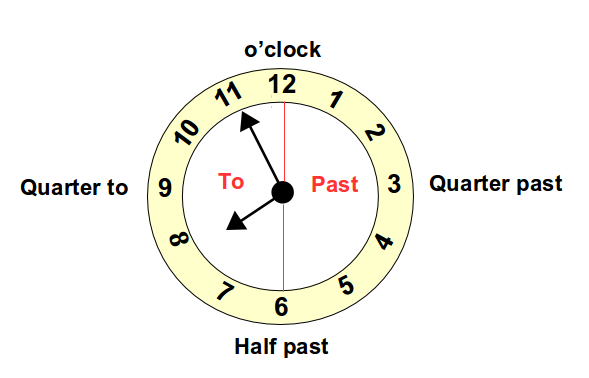
To tell the time in English, we must know a few basic words. The following figure illustrates the basic vocabulary for speaking about the time:
Notes:
- We use the word o’clock (Cat. en punt) only on the hour: three o’clock.
- For all the times between the hour and the half hour, we use the adverb past; for all the times between the half hour and the next hour, we use the adverb to.
- We must always use the word quarter (quarter past or quarter to). It is wrong to say:
fifteen pastorfifteen to. - The half hour is expressed with half past + the previous hour.
- With the multiples of five, we say: ten past three. With all the others, we must add the word minutes: twelve minutes past three
Here are some examples of clock times in English. We distinguish between:
- A written form, as we find it in timetables.
- A formal use, as we say the time in formal situations, as for example, when speaking about the times in a timetable.
- An informal use, as we say the time in informal situations, as for example, when talking to a friend about our activities.
| Written form | Formal use | Informal use |
|---|---|---|
| 3:00 | three (o’clock) | three |
| 3:05 | three oh five | five past three |
| 3:12 | three twelve | twelve minutes past three |
| 3:15 | three fifteen | a quarter past three |
| 3:30 | three thirty | half past three |
| 3:40 | three forty | twenty to four |
| 3:45 | three forty-five | a quarter to four |
| 3:56 | three fifty-six | four minutes to four |
| 4:00 | four (o’clock) | four |
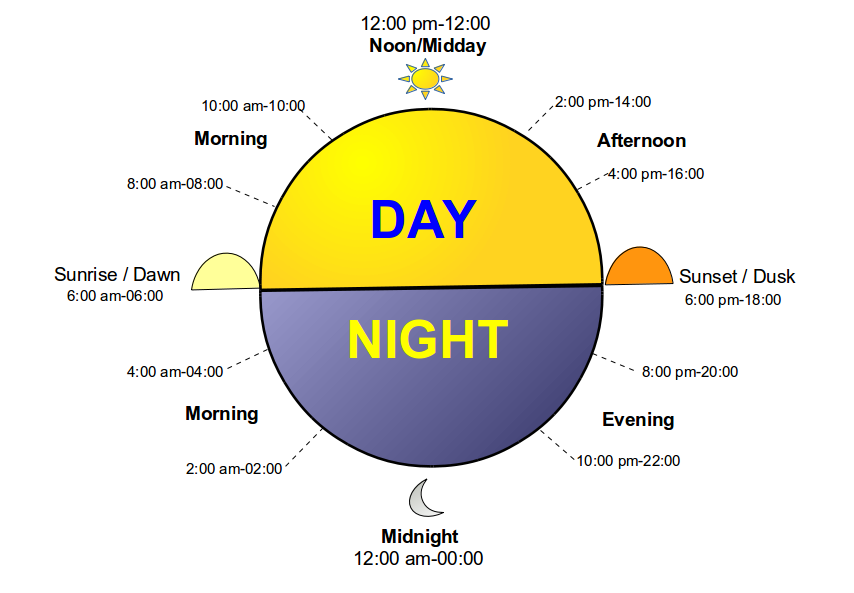
We can add the parts of the day to the clock times to make the time more specific.
In the formal written form, we say:
- am (ante meridiam): in the morning (3 am = three in the morning)
- pm (post meridiam): in the afternoon/evening (3 pm = three in the afternoon)
In the informal oral form, we generally say:
- In the morning (from 00:00 to 12:00)
- In the afternoon (from 12:00 to 18:00)
- In the evening (from 18:00 to 00:00)
- At midday (=12:00; Cat. migdia)
- At midnight (=00:00; Cat. mitjanit)
The following image illustrates the meanings of the parts of the day:
Here are some expressions related to clock times:
- What time is it? / what’s the time (Cat. ‘Quina hora és?’).
- It’s a quarter past four (Cat. ‘És un quart de cinc/Són les quatre i quart’).
- It’s half past seven (Cat. ‘Són dos quarts de set/Són les sis i mitja’).
- What time will you come? (Cat. ‘A quina hora vindràs?’).
- I’ll come at ten (Cat. ‘Vindré a les deu’).
- It’s three in the morning (Cat. ‘Són les tres de la matinada’).
- The day starts at midnight (Cat. ‘El dia comença a la mitjanit’).
- We have lunch at midday (Cat. ‘Dinem al migdia’).
- We’ll start at sunrise (Cat. ‘Ens posarem en marxa a la sortida del sol’).
- Wait until sunset (Cat. ‘Espera’t fins a la posta de sol’).
- I’ll meet you around six (Cat. ‘Ens trobem cap a les sis’).
Notes:
- To say the time when something happens, we must use the preposition at: I’ll come at ten, but we do not use the preposition in questions. We say: what time will you come?. It is wrong to say:
At what time will you come? - To say the approximate time, we can use the prepositions about or around: I’ll meet you around six.
The 12-hour-system
In English, it is not common to use the 24-hour-system, as in Catalan and Spanish. Instead, they use the 12-hour-system:
- 01:00h is 1 am
- 11:00h is 11 am
- 13:00h is 1 pm
- 23:00h is 11 pm
In a formal situation, we say: one am; in an informal situation, we must say: one in the morning.
A report about Mark Higgins
As supervisor of Mark Higgins’ training, Josep Martínez must write a progress report to the London Firefighting Service. He was filling in the form when he came across the following question: ‘Please describe a service in which the trainee has taken part '. Here is what Josep wrote:
“Barcelona, 15th June 2019
On 12th June, we received an emergency call at 7’35 pm. informing of a fire in an apartment block in the city center.
Mr Higgins joined our team and took an active part in the decision-taking. When we arrived to the site, the police were already evacuating some people from the building, but the fire was spreading rapidly on the second and third floors. We saw that some people were asking for help from the roof top, so we put up a ladder to evacuate them.
Mr Higgins suggested using a combination attack to combat the overhead gases and the flames at the same time. In this way, they soon got the fire under control. While we were still taking down some people from the building, the second and third floor collapsed. Fortunately, no one was injured.
Mr Higgins has worked hard and enthusiastically so far. He has taken the right decisions and has decisively contributed to the success of all the services in which he has participated.”
Grammar: the past simple
In the text called ‘A report about Mark Higgins’, we can find different verbs in the past simple tense. For example:
- He came across…
- He wrote…
- We received…
- Mr Higgins joined…
- He took…
- When we arrived…
- We saw…
- We put up…
- Mr Higgins suggested…
- They got the fire under control…
- The floors collapsed…
- No one was injured…
In the list of examples, we can distinguish two types of verbs in the past:
Irregular verbs:
- came across (>come across)
- wrote (>write)
- took (>take)
- saw (>see)
- put up (>put up)
- got (>get)
Regular verbs:
- received (>receive)
- joined (>join)
- arrived (>arrive)
- suggested (>suggest)
- collapsed (>collapse)
- was injured (>injure)
For a list of the most common irregular verbs in English, see “List of irregular verbs” in the “Annexes” section of this unit.
In regular verbs, the affirmative form of the past simple adds the ending -d or -ed to the infinitive, as in receive > received and join > joined. In irregular verbs, the affirmative form of the past simple is a different word from the infinitive, as in come across > came across.
Many basic verbs in English are irregular. For this reason, it is important to learn the irregular forms of these verbs.
These are the forms of the past simple of a regular verb (work):
| Affirmative | Negative | Interrogative | |
|---|---|---|---|
| I | worked | did not work | did I work…? |
| you | worked | did not work | did you work…? |
| he/she/it | worked | did not work | did he work…? |
| we | worked | did not work | did we work…? |
| you | worked | did not work | did you work…? |
| they | worked | did not work | did they work…? |
Here are the forms of an irregular verb (go):
| Affirmative | Negative | Interrogative | |
|---|---|---|---|
| I | went | did not go | Did I go…? |
| You | went | did not go | Did you go…? |
| He/She/It | went | did not go | Did he go…? |
| We | went | did not go | Did we go…? |
| You | went | did not go | Did you go…? |
| They | went | did not go | Did they go…? |
The past simple is used:
1) To express finished actions or states in the past:
- I worked in a factory 20 years ago (Cat. ‘Fa 20 anys vaig treballar a una fàbrica’).
- Did you watch the film on TV last night? (Cat. 'Vas veure la pel·lícula de la tele ahir a la nit?’).
- Mr Green didn’t come to his office yesterday. (Cat. ‘Ahir Mr Green no va venir al seu despatx’).
- Marcia met her husband at a party when they were both 15 (Cat. ‘La Marcia va conèixer el seu marit a una festa quan tots dos tenien 15 anys’).
- It was very hot last summer, do you remember? (‘L’estiu passat va fer molta calor, te’n recordes?’).
- We felt happy when he left (Cat. 'Ens vam alegrar quan (ell) va marxar’).
Time adverbials with the past simple
As the past simple expresses finished actions in the past, the time adverbials associated with this tense must refer to the past. For example:
- Yesterday (Cat. ‘Ahir’)
- Last (Monday) (Cat. ‘El [dilluns] passat’)
- Last week (Cat. ‘La setmana passada’)
- Last month (Cat. ‘El mes passat’)
- Last year (Cat. ‘L’any passat’)
- Last century (Cat. ‘El segle passat’)
- in (1980) (Cat. ‘L’any [1980]')
- (two days) ago (Cat. ‘Fa [dos dies]')
- When I was (a child) (Cat. ‘Quan jo era [un nen/una nena]')
These words and expressions are usually placed at the end of the sentence:
- I arrived yesterday (Cat. ‘Vaig arribar ahir’).
- We left two hours ago (Cat. ‘Hem marxat fa dues hores’).
- I liked painting when I was younger (Cat. 'Quan era més jove, m’agradava pintar’).
Grammar: the past continuous
In the text, ‘A report about Mark Higgins’, there are also some verbs in the past continuous tense:
- He was filling in…
- The police were evacuating…
- The fire was spreading…
- Some people were asking for…
- We were taking down…
Like the present continuous, the past continuous is a complex form composed of two elements: the auxiliary verb ‘to be’ conjugated in the past tense + the present participle of the verb.
To review the forms of the verb ‘to be’, see Unit 1. “People” > section 1 “Getting started” > 1.2.2 “Grammar: the verb ‘to be’”.
Here are the forms of the past continuous:
| Affirmative | Negative | Interrogative | |
|---|---|---|---|
| I | was working | was not working | was I working…? |
| you | were working | were not working | were you working…? |
| he/she/it | was working | was not working | was he working…? |
| we | were working | were not working | were we working…? |
| you | were working | were not working | were you working…? |
| they | were working | were not working | were they working…? |
We use the past continuous tense:
To review the verbs that do not take the continuous forms, see “Grammar: the present continuous” in the section “Accidents”, in the unit “People”.
1) To express an activity that was in progress at a specific time in the past:
- I was eating my dinner at 8 o’clock last night (Cat. ‘Ahir a les vuit estava sopant’).
- At this time yesterday, I was still working in my office (Cat. ‘Ahir a aquesta hora encara estava treballant al meu despatx’).
- I was looking for a job at this time last year (Cat. ‘Ara fa un any estava buscant feina’).
Please note the following structures: 1) ‘While’ (Cat. mentre) + past continuous 2) ‘When’ (Cat. quan) + past simple
2) In combination with the past simple, to express an interrupted action in the past:
- I was sleeping when he called last night (Cat. 'Estava dormint quan (ell) va trucar ahir a la nit’).
- The computer crashed while I was writing the email (Cat. ‘L’ordinador es va penjar mentre estava escrivint l’email’).
- While I was waiting at the bus stop, I saw your father (Cat. ‘Mentre estava esperant a la parada de l’autobús, vaig veure el teu pare’).
3) To express two or more parallel actions in the past:
- I was walking in the park, the sun was shining, the birds were singing… (Cat. ‘Jo passejava pel parc, el sol brillava, els ocells cantaven’…)
- I wasn’t listening while he was talking to me (Cat. ‘No estava escoltant mentre em parlava’).
Note: the equivalent forms of the English past continuous tense in Catalan and Spanish are: Cat. 'estava treballant’, Sp. 'estaba trabajando’. However, we can also translate the past continuous tense with the imperfet (Cat. ‘treballava’) and pasado imperfecto (Sp. ‘trabajaba’).
Time adverbials with the past continuous
With the past continuous, we can use the same time adverbials that we use with the past simple, but there is a difference:
- Past simple: I had lunch one hour ago (=I started the action one hour ago).
- Past continuous: I was having lunch one hour ago (=one hour ago the action was taking place: it had started before and would continue for some time afterwards).
One adverbial is very frequently used with the past continuous:
- While (Cat. mentre)
Grammar: the present perfect
In the text, we can also find several examples of the present perfect tense:
- The trainee has taken part…
- Mr Higgins has worked…
- He has taken…
- He has contributed…
- He has participated…
Like the present continuous and the past continuous, the present perfect tense is composed of two elements: the auxiliary verb ‘have’ conjugated in the present + the past participle of the verb.
The present participle and the past participle
Remember:
The present participle always ends in -ing. sometimes it is called ‘the -ing form’. It is used:
- To form the present continuous and the past continuous tenses (and other continuous tenses).
- As and adjective (as in: a raging fire).
The past participle ends in -ed (regular verbs) or it is irregular. It is used:
- To form the present perfect tense (and other perfect tenses).
- As an adjective (as in: a finished report).
Note: the present participle can also have the function of a noun, but then it is called a gerund. For example:
- Firefighting is a hard job.
- I like climbing.
For a list of the most common irregular verbs in English, see the annex called “List of irregular verbs”, in the “Annexes” section. The list includes the irregular forms of the past simple and the past participle.
In the list of examples above, we can also distinguish regular and irregular verbs. The irregularity affects the past participle form. As in the past simple, all the regular past participles add -d or -ed to the verb, as in contribute > contributed and work > worked. On the other hand, the irregular verbs have a different word for the past participle: take > taken.
The following table shows the forms of the present perfect of a regular verb (work):
| Affirmative | Negative | Interrogative | |
|---|---|---|---|
| I | have worked | have not worked | have I worked…? |
| you | have worked | have not worked | have you worked…? |
| he/she/it | has worked | has not worked | has he worked…? |
| we | have worked | have not worked | have we worked…? |
| you | have worked | have not worked | have you worked…? |
| they | have worked | have not worked | have they worked…? |
Here are the present perfect forms of an irregular verb (go):
| Affirmative | Negative | Interrogative | |
|---|---|---|---|
| I | have gone | have not gone | have I gone…? |
| you | have gone | have not gone | have you gone…? |
| he/she/it | has gone | has not gone | has he gone…? |
| we | have gone | have not gone | have we gone…? |
| you | have gone | have not gone | have you gone…? |
| they | have gone | have not gone | have they gone…? |
We use the present perfect:
1) To express unfinished actions or states that started in the past and continue to the present. We usually need the prepositions for (Cat. ‘durant’) and since (Cat. ‘des de’):
- I have been a firefighter for two years (Cat. ‘Fa dos anys que soc bomber’).
- I have worked at the fire station since July (Cat. ‘Porto treballant al parc de bombers des del juliol’).
- Mark has lived in Barcelona for only three months (Cat. ‘Mark només porta tres mesos vivint a Barcelona’).
- Núria has wanted to be a firefighter since she was a little girl (Cat. ‘La Núria ha volgut ser bombera des de que era petita’).
For/since
We very often use these two words with the present perfect.
- We use for with a period of time (for one week, for three hours, for 20 years, etc.)
- We use since with a specific point in the past (since 2017, since March 19th, since last week, etc.). The specific point can also be a clause in the past simple (since I was a child, since they arrived, etc.).
In the examples of use 1) above, please note the Catalan translation of the clauses with for. The Catalan sentences reflect the fact that the action is not finished yet.
2) To express finished actions in the past, actions or events that happened during a person’s life. The person must be alive (if not, we use the past simple). We do not say when the action happened (if we do, we must use the past simple). We usually use the words never (Cat. ‘mai’) and ever (Cat. ‘alguna vegada’):
- Have you ever been in Ireland? (Cat. 'Has estat alguna vegada a Irlanda?’).
- They have never participated in extinction tasks (Cat. ‘No han participat mai en tasques d’extinció’).
- We have rescued more than 50 people so far (Cat. ‘Fins ara hem rescatat a més de 50 persones’).
3) With a time word that has not finished yet (today, this week, this month, etc.):
- I have started at 8:30 today (Cat. ‘Avui he començat a les 8:30h’).
- He has changed his shift six times this year (Cat. ‘Aquest any ha canviat el seu torn sis vegades’).
- There have been many fires this summer (Cat. ‘Aquest estiu hi ha hagut molts incendis’).
4) To express an action that happened in the recent past that is still true or important in the present:
- I have lost my keys (so I can’t get into the house) (Cat. 'He perdut les claus [i per tant no puc entrar a casa]')
- He has had an accident (so he can’t come to work today) (Cat. 'Ha tingut un accident [i per tant avui no pot venir a treballar]').
- They have learnt English (so they can speak the language now) (Cat. 'Han après anglès [i per tant ara saben parlar l’idioma]').
Some words commonly used with the present perfect
There are certain time adverbials that are commonly used with the present perfect. Some of them are only used with this tense:
- never (Cat. ‘Mai’)
- ever (in questions) (Cat. ‘Alguna vegada’)
- just (Cat. — )
- already (Cat. ‘Ja’)
- yet (in questions) (Cat. ‘Ja’)
- not…yet (in negatives) (Cat. ‘Encara…no’)
- today (Cat. ‘Avui’)
- this week, etc. (Cat. ‘Aquesta setmana’, etc.)
These words are generally placed in the middle of the sentence, between the auxiliary and the past participle form:
- I have never seen anything like this (Cat. ‘No he vist mai una cosa semblant’).
- Have you ever spoken to Mr Rogers? (Cat. ‘Has parlat alguna vegada amb el Sr Rogers?’).
- I have just met Núria (Cat. ‘Acabo de trobar-me a la Núria’).
- I have already finished my report (Cat. 'Ja he acabat el meu informe’).
The adverb just has no equivalent meaning in Spanish and Catalan. It is used to indicate that the action of the verb has finished very recently. In Spanish and Catalan, we use the form acabar de + verb.
Yet, today and this week are generally placed at the end:
- Have you had lunch yet? (Cat. 'Ja has dinat?’).
- I haven’t had lunch yet (Cat. 'Encara no he dinat’).
- I haven’t seen Josep today (Cat. 'Avui no he vist el Josep’).
- She has called this week (Cat. ‘Ha trucat aquesta setmana’).
Apart from the adverbials of time, the past continuous is sometimes used with the prepositions for and since, as we explained above.
A forest fire
A forest fire, also called a wildfire, is a typical emergency that firefighters must respond to, especially in summer. Forest fires may be caused by a variety of reasons. Some have natural causes, like lighting, and some are accidental, like fires caused by power lines, but most forest fires are caused by people’s carelessness: throwing a cigarette end from a car, lighting a campfire or burning a field can easily provoke a forest fire, which may spread quickly under the right conditions (extremely dry vegetation, high temperatures, windy conditions, etc.). Finally, forest fires may also be caused by arsonists, who are the people who start a fire intentionally.
To fight forest fires, a fire crew sometimes creates control lines to prevent the fire from spreading. At the same time, they attack the flames from the front or from the side. If the fire is relatively small, the fire crews may begin from behind, starting from already burned land and working their way around the edge of the fire. If the fire covers a vast extension of land, firefighters can use planes or helicopters to drop a mixture of water and foam retardant on top of the flames.
Prevention is the best way of fighting forest fires. Government regulations forbid lighting fires in or near a forest when there is a major risk of a forest fire. An appropriate firefighting policy by local governments is also very important. They could clear the undergrowth to minimize the risk of fire and they should also invest larger sums in material and human equipment. However, only people can prevent forest fires. Therefore, education is essential. This could be done through talks in schools and awareness-raising campaigns.
Technical vocabulary: forest fires
| arsonist | piròman/a | forest fire | incendi forestal |
| awareness-raising campaign | campanya de conscienciació | lightning | llamp |
| burned land | terreny calcinat | power line | línia d’alta tensió |
| campfire | foc, foguera | to burn | cremar |
| carelessness | negligència | to cause | causar, provocar |
| cause | causa | to clear | netejar |
| cigarette end | burilla, punta de cigarreta | to light | encendre |
| control line | tallafoc | to provoke | causar, provocar |
| dry | sec/a | to spread | estendre’s, escampar-se |
| fire crew | equip de bombers, dotació de bombers | undergrowth | sotabosc |
| firefighting policy | política d’extinció d’incendis | wildfire | incendi forestal |
| flame | flama | windy conditions | vent |
| foam retardant | retardant, escuma retardant |
Vocabulary: the prepositions of time (I)
The three basic prepositions of time are: in, on and at. They have the same form as the prepositions of place, but we use the prepositions of time to say when an action happens. To use the prepositions of time correctly, we must learn the preposition + the noun.
These are the basic uses of the prepositions of time:
We use 'in'...
- With years, centuries and historical periods:
- In 2010
- In the 19th century
- In the Middle Ages
- In modern times
- In the present
- In the past
- In the future
- With the names of the months and seasons of the year:
- In April
- In September
- In Winter
- In Summer
- With the parts of the day:
- In the morning
- In the afternoon
- In the evening
- In the night
- With a period of time, to indicate the beginning of an action in the future:
- In a moment
- In five minutes
- In one week
- In three years
We use 'on'...
- With the days of the week:
- On Monday
- On Tuesday
- On Sunday
- On Fridays
- On weekdays
- With dates and nouns denoting specific dates:
- On 16th June
- On 4th November, 2005
- On the 23rd
- On Christmas Day
- On New Year’s Eve
We use 'at'...
- With clock times and nouns denoting clock times:
- At 6 o’clock
- At a quarter past eight
- At 2 pm
- At midnight
- At midday
- At sunset
- At dawn
- At night
- With names of holidays and with the noun ‘weekend’:
- At Christmas
- At Easter
- At the New Year
- At the weekend
Some differences between the prepositions of time
At vs On:
1) At is used to speak about holidays and weekends in general:
- We usually stay at home at Christmas (Cat. ‘Normalment ens quedem a casa per Nadal’).
2) On is used to speak about a special day or weekend:
- We usually stay at home on Christmas Day (Cat. ‘Normalment ens quedem a casa el dia de Nadal’).
- The meeting took place on the last weekend of June (Cat. ‘La reunió va tenir lloc el darrer cap de setmana de juny’).
In vs On:
1) In is used to speak about parts of the day:
- I work in the morning (Cat. ‘Treballo pel matí’).
2) On is used to speak about a part of the day in particular:
- I arrived on the morning of the ninth of November (Cat. ‘Vaig arribar el matí del nou de novembre’).
- It happened on a cold winter morning (Cat. ‘Va passar un fred matí d’hivern’).
At vs In:
1) At is used to speak about any night in general:
- I don’t like working at night (Cat. ‘No m’agrada treballar de nit’).
2) In is used to speak about one particular night:
- I met him in the night of the tenth (Cat. ‘El vaig conèixer la nit del dia 10’).
- I couldn’t sleep in the night because I was very nervous (Cat. ‘No vaig poder dormir per la nit perquè estava molt nerviosa’).