



Accidents
In this section, you will get some ideas for improving your reading and writing skills in English. When you write, you must pay especial attention to spelling (Cat. ‘ortografia’), punctuation (use of stops, commas, etc.) and the use of connectors (like, and, but, etc.). These three aspects are essential to write a good text, give it coherence and make it more fluent. You are also going to learn the characteristics of the formal and the informal language. In English, the difference is very important. When you speak, but especially when you write, you must think about the context and choose the appropriate language style.
In the grammar section, you will study the forms and the uses of the two present tenses: the present simple and the present continuous. As you will see, one is used for describing habitual actions and the other is used for speaking about actions that are happening at the moment.
Finally, in the vocabulary section you will read a text describing a road accident, which is an emergency situation that firefighters must usually attend to. As always, the text will include a list of technical vocabulary mostly used in that context. On the other hand, you will also learn the basic differences between the British and the American varieties of English.
Writing emails
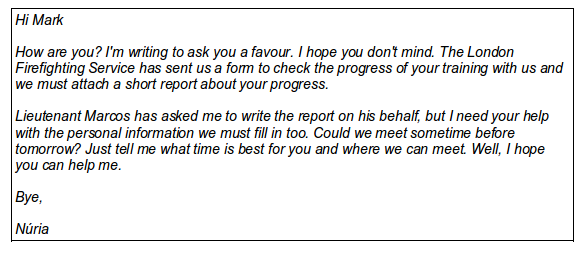
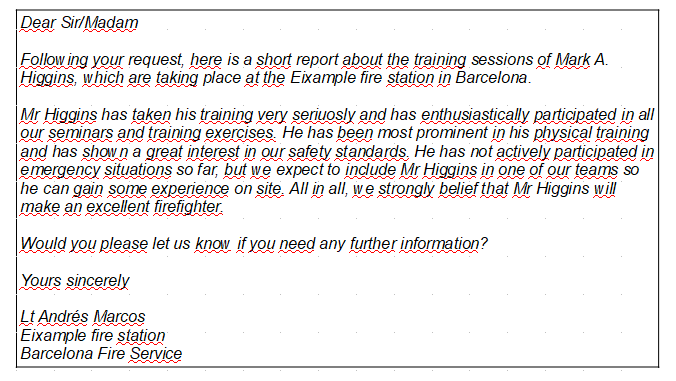
The London Fire Service has asked the fire station in Barcelona to send a short report about the progress of Mark Higgins’ training. Núria’s superior, Lieutenant Andrés Marco, does not speak English, so he has asked her to write the email on his behalf. Before sending the email, she writes to Mark Higgins to help her with the report.
Here is the text of Núria’s mail to Mark (see the image below):
With Mark’s help, Núria finally sent the following report to the London Firefighting Service (see the image below):
Communication: the written skills
The written skills are reading and writing. Reading implies the comprehension of a written text whereas writing means the production of a written text. The reading skill is especially important when you need to understand a letter or an email, or you need to look up at a manual related to your job, as manuals are usually available only in English. Reading skills are also necessary when you look for information in the internet because the most relevant information is usually in English. On the other hand, you may need to use your writing skills to write an email or a letter, or to write your curriculum vitae if you ever wish to apply for a job in another country or join an international association.
In order to improve your reading comprehension and written expression, you need to develop your reading and writing skills, and the only way of doing so is by practising as much as you can. This means reading and writing as much as possible. It also means having a lot of patience because it takes some time to notice the improvement. Although there are no specific rules that tell you how to read and write, we can give you some general guidelines that will facilitate your practice.
1) The reading skills
Reading is probably the easiest skill to practise because it is an individual activity that you can do at home. By reading in English, you will practise your skill and you will also learn new words and grammatical structures, so reading is a very good activity for improving your grammatical and lexical accuracy.
See the ‘Interesting links’ in the ‘Reference’ section to find links to recommended websites for practising the reading skills.
If you wish to practise the reading skills, we suggest the following material:
- Graded readers: if you like fiction, there are many graded readers at different levels, from beginners to advanced learners. These readers offer adaptations of classical works from the English and American literature.
- Wikipedia: if you prefer reading online, the Internet offers a huge quantity of reading material. The English version of the Wikipedia has millions of articles about any possible topic that you can imagine.
- Simple English Wikipedia: if you find the articles in the Wikipedia too difficult, there is a more simple version specially designed for learners of English. The Wikipedia in Simple English uses basic words and very simple grammatical structures. It currently has more than 125,000 articles.
- Howstuffworks: in this website, you can find a great variety of articles divided into different topics. There are a lot of technical manuals that explain how things (stuff) works. It is specially recommended for intermediate to advanced students.
Here is some advice for practising your reading skills:
- Read slowly. You may need to read a sentence or a paragraph several times before you can understand the meaning.
- You do not need to know all the words to understand the general meaning of a text.
- Do not mentally translate the text into your own language, but try to ‘think’ in English. This means to interiorize the syntactical structures and vocabulary of the language and use it naturally without having to think in your own language first.
- Try to guess the meaning of unknown words. You will notice that many English words are of Latin origin: you do not need a dictionary to understand words like: family, future, university, excuse, practice, manual, dictionary, etc.
- Choose a topic of your interest and read as much as possible in your free time. It is very important thay you enjoy your reading. If you find a text boring, just leave it aside.
2) The writing skills
At work or in your daily life, you will mostly need to write emails and (perhaps) formal business letters, for example, if you ever apply for a job in another country. You may also need to take notes in a meeting or when attending a speech. For all this, you need to develop your writing skills. As in all the skills, the only way of improving is by writing as much as you can and developing the skill gradually.
Here are some general guidelines to write a text:
a) Think about the objective of the text. The objectives may be varied: to describe facts (for example, your daily routine), to express your opinion (for example, about the importance of English in your job), to give advice (for example, to become a good firefighter), to persuade a person (for example, when you must explain why you are a good candidate for a job), and many other objectives. When you write a text, you must think about the type of language required for each objective (for example, when you give your opinion, you can say: I think that…, in my opinion, …, etc.)
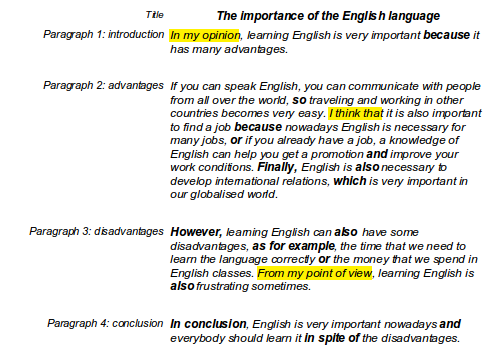
b) Think about the contents (what you want to say). It is a very good idea to write down your ideas in note form and then develop these ideas in the text. For example, imagine that you must write your opinion on the topic: The importance of the English language. You could write down the following:
- Introduction: Learning English very important
- Advantages: speaking with other people; find a job, get a promotion, international relations …
- Disadvantages: expensive, needs time, frustrating…
- Conclusion: necessary to learn.
c) Write an appropriate title, organize the text into paragraphs and write clear and simple sentences. Dedicate one paragraph to each idea. For example, one for the introduction, one for the advantages of English, one for the disadvantages and a final one for the conclusion.
d) Think about the following aspects:
- Appropriate vocabulary: use the right words to express your ideas (use a dictionary if you have any doubts) and the specific words and expressions used for giving opinions (see them in yellow in the example text below).
- Appropriate syntactical structures: correct use and forms of the verb tenses, word order, etc.
- Correct spelling: many spelling mistakes are due to typewriting errors; if in doubt about the correct spelling of a word, look it up in a dictionary.
- Use of connectors (see them in bold type in the model text below) and punctuation (stops, commas, etc.).
Here is an example of text (see the image below):
Please note:
- When you write, try to ‘think’ in English. You will logically think in your own language and, when writing (and also when speaking), you will mentally translate your thoughts into English. As you have a much wider knowledge of vocabulary and grammar in your own language, the translation into English is often complicated and full of errors. You must be conscious of your limitations in English and try to use simple language and syntactical structures at first. As you advance in your knowledge of English, you will come to express more and more complex ideas.
- The use of automatic translators is not appropriate for writing a text. They are useful for understanding a short text in English, but automatic translators are not appropriate tools for writing because you can only develop your skills by practising. On the other hand, you need to introduce a text without any mistakes (including punctuation, graphical accents, etc.) to obtain a fairly correct text in English. We strongly recommend you to write a text by following the guidelines above.
Apart from the guidelines indicated, in formal letters you must use some conventional words and expressions, as well as some obligatory elements, such as the address, the date and the signature. Here is an example of a formal letter (see the image below). The purpose of the letter is to thank the Chief Fire Officers Association for a meeting:
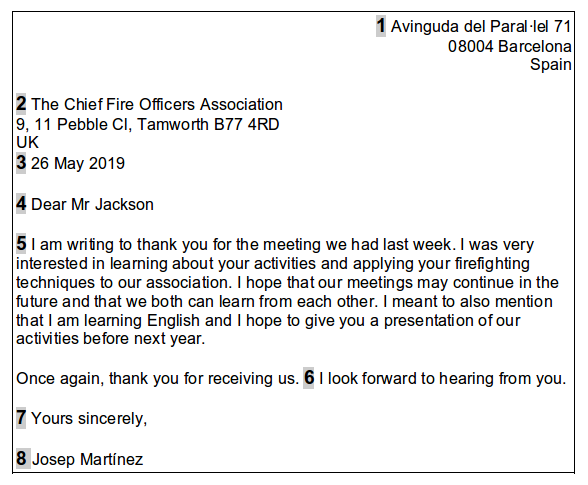
Note the necessary elements of a formal business letter:
- Writer’s address (usually without the name)
- Recipient’s address
- Date
- Opening salutation
- Body of the letter (in formal style)
- Closing sentence
- Closing salutation
- Writer’s full name (name + surname)
Communication: connectors, punctuation and spelling
Connectors, punctuation and spelling are three aspects that we tend to overlook when writing a text. However, they are very important because they bring clarity and coherence to a text and facilitate the reading.
1) Connectors
Here is a list of some common English connectors. We include their Catalan equivalent forms and examples of their use:
Expressing addition:
- and (Cat. ‘i’): I like reading and listening to music (Cat. ‘M’agrada llegir i escoltar música’).
- or (Cat. ‘ni’) (in negative sentences): I don’t like reading or listening to music (Cat. ‘No m’agrada llegir ni escoltar música’)
- also (Cat. ‘també’) (formal): I also like reading (Cat. ‘A mi també m’agrada llegir’).
- too (Cat. ‘també’) (informal): I like reading too (Cat. ‘A mi també m’agrada llegir’).
Expressing alternatives:
- or (Cat. ‘o’): You can go or wait a little longer (Cat. ‘Pots marxar o esperar-te una estona més’).
Expressing contrast:
- but (Cat. ‘però’): It’s late, but I will wait a little longer (Cat. ‘És tard, però , esperaré una estona més’).
- however (Cat. ‘malgrat tot’): It’s late. However, I will wait a little longer (Cat. ‘És tard. Malgrat tot, m’esperaré una estona més’).
- although (Cat. ‘encara que’, ‘tot i que’ ): Although it’s late, I will wait a little longer (Cat. 'Encara que sigui tard, m’esperaré una estona més’).
- on one hand…on the other hand (Cat. ‘per una banda… per una altra banda’): On one hand it is raining. On the other hand, it is very cold (Cat. 'Per una banda, està plovent. Per una altra banda, fa molt de fred’).
Explaining ideas:
- in other words (Cat. ‘amb altres paraules’): It’s crystal clear. In other words, it is very clear (Cat. ‘Està clar com el cristall. En altres paraules, està molt clar’).
- for example (Cat. ‘per exemple’). There are many things to do. For example, bring water and take out the chairs (Cat. ‘Hi ha moltes coses per fer. Per exemple, portar aigua i treure les cadires’).
Listing ideas:
- firstly…; secondly… (Cat. ‘en primer lloc…; en segon lloc…): Firstly, bring water; secondly, take out the chairs (Cat. 'En primer lloc, porta aigua; en segon lloc, treu les cadires’).
- and then (Cat. ‘i aleshores’): Bring water and then take out the chairs (Cat. ‘Porta aigua i aleshores, treu les cadires’).
- next (Cat. ‘després’): Bring water. Next, take out the chairs (Cat. ‘Porta aigua. Després, treu les cadires’).
- finally (Cat. ‘finalment, per acabar’): Bring water, take out the chairs and finally check the computer (Cat. ‘Porta aigua, treu les cadires i finalment comprova l’ordinador’).
Expressing purpose:
- to (Cat. ‘per a’, ‘per tal de’): Use a dictionary to look up the meaning of a word (Cat. ‘Utilitza un diccionari per a consultar el significat d’una paraula’).
Expressing the reason:
- because (Cat. ‘perquè’): I study English because it is very important (Cat. ‘Estudio anglès perquè és molt important’).
- because of (Cat. ‘degut a’, ‘a causa de’): I study English because of its great importance (Cat. ‘Estudio anglès degut a la seva gran importància’).
Expressing the result:
- so (Cat. ‘així que’, ‘per tant’) (informal): I need money so I work extra hours (Cat. ‘Necessito diners així que faig hores extres’).
- therefore (Cat. ‘així que’, ‘per tant’) (formal): I need money. Therefore I work extra hours (Cat. ‘Necessito diners. Per tant, faig hores extres’).
Summarizing ideas:
- in conclusion (Cat. ‘en conclusió’): We have no money and we do not work. In conclusion, we cannot give you anything (Cat. ‘No tenim diners i no treballem. En conclusió, que no et podem donar res’).
- Summing up (Cat. ‘resumint’). We have no money and we do not work. Summing up, we cannot give you anything (Cat. ‘No tenim diners i no treballem. Resumint, que no et podem donar res’).
To see the importance of connectors, compare these two texts:
Text without connectors:
The Internet has some advantages. It is useful to broaden your knowledge and meet new people. It has some disadvantages. Its free access to pages which show violence and crimes. There are people who think that the Internet should be a free space to express ideas. Some people consider that the Internet can be dangerous if it is not controlled. The Internet has both advantages and disadvantages. People must learn to use it for positive aims.
Text with connectors (in bold type):
The Internet has some advantages because it is useful to broaden your knowledge and meet new people, but it also has some disadvantages, as for example, its free access to pages which show violence and crimes. On the one hand, there are people who think that the Internet should be a free space to express ideas. On the other hand, some people consider that the Internet can be dangerous if it is not controlled. In conclusion, the Internet has both advantages and disadvantages, but people must learn to use it for positive aims.
2) Punctuation
Here are the most common uses of the punctuation marks:
- Do not write a comma (,) between the subject and the verb.
- Write a full stop (.) at the end of a sentence.
- The adverbials and connectors are usually separated from the sentence by a comma. For example: in the mornings , I usually check my mail.
- Write a colon (:) to introduce a list of items or an explanation. For example: the continents are: Europe, Asia, Africa, America and Oceania.
- Write a comma to separate the elements in a list. For example: I visit customers on Monday , Wednesday , Thursday and Friday.
- Use a semi-colon (;) to separate the groups of items in a list. For example: in computing, we must distinguish between hardware and software. Hardware refers to the material parts of a computer ; software refers to programming and includes operating systems, compilers, editors, etc.
- Use brackets () to add extra information. For example: in writing, we must use connectors (also called ‘linking words’).
- Write a capital letter at the beginning of a sentence or after a full stop.
- Write a question mark (?) at the end of a sentence. For example: what’s your name ?.
- Write an exclamation mark (!) at the end of a sentence with the imperative form. For example: Come in !.
3) Spelling
English words are usually spelt very differently from the way we pronounce them, so we must learn the meaning of a word together with its spelling. However, there are a few basic spelling rules:
- Changing y to ies: when we add -s to a word ending in vowel+y, we just add -s (play > plays, delay > delays); when the word ends in consonant+y, the ending is -ies (company > companies, baby > babies).
- Adding -es to words ending in -s, -ss, -z, -ch, -sh, -x (wish > wishes, box > boxes, business > business).
- Doubling up: when we add an ending to words in vowel + final consonant, we double the consonant (big > bigger, begin > beginning).
- Drop the ‘e’: we drop the final '-e’ when we add suffixes starting with a vowel (write > writing, hope > hoped, sense > sensible); we keep the '-e’ if the word ends in '-ce’ or '-ge’ and the suffix is '-able’ or '-ous’ (courage > courageous, notice > noticeable).
- Changing ‘y’ to ‘i’: if a word ends in a consonant + ‘y’, the ‘y’ changes to ‘i’ (beauty + ful > beautiful, happy + ness > hapinnes).
- Changing '-f’ to '-ves’ or '-s’: most words ending in '-f’ or '-fe’ change their plurals to '-ves’ (half > halves, life > lives, yourself > yourselves).
Capitalization
Capitalization is the use of capital letters (Cat. ‘lletres majúscules’). In English, capitalization is sometimes different from Spanish or Catalan.
In English, capital letters are used:
- with the pronoun ‘I’.
- with adjectives derived from proper names: English, Spanish, Londoner, etc.
- with days of the week and months of the year: Monday, Tuesday, February, April, etc.
- with names of personal and job titles: Mr., Miss, Sales Manager, Director, etc.
- at the beginning of a sentence.
Communication: formal and informal style
In the text ‘Writing emails’, you can see two emails: one is from Núria to Mark; the other is from Lt Andrés Marcos to the London Fire Service. Núria’s email is in informal language because she is writing to a friend and colleague. On the other hand, Lt Marcos’ email is in formal language because it is a report for the London Fire Service.
In English, we must distinguish between the formal and the informal language. Both styles are correct. Their use is a matter of tone and setting. Formal English is generally used in academic writing and business communication whereas informal English is appropriate for communication with friends and relatives.
Here are the main characteristics of each style:
Formal style:
- Does not use colloquial words/expressions (use: post instead of job, I would appreciate it if… instead of I would like…, etc.).
- Does not use contractions (write full words: I am, do not, cannot, will not, etc.).
- Writes in third person (except in business letters, where the first person may be used).
- Does not use abbreviated words (use full versions, like photograph, and not photo; television, and not TV, etc.).
- Does not use the imperative voice (say: could you send me…? instead of send me…).
- Uses the passive voice (for example: it is believed that… instead of we believe that…).
- Uses longer and more complex sentences (short and simple sentences makes a writing poor).
Informal style:
- Uses colloquial words and expressions (well, kids, guy, etc.).
- Uses contractions (I’m, don’t, can’t, won’t, etc.).
- You may use first, second, or third person.
- You may use abbreviated words (photo, TV, etc.).
- You may use the imperative voice (for example: Send me…, Please remember…, etc.).
- You may use the active voice (for example: we believe that…, etc.).
- You may use short and simple sentences.
Here you are two texts, one in formal style and one in informal style. They both express the same ideas and they are both correct, but we should always think about the person whom we address our text and choose the appropriate style.
Text in formal style
Dear Sir or Madam
This is to inform you that I am interested in the English course advertised in ‘The Times’ of 3rd March. I would appreciate it if you could send me further details. Thank you in advance.
Yours sincerely,
Josep Martínez
Text in informal style
Hi
Do you remember your advertisement for an English course? I saw it in ‘The Times’ of 3rd March. Well, I want to say that I’m interestied in learning English. Can you tell me more about it? Thanks
Cheers
Pep
Josep's daily routine
Josep Martínez does the same things everyday. He has a 24-hour shift at the fire station. He gets up at six in the morning, has breakfast in the kitchen and then takes the bus to go to work. He arrives a little before eight, when his shift starts. There he puts on his uniform and talks to his colleagues while they have a coffee. After that, he checks his personal protective gear, which includes a turnout jacket, pants, boots and air supply, and next he prepares all the equipment for service. After all the routine checks and facility maintenance tasks, the Company Officer calls a crew meeting. The Company Officer gives the crew an agenda for the day’s activities. The firefighter’s priority is to respond to fire and medical calls, but scheduled activities are altered depending on emergency incidents. At around 10 pm, he retires to the dormitory to sleep. During this time, however, he is still available for immediate response to emergencies. His shift ends the following morning at 8 am, when the next shift starts.
Today is a different day for Josep. He is not working because he has interchanged his shift with his colleague Núria Gómez. Josep is now jogging in the park near his home. The sun is shining brightly and he is really enjoying his day off.
Tomorrow he starts at eight in the morning again on another normal day at the fire station, but at ten he has a training course on sea rescue which breaks his routine.
Grammar: the present simple
The first paragraph of the text ‘Josep’s daily routine’ describes a normal day at the fire station. For this reason, all the verbs in that paragraph are in the present simple tense. In the last paragraph, we can see a different use of the present simple, which sometimes can be used to speak about the future. Let’s study this verb tense in some detail.
These are the forms of the present simple:
| Affirmative | Negative | Interrogative | |
|---|---|---|---|
| I | work | do not work | Do I work…? |
| You | work | do not work | Do you work…? |
| He/She/It | works | does not work | Does he work…? |
| We | work | do not work | Do we work…? |
| You | work | do not work | Do you work…? |
| They | work | do not work | Do they work…? |
Notes:
- The third person singular adds -s to the base form of the verb.
- The negative is formed with do not or does not in front of the base form.
- In the interrogative form, the auxiliary do/does is placed before the subject.
We use the present simple:
1) To express an habitual, regular action:
- Josep does the same things everyday (Cat. ‘Josep fa el mateix cada dia’).
- He gets up at six in the morning (Cat. 'Es lleva a les sis del matí’).
- He has breakfast in the kitchen (Cat. 'Esmorza a la cuina’).
2) To express a permanent state, something that is always true:
- Australia is a very big country (Cat. ‘Austràlia és un país molt gran’).
- The sun rises in the east (Cat. ‘El sol surt per l’est’).
- Water boils at 100ºC (Cat. ‘L’aigua bull als 100ºC’).
3) To speak about the future when the actions are part of a schedule or timetable:
- Tomorrow Josep starts at eight in the morning again (Cat. ‘Demà Josep comença una altra vegada a les vuit del matí’).
- At ten he has a training course on sea rescue (Cat. ‘A les deu té un curs de salvament marítim’).
Frequency adverbs:
These adverbs express how often an action happens. We often use them with the present simple because they indicate regular actions.
Here is a list of the most common frequency adverbs:
- Always (Cat. ‘sempre’)
- Usually (Cat. ‘normalment’)
- Often (Cat. ‘sovint’)
- Sometimes (Cat. ‘algunes vegades’)
- Seldom (Cat. ‘poques vegades’)
- Never (Cat. ‘mai’)
- Every day (Cat. ‘cada dia’)
- Every week (Cat. ‘cada setmana’)
- Once a week (Cat. ‘una vegada a la setmana’)
- Twice a week (Cat. ‘dues vegades a la setmana’)
- Three times a week (Cat. ‘tres vegades a la setmana’)
- From time to time (Cat. ‘de tant en tant’)
When they go in the middle of the sentence, frequency adverbs are placed before the lexical verbs and after the auxiliary and modal verbs.
The adverbs always, usually, often, seldom and never are placed in the middle of the sentence:
- He always arrives late (Cat. 'Sempre arriba tard’).
- We are often tired in the evening (Cat. ‘Estem sovint cansats al vespre’).
The adverb sometimes may be placed at the beginning, at the end or in the middle of the sentence:
- He sometimes calls me (Cat. ‘Em truca algunes vegades’).
- Sometimes he calls me.
- He calls me sometimes.
The expressions every day, every week, etc. are usually placed at the end of the sentence:
- We meet every day (Cat. ‘Ens reunim cada dia’).
- I see David twice a week (Cat. ‘A David el veig dues vegades a la setmana’).
Grammar: the present continuous
The present participle is an invariable form of the verb that always ends in -ing. Present participles can be part of a verb (as in the continuous forms) or they can have the function of an adjective (as in: interesting, exciting, etc.).
In the second paragraph of the text ‘Josep’s daily routine’, we can see a few examples of the use of the present continuous tense:
- He is not working…
- Josep is now jogging…
- The sun is shining…
- He is really enjoying…
The contrast is between Josep’s usual activities (present simple) and his activities on a special day (present continuous).
As you can see, the present simple is a complex verb form composed of two elements: the auxiliary verb ‘to be’ conjugated in the present + the present participle of the verb.
To review the forms of the verb ‘to be’, see “Grammar: the verb ‘to be’” in the section “Getting started”, in this Unit.
These are the forms of the present continuous:
| Affirmative | Negative | Interrogative | |
|---|---|---|---|
| I | am working | am not working | am I working…? |
| you | are working | are not working | are you working…? |
| he/she/it | is working | is not working | is he working…? |
| we | are working | are not working | are we working…? |
| you | are working | are not working | are you working…? |
| they | are working | are not working | are they working…? |
We use the present continuous:
1) To express an action that is happening at the moment of speaking:
- He is not working because he has interchanged his shift with his colleague Núria Gómez (Cat. 'No treballa perquè li ha canviat el torn a la seva companya Núria Gómez’).
- Josep is jogging in the park near his home (Cat. ‘Josep està fent footing al parc de prop de casa seva’).
- The sun is shining brightly (Cat. ‘El sol brilla amb intensitat’).
- He is enjoying his day off (Cat. 'Està gaudint del seu dia lliure’).
Note that in Catalan and Spanish we tend to use the present simple rather than the present continuous.
2) To express a temporary action, one that is not permanent:
- Josep is not working because he has interchanged his shift with his colleague Núria Gómez (Cat. ‘Josep no treballa perquè ha canviat el torn amb la seva companya Núria Gómez’).
- Núria works at the Eixample fire station, but this week she is working in Calell. (Cat. ‘Núria treballa al parc de l’Eixample però aquesta setmana està treballant a Calella’).
- My car is in the garage so these days I am taking the bus to go to work (Cat. ‘El meu cotxe és al taller així que aquests dies agafo l’autobús per a anar a treballar’).
3) To express a future plan or arrangement:
- I am staying at home during the holidays (Cat. 'Em quedaré a casa durant les vacances’).
- What are you doing tonight? (Cat. ‘Què tens pensat fer aquesta nit?’).
- I am not working at the weekend (Cat. 'No tinc intenció de treballar el cap de setmana’).
Adverbs of time:
There are some adverbs and adverbial expressions of time that are commonly used with the present continuous tense. For example:
- Now (Cat. ‘ara’)
- In this moment (Cat. ‘en aquest moment’)
- This week (Cat. ‘aquesta setmana’)
We usually place these words at the end of the sentence:
- He is sleeping now (Cat. 'Ara està dormint’).
- I’m reading your mail in this moment (Cat. 'En aquest moment estic llegint el teu mail’).
- We are not working this week (Cat. 'Aquesta setmana no treballem’).
Verbs that do not take the continuous tenses:
Some verbs are never expressed in the continuous tenses. Some of these verbs are:
- Believe (Cat. ‘creure’)
- Doubt (Cat. ‘dubtar’)
- Enjoy (Cat. ‘agradar’, ‘gaudir’)
- Hate (Cat. ‘odiar’, ‘detestar’)
- Have (Cat. ‘tenir’)
- Know (Cat. ‘saber’)
- Like (Cat. ‘agradar’)
- Love (Cat. ‘estimar’)
- Prefer (Cat. ‘preferir’)
- Remember (Cat. ‘recordar’)
- See (Cat. ‘veure’)
- Think (Cat. ‘opinar’)
- Understand (Cat. ‘entendre’)
- Want (Cat. ‘voler’)
For example, it is wrong to say: I am liking this film. We must say: I like this film.
But we can use the continuous tenses with two of these verbs when they have a different meaning:
- Have (Cat. ‘prendre’): I am having breakfast (Cat. 'Estic prenent l’esmorzar/Estic esmorzant’)
- Think (Cat. ‘pensar’): What are you thinking about? (Cat. ‘En què estàs pensant?’)
A road accident
Josep Martínez and Núria Gómez are on an emergency service. Mark Higgins is with them. There is a road accident on the motorway just outside the city. A bus full of passengers hit the crash barrier and it is now overturned in the middle of the road.
A quick survey shows that there is a petrol leak and that the bus engine is still on, so the first thing is to turn it off to prevent a fire. There seems to be no casualties, but there are several passengers trapped in the wreck. It will be necessary to extricate them, so Josep prepares the power saw to remove the side of the bus and gain access to the interior.
Meanwhile, Núria and Mark are helping the medical personnel in assisting the injured people, who are lying on the side of the road. The emergency care assistants will take them to the hospital in the ambulances that have arrived to the site.
Technical vocabulary: road accidents
| casualty | víctima mortal | side | lateral |
| emergency care assistant | personal d’ambulàncies | survey | inspecció |
| emergency service | servei d’emergències | to assist | ajudar, atendre, donar assistència |
| engine | motor | to be on | estar engegat/da, estar en marxa, estar encès/esa |
| injured | ferit/da | to extricate | excarcerar |
| medical personnel | personal mèdic | to gain access | accedir |
| motorway | autopista | to remove | desmuntar |
| overturned | bolcat/da, tombat/da | to turn off | apagar |
| petrol leak | fuita de gasolina | crash barrier | barrera de seguretat, guarda-rail |
| power saw | serra mecànica | trapped | atrapat/da |
| road accident | accident de trànsit | wreck | restes, vehicle accidentat |
Vocabulary: British English vs American English
Although British and American people speak the same language and they can understand each other perfectly well, there are some differences between the British and the American varieties of English.
As a learner of English, you should not worry much about these differences because both varieties are equally correct, but you should be aware of the basic differences between British and American English.
Most differences are in the vocabulary and the spelling, but there are also some differences in the grammar and the pronunciation.
Vocabulary
Here are some words that are different in British and American English:
| British English | American English | Meaning |
|---|---|---|
| trousers | pants | pantalons |
| flat | apartment | pis, apartament |
| university | college | universitat |
| holiday | vacation | vacances |
| postbox | mailbox | bústia |
| shop | store | botiga |
| chemist | pharmacy | farmàcia |
| lift | elevator | ascensor |
| lorry | truck | camió |
| fire engine | fire truck | cotxe de bombers |
| bonnet | hood | capó del cotxe |
| boot | trunk | maleter del cotxe |
| motorway | highway | autopista, autovia |
| petrol | gasoline | gasolina |
| petrol tank | gas tank | dipòsit de combustible |
| petrol station | gas station | gasolinera |
Spelling
Some differences in spelling between British and American English are:
| British spelling | American spelling | Examples |
|---|---|---|
| -t | -ed | burnt/burned, learnt/learned, spelt/spelled |
| -ence | -ense | defence/defense, licence/license |
| -ell- | -el- | cancelled/canceled, traveller/traveler |
| -ise | -ize | realise/realize, organise/organize |
| -l | -ll | fulfil/fulfill, enrol/enroll |
| -ogue | -og | catalogue/catalog, analogue/analog |
| -our | -or | colour/color, behaviour/behavior |
| -re | -er | metre/meter, centre/center |
For further details about the dates in English, see “Communication: speaking about dates” in the section called “Fire” in this Unit.
Apart from the spelling of words, the way of expressing the dates is also different in British and American English:
- British English: 16th June
- American English: June 16
Grammar
There are very few differences in the grammar between British and American English. Here are some:
1) The verb form needn’t is considered as a modal verb in British English, but in American English it is used as a normal lexical verb:
- British English: You needn’t go > American English: You don’t need to go
2) The verb have (meaning possession) is considered as an auxiliary verb in British English, which usually adds the particle got, but in American English it is used as a normal lexical verb:
- British English: I’ve got a sister > American English: I have a sister
- British English: I haven’t got any sisters > American English: I don’t have any sisters
- British English: Have you got any sisters? > American English: Do you have any sisters?
3) In British English we use the present perfect when talking about recent actions with an effect in the present, but in American English they prefer to use the past simple instead:
- British English: I’ve seen Max this morning > American English: I saw Max this morning
- British English: Have you slept well? American English: Did you sleep well?
Pronunciation
To listen to the difference in pronunciation between British English and American English, see “British English vs. American English pronunciation” in the “Annexes” section.
The American pronunciation is quite distinctive from the British pronunciation, but it is equally understandable. In fact, English has many different phonetical varieties. There is a London accent, a Southern British English accent, an Irish accent, a Scottish accent, an Australian accent, a Texan accent, etc.
English students generally learn Standard English (also called BBC English).