



Workplace
In this lesson we are going to see the layout of different health care and office settings, and we are going to learn how to ask for and give directions.
Workplace Settings
Have you ever thought where you are going to work? Would you enjoy working in a hospital? Or would you rather work at a private clinic or in an aged care facility? You can be employed in one of these settings or any other health organization, usually in an office setting, or at a reception.
We will read about Lily’s experience at the front desk of a healthcare facility:
Lily used to work at an age care facility, but now she works at the reception of an outpatient facility called Pacific Medical Centre, where they offer a range of essential medical services.
See the floorplan of Pacific Medical Centre:
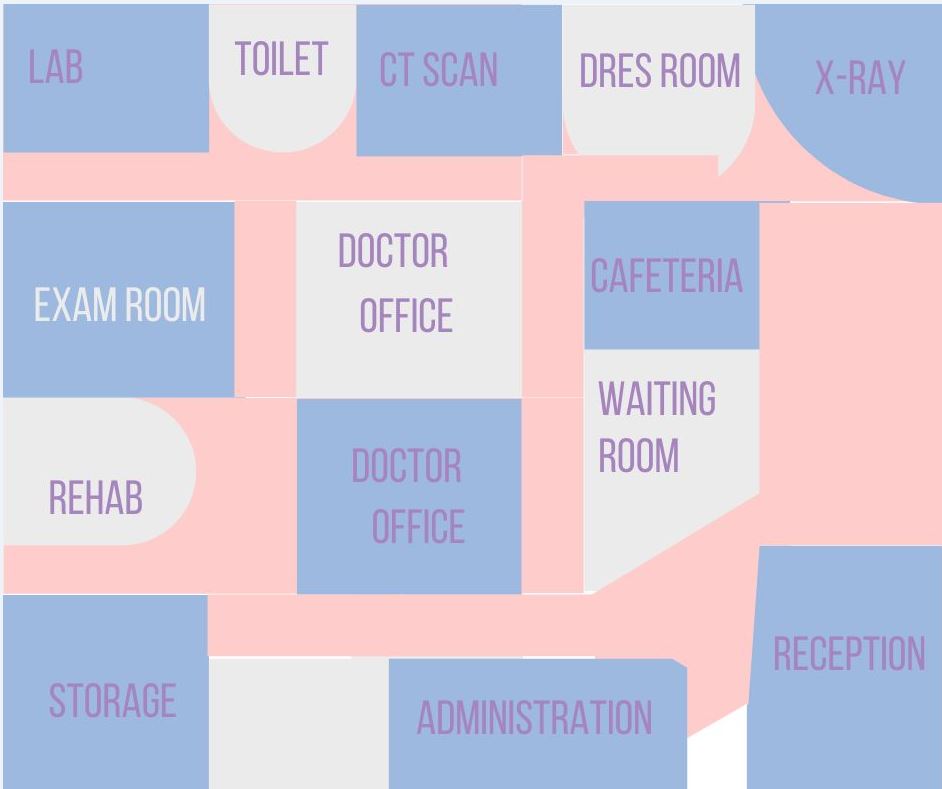
Read Lily's description of her workplace

I’m a Medical receptionist. As soon as you step in, you will see me at the reception, ready to assist patients, schedule appointments, and provide any information they need.
In front of the reception, there is the waiting room, where patients wait for their turn. They can also wait at the cafeteria, which is next to the waiting room. On the left, there is an administration area, and at the end of the corridor, a storage space.
In the centre, there are two doctor offices. On the left, there is an exam room, and a rehab room.
To the left, there’s our lab, where various tests are conducted. Adjacent to it, there is a restroom. Continuing to the right, we have advanced imaging services, including a CT scan room and an X-ray room. Between the two, there is a private space, a dressing room, which provides comfort and privacy during examinations.
I love my job because I have the opportunity to help people every day.We assist a diverse range of people, from patients seeking routine check-ups to those requiring specialized treatments.
This is the exam room at Lily’s healthcare centre. Read the description:
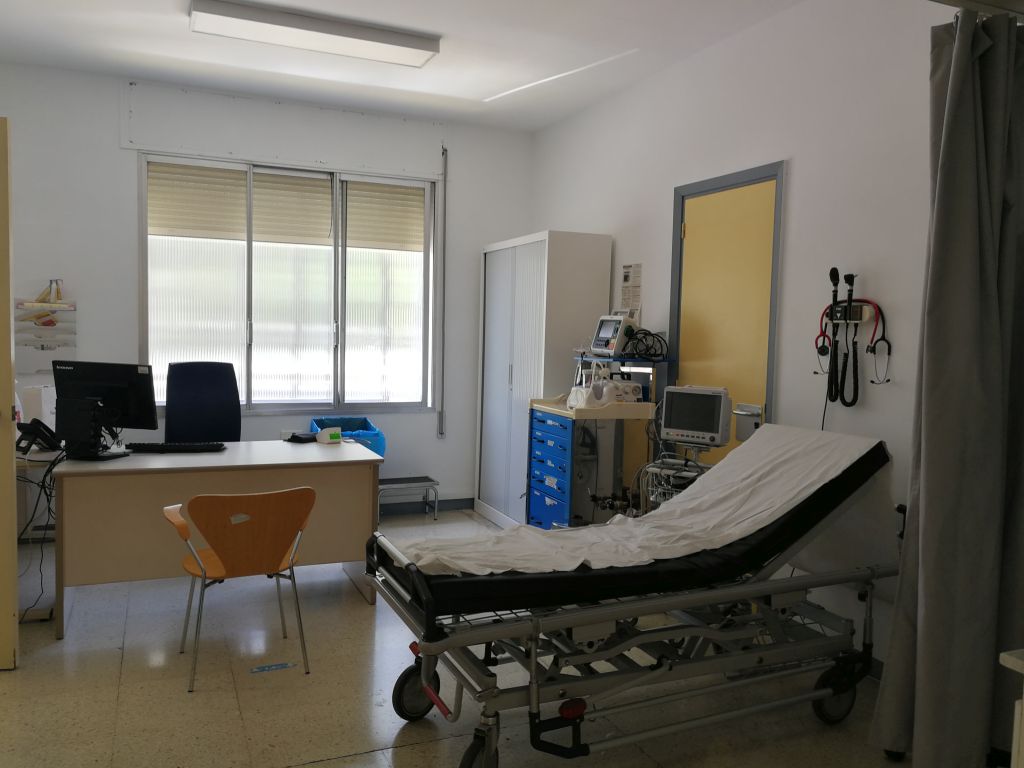
Exam room description
In the background, there is a window from where the light comes in. Under the window there is a table with an office chair for the doctor, and a wooden chair for the patient. On the table, there is a computer. On the right side, there is a filing cabinet, which is closed. In the foreground, we can see a wheeled stretcher, covered with paper. It looks used, as it is a little crumpled. On the left side, above the strecher, we can see a stetoscope and other medical tools. On the right, there is an echo cardio graph (ECG), which is used to monitor the patients heart rate.
Offices
In this section we are going to learn how to describe an office setting. Offices differ in size, they can be bigger or smaller, or even tiny, but they all have a few things in common, such as desks, office chairs, computers, printers, filing cabinets, etc.
Administration workers usually keep files in filing cabinets in order to organize them and put the documents that belong together. They use computers most of the time instead of paper. However, papers like patient histories, reports, or minutes must be printed. The printer still plays an important role, and paper is an essential tool in an office.
Apart from the furniture, in an office there are always stationery items, such as staplers, pencilhoders, hole punch, scissors, etc. See some of these elements present in the picture above.
Connectors are words that link two similar elements in a sentence. See some examples in the text:
- '…, or even tiny’ = '…, o fins i tot minúscules’
- '…such as desks…’ = '…així com/tals com escriptoris…’
- '…in order to organize…’ = '…per tal d´organitzar…’
| Vocabulary | ||
|---|---|---|
| A few: uns quants/es | File: arxiu | Printer: impressora |
| Always: sempre | Filing cabinet: Arxivador (moble) | Report: informe |
| Belong together: van junts/es corresponen | In order to: per tal de… | Size: mida |
| Desk: escriptori | Minutes: acta (d’una reunió) | Tiny: petit/minúscul |
Here is an example of an office:
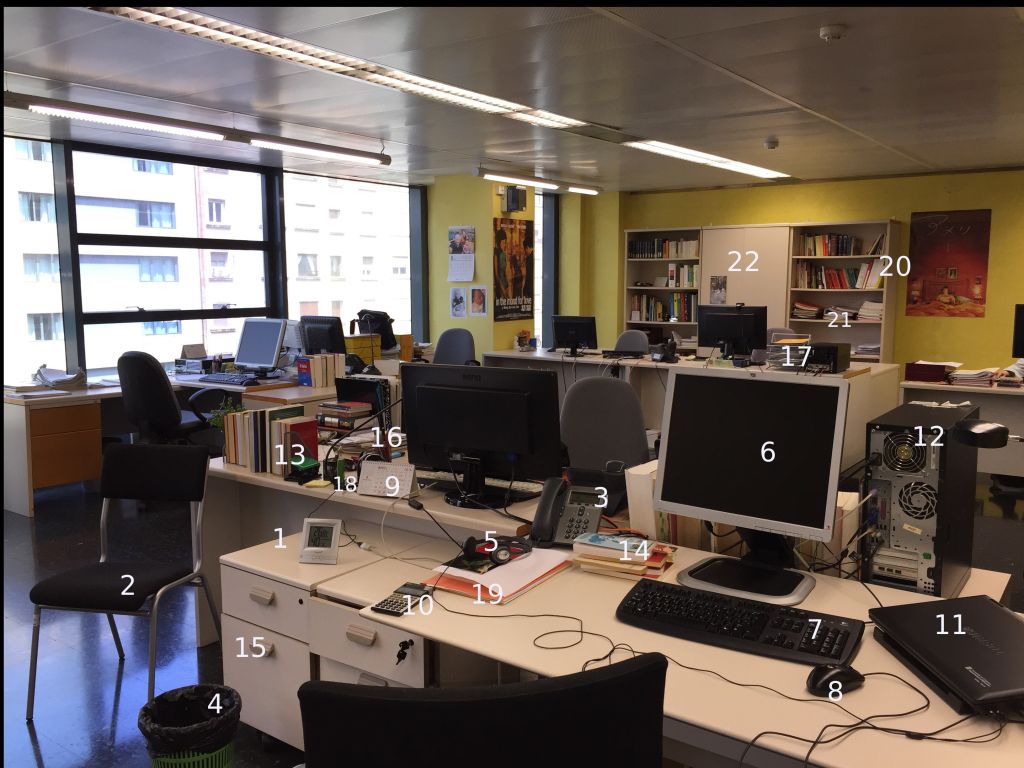
| Vocabulary | |||||||
|---|---|---|---|---|---|---|---|
| 1 Clock | 2 Chair | 3 Phone | 4 Waste bin | 5 Earphones | 6 Screen | 7 Keyboard | 8 Mouse |
| 9 Calendar | 10 Calculator | 11 Laptop | 12 Computer | 13 Hole punch | 14 Books | 15 Drawer | 16 Monitor |
| 17 Paper tray | 18 Pencilholder | 19 Folder | 20 Bookcase | 21 Shelf | 22 Filing cabinet |
Picture description: Queen's Hospital reception
See the picture of Queen’s Hospital reception, where the administrative work is done. They welcome patients, register them, give them information, schedule appointments, direct people to different places at the hospital, do the billing, and keep accounts.
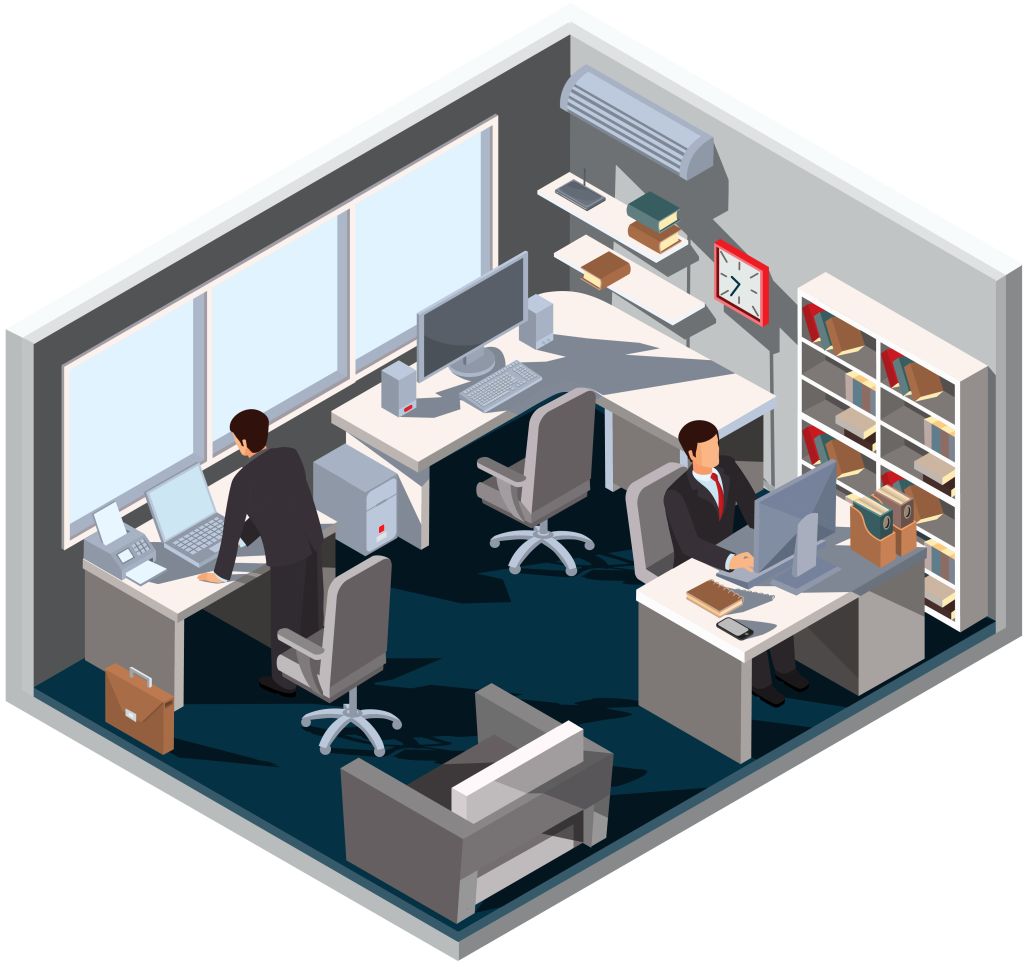
Description: Queen's Hospital reception
The office has three big windows, from where the light comes in. There are three desks. At this moment, there are only two people at the office, one is standing in front of the window. He is checking something on his laptop. The other one is sitting at his desk, he is working on his desktop. Both men are wearing a suit. One of them is wearing a red tie. There is another desk, but no one is sitting there.
In the foreground, we can see an armchair, but no one is sitting there, either. On the right side of the picture, we can see a man in front of the computer’s screen. He has a brown notebook on the table, next to the keyboard, and his mobile phone, too. On the other side of the table there are some binders. On his left side, we can see a bookcase with a lot of books.
In the background there is an empty chair and a desk with a keyboard and a screen, which is between two speakers. The computer case is on the floor. Above the desk there are two bookshelves with a few books. And above them, there is the AC. There is also a red clock on the wall, between the bookcase and the shelves.
On the left side there is a small desk where the man is standing. On the table there is a laptop, and beside it, a printer. On the floor there is a briefcase.
The working space has a plain style, it is very functional, but there are no flowers or paintings on the wall.
Source: freepick. author:@vectorpocket
| Vocabulary | ||
|---|---|---|
| AC: aire condicionat | Empty: buit (adj) | Notebook: llibreta |
| Armchair: butaca | Event: esdeveninment | Plain: senzill |
| Binder: carpeta (d’anelles) | In the background: al fons | Screen: pantalla |
| Bookcase: llibreria (moble) | In the foreground: en primer pla | Speaker: altaveu |
| Bookshelves: lleixes | Keep accounts: portar la comptabilitat | Stand: estar dret |
| Briefcase: cartera | Keyboard: teclat | Suit: vestit |
| Clock: rellotge (de paret o taula) | Laptop: ordinador portàtil | Tie: corbata |
| Desk: escriptori | No one: ningú | |
Comparing Workplace Settings
Read the following dialogue, where Craig and Samantha compare their offices. Note the use of comparative and superlative forms highlighted in bold:
See the use of the present continuous to describe what the people are doing in the picture:
- ‘One is standing…’
- ‘He is checking…’
- ‘Both are wearing…’
- ‘no one is sitting…’
Conversation: Comparing workplace settings
Craig: I really like your office. I love the colour of the walls. Yellow is my favourite colour. Your office is better than mine!
Samantha: Oh, really? I think yours is a lot nicer.
Craig: Well, mine is a lot smaller. That’s why I like yours better.
Samantha: Correct, but yours is independent from the rest. I wish my office were as private as yours.
Craig: You might feel that yours is less private than mine, but it’s not true. People often come in with any excuse. I’m sure mine is busier than yours.
Samantha: I don’t think so. Mine is louder, because it’s open, there’s no door.
Craig: Yes, you’re right. How long does it take you to get home?
Samantha: It takes me only 15 minutes.
Craig: Oh, that’s not much. Mine is farther. So, tell me… Which one is the best office?
Samantha: Well, mine is not the tidiest, or the quietest office in the world, but I must admit that mine seems to be better than yours.
Note the sentences Craig and Samantha use to compare their offices:
- Comparative of superiority:
- ‘Your office is better than mine!’
- ‘mine is a lot smaller’
- Comparative of equality:
- ‘I wish my office were as private as yours’
- Superlative:
- ‘Which one is the best office?’
- ‘mine is not the tidiest’
Indicating location
In the previous section, we saw descriptions of various settings. In all of them we made use of prepositions to indicate the position of the elements in the different settings.
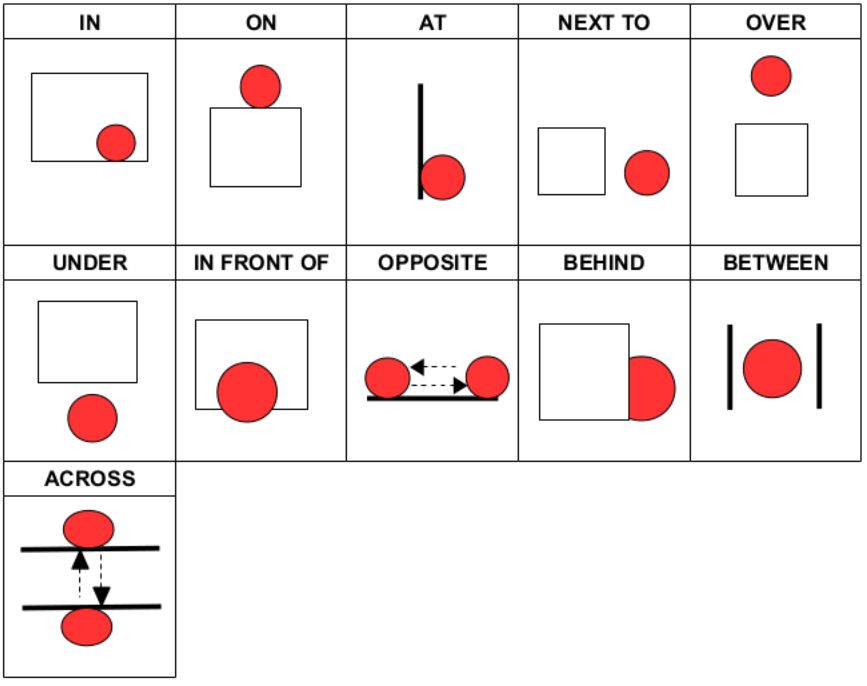
In this section, we will look into the use of prepositions of place to indicate location. These prepositions can express position or movement.
Prepositions to indicate position:
After a preposition...
we can use:
- a noun: in the garden
- an object pronoun: for him
- a verb in -ing: without saying anything
| Preposition | Translation | Preposition | Translation |
|---|---|---|---|
| in | a, dins de | on | a sobre de, damunt de |
| next to | al costat de | above | per damunt de |
| under | a sota de | in front of | al davant de |
| opposite | davant de | behind | al darrera |
| between | entre | across | a l’altra banda de |
| over | per damunt | along | al llarg de |
Some common expressions with these prepositions
| In | On | At |
|---|---|---|
| in London | on the corner of | at home |
| in England | on the wall | at work |
| in the street | on the floor | at school |
The following image shows a graphical representation of the prepositions of place indicating position:
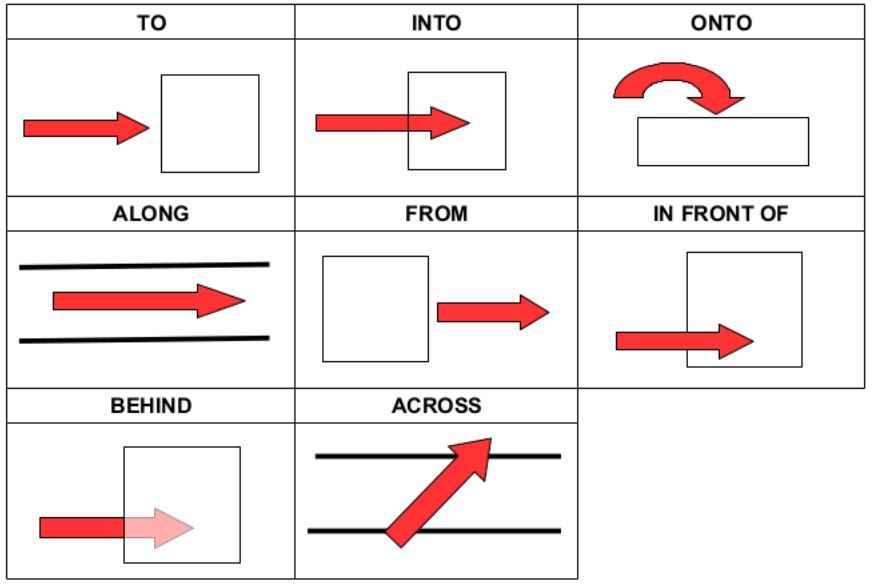
The prepositions that express movement are:
| Preposition | Translation | Preposition | Translation |
|---|---|---|---|
| To | a, cap a | Into | cap a dins de |
| Onto | cap el damunt de | Along | per, al llarg de |
| From | de, des de | In front of | cap al davant |
| Behind | cap el darrera | Across | a través de |
| Towards | en direcció a |
Towards is more formal than the preposition to. Example: I saw him walking towards the car park.
We use all these prepositions with verbs that indicate movement, for example:
| Verb | Meaning | Verb | Meaning |
|---|---|---|---|
| go | anar | drive | conduir |
| fly | volar | run | córrer |
| walk | caminar |
Here are some examples:
| Example | Translation |
|---|---|
| I am flying to London | ‘Estic volant cap a Londres’ |
| Please, walk into the house, do not stay out | Sisplau, entra a la casa, no et quedis a fora |
| Put the boxes onto the table | ‘Posa les caixes a sobre la taula’ |
| I am coming from the office | ‘Vinc de l’oficina’ |
| They are walking behind the house | ‘Estan caminant cap a darrera de la casa’ |
But we do not use a preposition with the noun home:
| I am going home | ‘Vaig cap a casa’ |
It is wrong to say: *I am going to home.
The following image represents the prepositions of place that indicate movement:
Other prepositions
| Example | Translation |
|---|---|
| I work with very interesting people | ‘Treballo amb gent molt interessant’ |
| He left without saying goodbye | ‘Va marxar sense dir adéu |
| February is the second month of the year | ‘El febrer és el segon mes de l’any’ |
| Is this present for me? | ‘Aquest regal és per a mi?' |
| The job was finished by Peter | ‘La feina va ser acabada per en Peter’ |
Asking for and Giving Directions
Giving directions means to explain someone the way to a certain place. We can ask for directions with these questions:
| Asking for directions | Translation |
|---|---|
| How can I get to…? | ‘Com puc anar a…?' |
| Can you tell me the way to…? | ‘Em pot indicar el camí per anar a…?' |
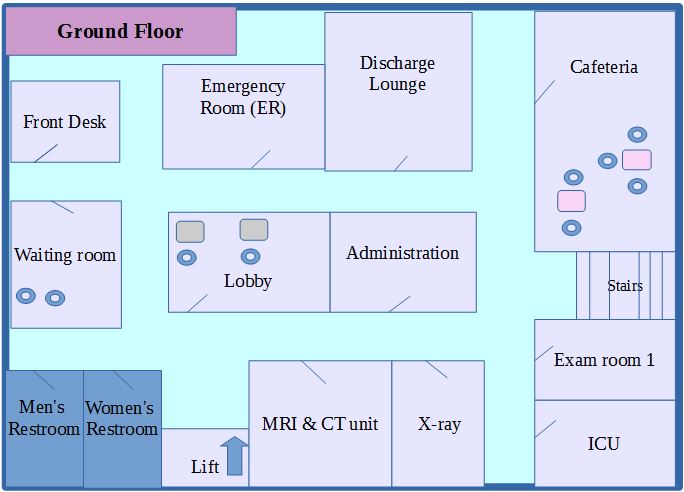
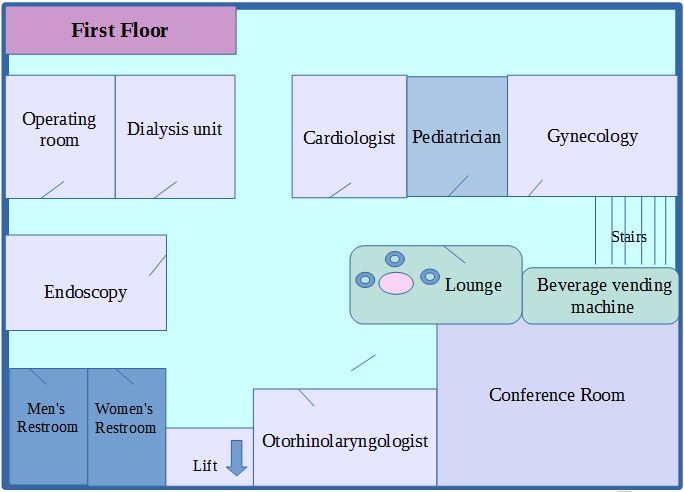
When you are at the front desk or the reception, you have to direct patients and visitors to different places in the facilities. They will be asking where they are having their tests or examinations. See the floorplan of BDL Hospital (following two images), and read the dialogues below.
Medical receptionist: Good morning. How can I help you?
Patient: Hello, I have an appointment for an MRI test scheduled.
Medical receptionist: Alright. Could you please confirm your name and date of birth for me?
Patient: Sure. My name is Sarah Davis and my date of birth is June 15th, 1990.
Medical receptionist: Thank you, Ms. Davis. Just give me a moment to pull up your file. Ah, here it is. Everything seems to be in order. Your appointment is at 10:30 AM today.
Patient: Great. Can you tell me where I need to go for the MRI?
Medical receptionist: Of course. The MRI department is located on this floor, just turn left, past the waiting room. You will see the restroom, continue straight, past the elevators, and you will see the MRI & CT Unit. You’ll see signs along the way directing you as well.
Patient: Got it.Thank you for your help.
Medical receptionist: You’re welcome, Ms. Davis. Best of luck with your MRI test today. Have a nice day!
Patient: Thank you. Goodbye!
Medical receptionist: Good morning, how can I help you?
Patient: Hi, I received a message confirming my appointment to check the results of my gynecologist test.
Medical receptionist: May I have your full name?
Patient: Certainly, Emma Woods.
Medical receptionist: Yes, that’s correct. Let me just check your details. Ah, here it is. Dr. Williams at 10:30 am. Please take a seat and wait for your turn.
Patient: Thank you. Can you also tell me where Dr. Williams’ room is located?
Medical receptionist:: Of course. Dr. Williams’ office is on the first floor. Just take the lift to the first floor, go straight, turn right, and it’ll be the third door on your left.
Patient: Got it. First floor, third room. Thank you so much!
Medical receptionist: You’re welcome. If you need any further assistance, don’t hesitate to ask.
Indicating location
To give directions, it is sometimes useful to indicate the location of buildings and other reference points. To indicate the location, we must use the appropriate prepositions of place. Here are some useful expressions:
| Preposition | Translation |
|---|---|
| On the left/right | ‘A l’esquerra/dreta’ |
| On the corner of Green St. and Oak St. | ‘A la cantonada de Green St. i Oak St.' |
| Opposite the park | ‘Davant del park’ |
| Across the street | ‘A l’altra banda del carrer’ |
| Between the bookshop and a bank | ‘Entre la llibreria i un banc’ |
| Around the corner | ‘Al girar la cantonada’ |
| In Green St. | ‘A Green St.’ |
| Next to a hotel | ‘Al costat d’un hotel’ |
The names of the streets (abbreviations)
In the written form (for example, in maps and addresses), we may find the following abbreviations:
- St. : street
- Rd. : road
- Sq. : square
- Ave. : avenue
- Blvd. : boulevard
These abbreviations are always placed after the proper name: Green St., Central Sq., etc.
When we say the name of the street, we do not include the article the. It is wrong to say: ‘Go along the Green St.’ or ‘It is in the Green St.’, but we can use the article when the name is ‘Main St.’: Go along the Main St., It is in the Main St..
In the following dialogue, one person is giving directions (see map on following image for reference):
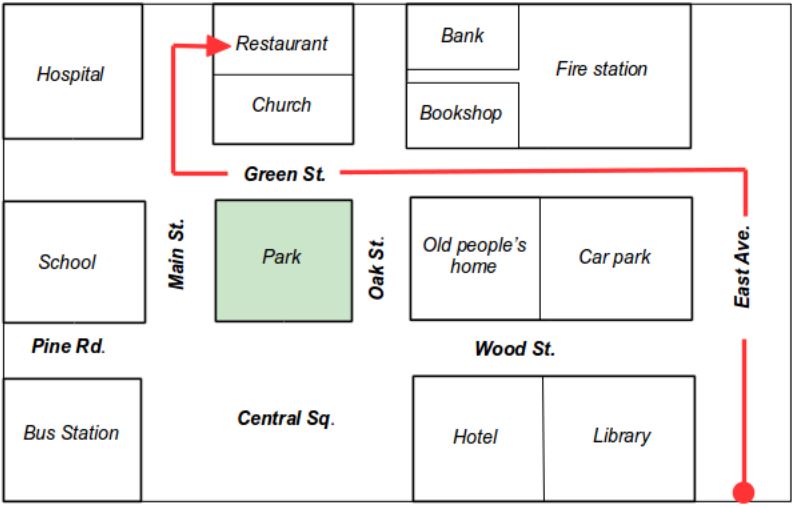
Read the following conversation:
A: Excuse me, how can I go to the restaurant?
B: The restaurant? Well, go along this street and turn second left. That’s Green Street. Go straight ahead, cross Oak Street and then turn right into the Main Street. Go past a church on the right and the restaurant is right there, next to the church.
Directions, direction and address
These three words are sometimes confusing. Here is the difference:
- Directions (Cat. orientacions, indicacions): always in plural; a synonym of ‘instructions’ (for example: I’ll give you directions to do the exam).
- Direction (Cat. direcció): the term refers to a course taken in relation to a reference point (for example: We’re going in the wrong direction).
- Address (Cat. adreça): the place where a building is located (for example: my address is 23, Green St.). We say: until you come to the traffic lights.
Some verbs commonly used to give directions are:
| Verb | Translation |
|---|---|
| Walk | caminar |
| Turn | girar |
| Take | prendre, agafar |
| Go along | anar per |
| Go across | travessar |
| Go past | passar per davant de |
Here are some expressions for giving directions:
| Expression | Translation |
|---|---|
| Turn (first/second…) left/right | ‘Gira pel (primer/segon…) carrer a l’esquerra/dreta’ |
| Turn left/right at the traffic lights | ‘Gira a l’esquerra/dreta quan arribis al semàfor’ |
| Turn left/right into Green St. | ‘Gira a l’esquerra/dreta per Green St.' |
| Go straight ahead/on | ‘Ves recte’ |
| Go along this street | ‘Ves per aquest carrer’ |
| Go across Green St. | ‘Travessa Green St.' |
| You will go past a bank | ‘Passaràs per un banc’ |
| Take the (first/second…) street on the left/right | ‘Agafa el (primer/segon…) carrer a l’esquerra/dreta’ |
The expressions ‘go straight ahead’ and ‘go along’ are often confused:
- ‘Straight ahead’ is an adverb that indicates the direction of the movement: we cannot say the name of the street with this expression. It is wrong to say:
Go straight ahead Green St. and turn left. We say: Go straight ahead and turn left. - ‘Along’ is a preposition, so we must use a noun. It is wrong to say:
Go along and turn left. We say: Go along Green St. and turn left.
To give directions, we have to give clear instructions: Use short sentences and keep them simple. Do not give long and detailed information. The words and expressions must be appropriate to the context. The normal pattern is: first, explain the way to the place; next, say the exact location by using the appropriate prepositions and reference points (for example: opposite a park). We generally use the imperative form or the modal verb should. We can combine the imperative with the future form (will): you will go past a bank, you will see a park, etc.
A frequent mistake when giving directions is the wrong use of the preposition until (Cat. fins a). This is a preposition of time, so it is wrong to say: until the traffic lights. We say: until you come to the traffic lights.