


Arrangements
The term ‘arrangements’ (used in its plural form) is generally used to describe the different activities carried out by a company in order to improve business. Such activities may include business meetings, business meals or the organization and/or attendance to trade fairs.
Business meetings
Formal meetings are an essential part of the planning and direction of a company since important decisions about the organisation may be taken. These meetings are held at a specific time, at a defined place (venue) and according to an agreed agenda, which should be sent to the participants at least one week in advance.

Formal meetings are typically led by a chairperson, and the discussions and agreements are recorded in what is known as minutes. One example is the AGM. Most companies organize the Annual General Meeting (AGM) for all members of the company. The agenda usually includes the approval of the last AGM, the presentation of the annual accounts for the last financial year, a report from the Management Comittee on the organisation’s activities during the last year, the election of the Management Committee, and other relevant topics.
In some cases, members of a company travel to another country for a formal meeting and they have to stay away for some days. Business tourism can involve individual and small group travel, and destinations can include small to larger meetings, including conventions and conferences, trade fairs, and exhibitions.
Big cities usually have a specific venue to hold fairs and exhibitions. Barcelona, the capital of Catalonia, is known for its enterprising and dynamic nature. The city is open to people and to the world and it is an international point of reference both socially and economically. Fairs and conferences take place in Barcelona every year. One example is the Mobile World Congress, a congress on the last technologies related to mobile communication which is held in Fira Gran Via. Other annual fairs and exhibitions go on in the city, such as Construmat, a construction industry fair, and the Saló de l’Ensenyament, with information about universities, courses and all kind of training for students, etc.
| Agenda (n): ordre del dia | Fair (n): fira |
| Agreement (n): acord | Hold (v): celebrar |
| Approval (n): aprovació | Meeting (n): reunió |
| Be recorded (v): estar registrat, estar anotat | Minutes (pl n): acta (d’una reunió) |
| Chairperson (n): persona convocant (d’una reunió) | Report (n): informe |
| Conference (n): conferència | Take place (v): tenir lloc |
| Congress (n): congrés | Topic (n): tema, assumpte |
| Convention (n): convenció | Trade fair (n): fira comercial |
| Enterprising (adj): emprenedor | Venue (n): lloc (d’un esdeveniment) |
| Exhibition (n): exposició |
Business meals
The promotion activities of a company often include a business meal with customers or colleagues from other companies. These meals can be more or less formal, depending on the objective of the meal and the people who will attend. If we must organise or attend a formal business meal, it is very important that we are well acquainted with the rules of protocol which have been established for these events. These rules usually include a certain behaviour, the use of formal language and a strict dress code: an evening dress for women and a suit and tie for men. In very formal meals, a dinner jacket for men may be required.
Organising a formal business meal
The organisation implies the sending of invitation letters to the potential guests, the choice of a restaurant and often the choice of a menu. Depending on the degree of formality of the meal, you may also need to consider the setting of the table, which must follow certain rules of protocol.
The elements that compose a table are referred to with the generic term ‘tableware’, a term that includes plates, cutlery and different types of glasses. ‘Cutlery’ is another generic term that includes any kind of hand utensils used in preparing, serving and especially eating the food, although in the USA, ‘cutlery’ refers only to knives and other cutting utensils, whereas the rest of hand utensils are known as ‘silverware’. In the Western cultures, the three major utensils for eating are the knife, the spoon and the fork.
The basic elements of a dinner service include the plate or plates (one on top of the other), the napkin, the spoons, the knives, the forks and the glasses.
The cutlery is placed in order of use. The pieces that are used first go on the outside position and those used last are placed nearest the plate. The napkin is carefully folded and usually placed to the left of the cover or on the plate.
The following image shows the proper setting of a table for a formal meal:

Attending a formal business meal
When attending a formal meal, you must show a distant, but polite attitude. This will give an overall positive impression. You should greet other people by using polite formulas like: Mr Smith, how do you do? Always shake hands. Do not use informal gestures like patting a person’s back, for example, although they may seem more friendly. Do not forget to turn off your mobile phone before you go into the restaurant.
-
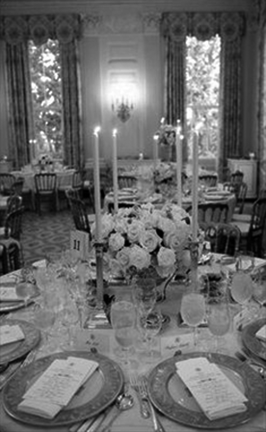
- A table laid for a formal meal
You should think that non-verbal communication can say a lot of things about us, so your behaviour is very important on these occasions. You should wait until everyone is seated at the table and then place your napkin on your lap. If your napkin happens to fall to the floor, you should ask the waiter for a new one. If you are the guest, you should be careful not to order the most expensive items on the menu or to order more than two courses unless your host specifically asks you to do so or the menu has been fixed beforehand.
Once you are sitting at the table, you will be faced with a multi-course meal with lots of different utensils. There is also a protocol that establishes the use of such utensils. You should start with the knife, fork or spoon which is the farthest from your plate and work your way in, using one utensil for each course.
There are two ways to use a knife and fork to cut and eat your food: the American style and the European or Continental style. Either is considered appropriate.
In the American style, food is cut by holding the knife in the right hand and the fork in the left hand with the fork tines piercing the food to secure it on the plate. Once the food has been cut, you have to change your fork from your left to your right hand to eat, with the fork tines facing up.
The European or Continental style is the same as the American style in that you cut your meat by holding your knife in your right hand while securing your food with your fork in your left hand. The difference is that your fork remains in your left hand, the tines facing down, and the knife in your right hand.
After the meal, the correct way of showing that you have finished is to place the knife and fork on your plate in a 4 o’clock position and the napkin on the right-hand side of your table setting.
After the formal business meal
After a formal meal, it is customary to have some sort of follow-up. It is proper business etiquette to send your host a thank-you letter where you express your gratitude for the meal. It is a good way to appreciate the host and to reinforce your interest in a particular business relationship.
These letters do not need to be long or very formal. A few lines focusing on what you value or appreciate about the other person’s effort will be enough. A thank-you letter should be sent as soon as possible after the event.
These letters should ideally include the following information:
- First paragraph: thank the interviewer for taking the time to meet with you (mention the date).
- Second paragraph: restate your interest in the organisation. Mention something you learned from the meeting or comment on something of importance that you discussed. Again, emphasize your strengths, experiences and skills.
- Third paragraph: thank the host for his/her time and consideration. You may want to finish your message with a suggestion for further action and you can also mention that you will provide your phone number and the hours you can best be reach.
| Attend (v): assistir | Gratitude (n): agraïment, gratitud |
| Be acquainted with (v): estar familiaritzat amb | Guest (n): invitat, comensal |
| Behaviour (n): comportament | Host (n): amfitrió |
| Business meal (n): dinar/sopar de negocis | Invitation letter (n): carta d’invitació |
| Choice (n): tria, elecció | Knife (n): ganivet |
| Colleague (n): company de feina | Lap (n): falda, part del damunt de les cases |
| Course (n): plat (en un menú) | Napkin (n): tovalló |
| Customer (n): client | Order (v): demanar (en un restaurant) |
| Cutlery (n): coberts, coberteria | Pat a person’t back (n): donar copats a l’esquena (d’algú) |
| Dinner jacket (n): esmoquin | Pierce (v): punxar |
| Dinner service (n): servei , sopar | Plate (n): plat (recipient) |
| Dress code (n): normes en el vestir | rule of protocol (n): norma de cortesia |
| Etiquette (n): etiqueta, protocol | Shake hands (v): donar la mà |
| Evening dress (n): vestit de nit | Silverware (n): coberts, coberteria |
| Folded (adj): plegat | Spoon (n): cullera |
| Follow-up (n): seguiment | Suit (n): vestit (d’home) |
| Fork (n): forquilla | Tableware (n): vaixella, servei de taula |
| Fork tie (n): pua de la forquilla | Thank-you letter (n): carta d’agraïment |
| Glass (n): copa, got | tie (n): corbata |
Trade fairs
Companies usually participate in trade fairs as part of their marketing strategy because fairs are very good to show potential customers what the companies sell or do, to establish business relationships with similar companies and to learn about the latest innovations in the corresponding field of interest. Local governments are usually very interested in trade fairs because they are an excellent means of development and promotion for the city. For this reason, the city councils often become the greatest promoting agents of trade fairs.
-

- The Barcelona fairgrounds
There are several types of trade fairs. They can be classified as:
- General trade fairs. These trade fairs exhibit all types of consumer and industrial commodities. They are open to professionals and to the general public. They are good for promotion because the number of visitors is very large, but it is difficult to make good business deals.
- Specialized trade fairs. These fairs are primarily for business exhibitors from various levels of trade and industry. It attracts large numbers of business people, specifically concerned with the area of specialization. For new companies, these fairs offer the best opportunity to find buyers, distributors and retailers.
- Consumer fairs. These fairs are primarily addressed to the general public. They are characterised by the great variety of products exhibited and by the wide interests of the visitors. These fairs are especially appropriate for companies that are already established but wish to promote their products.
According to their geographical range, the trade fairs could be divided into:
- Local fairs. They are especially addressed to the customers from a town and its surrounding area. The participants are usually small businesses whose main objective is to promote local products.
- National fairs. They attract customers and exhibitors from all over the country. The participants are usually medium-sized businesses that seek to expand at a national scale and promote their products and services over a wide public.
- International fairs. These fairs attract professionals from all over the world. They are excellent platforms for companies that wish to expand their businesses to other countries and for multinational companies that want to promote their products at a global scale.
Organising a trade fair
Trade fairs may be organised by a company itself, by the council or by specialised companies whose business is precisely to organise fairs and other events for other companies. In any case, organising a trade fair requires careful planning and systematic decision-making because they often involve a great investment of money. First of all, the organisers must set clear objectives and know in advance the type of products that will be displayed in the fair and, consequently, provide facilities and take into consideration thousands of details.
Here are some guidelines for organizing a trade fair.
1. Before the trade fair:
In the planning stage of the trade fair, the organisers must identify the tasks to be carried out and select the speakers in case speeches have been planned. They must also draw up a detailed budget, including such items as advertising, staff recruitment, space rental, design, construction and dismantling of stands, furniture rental, decoration within the stand, telecommunications and networking facilities, participant accommodations, electrical fitting, stand cleaning, telephone installation, mailing, security, reception, public relations, transportation, food services, first-aid emergency, and giveaway items.
Hotel bookings for the visitors must be placed well in advance to ensure availability. Organisers should negotiate special convention rates and types of rooms, special meals (like religious and disease diets) and registration deadlines. Other issues to consider are the existence and cost of parking facilities, nearby restaurants, points of interest and available transportation to and from the hotel.
Planning a special promotional program for the trade fair is also very important. When the visitors are well identifed, the most common means of advertising the event is by means of invitation letters. To attract the general public, the organisers should consider publication on the local radio, newspapers and television, depending on the importance of the event.
2. During the trade fair:
An important and necessary event at any trade fair is the registration of the exhibitors on the opening day. In order to gain productivity during the whole presence at the trade fair, the exhibitors must pay attention to the promotion and presentation of their company to ensure that potential customers seek their stand in particular.
Most trade fairs also include activities pursued directly within the fairgrounds or outside their boundaries. These activities represent a value added to the participation at the fair. The company’s representatives can participate in presentations or press conferences and can hold lectures at fair-related events. An ideal opportunity for addressing important customers may also be an evening party, as an informal meeting is often more successful for making business contacts than an official meal or an official reception.
-
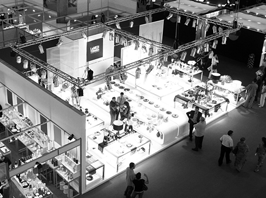
- A stand in a trade fair
3. After the trade fair:
When the fair is finished, it is time for the participants to evaluate the results of the fair and draw conclusions about the objectives reached.
The organisers should:
- Register items to be returned to the respective companies.
- Remove the exhibits from the racks.
- Dismantle the stands safely and without destroying the stand materials.
- Hold a reception on the closing day to facilitate contacts between exhibitors and potential customers.
- Send out press releases as a promotional activity to state the positive results of the participation.
- Draw up a follow-up plan to determine the benefits and help in the organisation of future events.
On the other hand, the exhibitors should:
- Compare invitations with the guest list at the stand.
- Forward a list of post-fair customer appointments to the sales department.
- Write letters to the new contacts.
- Analyse the coverage of the fair in the media.
- Send press releases and feedback questionnaires quickly to the new contacts.
- Set goals for future events.
| Accomodation (n): allotjament | Hotel booking (n): reserva d’hotel |
| Advertising (n): publicitat | Industry (n): indústria |
| Appointment (n): cita | Investment (n): inversió |
| Be concerned with (v): estar interessat en | Invitation letter (n): carta de invitació |
| Budget (n): pressupost | Involve (v): implicar, significar |
| Business (n): negoci, empresa | Issue (n): tema, aspecte |
| Business deal (n): acord, tracte, negoci | Marketing strategy (n): estratègia publicitària |
| Buyer (n): comprador | Parking facilities (n): aparcament, servei d’aparcament |
| City council (n): ajuntament (institució) | Press conference (n): conferència de premsa |
| Commodity (n): producte, mercaderia | Press release (n): comunicat de premsa |
| Coverage (n): cobertura mediàtica | Professional (n): professional |
| Development (n): desenvolupament | Promoting agent (n): promotor |
| Dismantling (n): desmuntatge | Promotion (n): promoció |
| Display (v): mostrar, exhibir | Rack (n): prestatgeria |
| Distributor (n): distribuidor | Rate (n): tarifa |
| Exhibit (n): peça, objecte exposat | Registration (n): inscripció |
| Exhibit (v): exposar, exhibir | Registration deadline (n): data límit per a la inscripció |
| Exhibitor (n): expositor | Retailer (n): minorista |
| Expand (v): expandir-se, estendre’s | Set goals (v): establir objectius |
| Facilities (pl n): serveis, instal·lacions | Speaker (n): orador |
| Fairground (n): fira, espai destinat a la fira | Speech (n): discurs |
| Follow-up plan (n): pla de seguiment | Staff recruitment (n): contractació de personal |
| Furniture rental (n): lloguer de mobiliari | Stand (n): stand |
| Geographical range (n): àrea geogràfica | Trade (n): comerç |
| Giveaway item (n): obsequi, regal | Trade fair (n): fira comercial |
| Guest list (n): llista de invitats | Visitor (n): visitant |
| Hold lecturs (n): celebrar xerrades |
Language in use
Anuga Fair
Anuga Fair is held in Cologne. It is a food fair for the retail trade and the food service and catering market. Companies related to food and hotel services summon there to exhibit their products and share their knowledge through the various speeches and workshops. In the fair there are gala dinners, banquets, and buffets giving different choices of menu each day offering the best and most original food combinations.
Belinda Jenkings, Pawel Janczak and Céline Thierry are of some of the attendants of the fair this year. These are their business cards:
Belinda Jenkings works for the Marketing department of the company “Ecotasty Food”. The company develops organic processed products, they do research on organic farming and organize courses and talks on organic products and cooking.
Pawel Janczak is a Polish entrepreneur who has started a venture. He aims to introduce and spread organic farming in his country, and to raise awareness among farmers. He wants to attend the fair in order to see the current trends in the international market.
Céline Thierry lives in the South of France. Since an early age she has been interested in farming and ecology. In addition, she promotes fair trade in her region. She believes that farmers have to be paid a fair price for their goods.
Language notes
- Since: This word has been used twice in the text, but with different meanings. In the first paragraph: ”…direction of a company since important decisions…” Since in this context is used to express the reason. In the last paragraph, where Céline is introduced (since an early age…”), since means ‘from that time on’.
- Note that the use of the passive voice is more common in English than in other languages. See some instances in the text and the translation into Catalan:
- May be taken (decisions): poden ser preses (les decisions).
- is/are held (the fair): té lloc (la fira).
- should be sent (the agreed agenda): hauria de ser enviada / s’hauria d’enviar (l’agenda/ordre del dia acordada).
- are led (formal meetings… by a chairperson): les reunions formals són liderades/moderades per un moderador.
- “are recordered” (discussions and agreements): són enregistrats (discussions i acords).
- “is known as…“: és conegut com…/es coneix com…
- “have to be paid” (“farmers…a fair price”): als agricultors se’ls ha de pagar un preu just.
- Such as: It is used to list different elements. It means ‘for example’.
Protocol
Protocol is very important in a business context. It is necessary to be well trained in business meeting etiquette to ensure that a business meeting is effective.
- First of all, a formal invitation has to be sent to the intended guests (see an example in the previous section: invitation mail to the AMM of the company Kdiet).
- Attire also matters; wear casual or formal clothes according to the type of meeting. In very formal meetings or official dinners you will have to dress up.
- Do not interrupt while someone is speaking, wait for the designated question period to raise your questions. Take notes, since some of your questions might be answered by the content of the meeting.
- During formal meetings it is quite usual to interchange business cards for future contact. It is advisable to have them prepared and updated for that day. You may have to wear badges with your name and the name of your company. Badges are quite useful in order to identify other participants in the meeting.
- Avoid nervous habits, such as tapping a pen or your fingers on the table, making noises, or showing disapproval with your body language.
- Turn off your cell phone prior to the start of the meeting. It would be rude to be looking at your smartphone while relevant matters are discussed.
- After the meeting, a thank you letter should be sent to all the participants.
Practical examples
In some cases, we might find ourselves in a group, and there is an uncomfortable silence. It is good to have a strategy to avoid such situations, for example you can discuss about the weather, or other general topics. Here you will see some dialogues which took place in different contexts in the Anuga Fair held in Cologne this year.
Dialogue 1
Belinda Jenkings: Hello, I’m Belinda Jenkings, I work with Ecotasty Food, in The Netherlands.
Céline Thierry: Nice to meet you. I’m Céline Thierry, with Agriécolo.
Belinda Jenkings: Where are you from?
Céline Thierry: I’m from France.
Dialogue 2
Pawel Janczac: Good morning, My name’s Pawel Janczac. How are you?
Céline Thierry: Nice to meet you, Mr. Janczac, I’m Céline Thierry, with “Agriécolo”.
Pawel Janczac: Nice to meet you, Ms. Thierry. You’re from France. Aren’t you?
Céline Thierry: Yes, I am. And you?
Pawel Janczac: I’m from Poland.
Céline Thierry: What do you do?
Pawel Janczac: I’m an enterpreneur. I’m trying to raise awareness of organic farming in my country.
Céline Thierry: How interesting! I’m into farming and ecology, too.
Dialogue 3
Céline Thierry: Ms Jenkings, good to see you again! May I introduce you to Mr Janczac?
Belinda Jenkings: How do you do?
Pawel Janczac: How do you do.
Céline Thierry: Mr Janczac is Polish. He’s an enterpreneur and he’s interested in organic farming.
Belinda Jenkings: Oh, this is my field too. In our company we develop organic processed food and do research on organic farming.
Céline Thierry: So, we are all into organic farming. We have a lot of things to discuss about.
At the restaurant
Belinda Jenkings: Hello, we have a reservation for three people.
Waiter: Ok, your name, please?
Belinda Jenkings: Belinda Jenkings.
Waiter: Yes, I see. Would you follow me, please? I will show you your table.
Belinda Jenkings: What is on the menu?
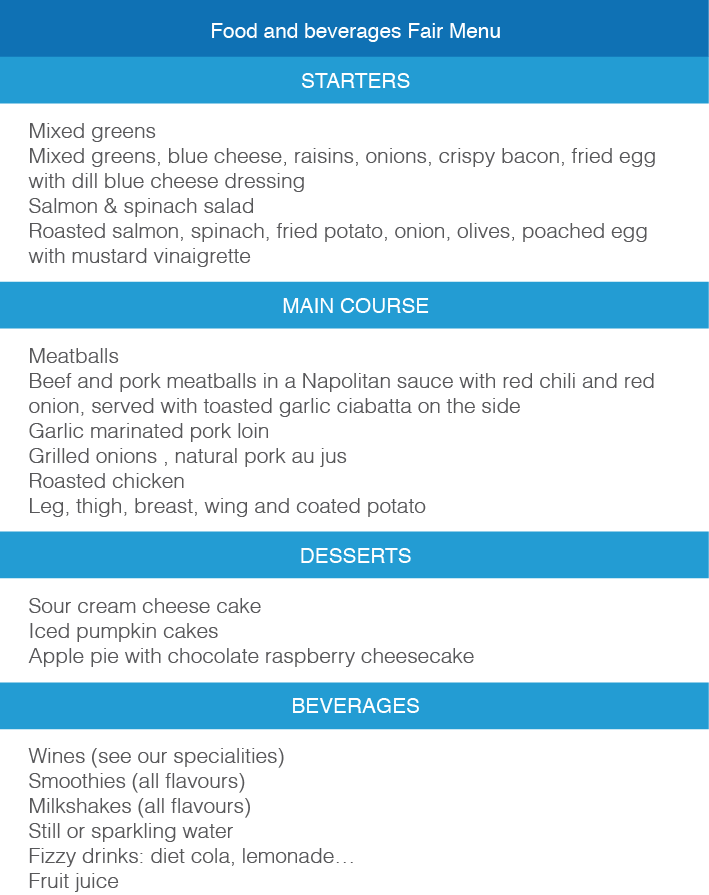
Waiter: We have a special menu for the fair. Here you are.
Céline Thierry: Thank you.
Waiter: Can I take your order?
Céline Thierry: Sure. I would like to start with mixed greens and roasted chicken for the main course.
Pawel Janczac: I’ll have the same.
Belinda Jenkings: What’s the pork loin like?
Waiter: It is very good.
Belinda Jenkings: Well…, then I’ll take a salad to start and pork loin as a second course.
Waiter: How would you like your steak? rare, medium or well done?
Belinda Jenkings: Well done.
Waiter: Anything to drink?
Céline Thierry: We’ll have red wine.
Booking a hotel room
Receptionist: Hello, Central Cologne Hotel. How may I help you?
Belinda Jenkings: Good morning, I’d like to book a single room for two nights please.
Receptionist: When for, madam?
Belinda Jenkings: Next Friday, October 9th.
Receptionist: Let me check. Yes, we have one single room available.
Belinda Jenkings: Great. How much is the charge per night?
Receptionist: Eighty euro, madam.
Belinda Jenkings: OK, that’s fine.
Receptionist: Can I have your name, please?
Belinda Jenkings: Yes, it’s Jenkings. Belinda Jenkings.
Receptionist: Can I have your telephone number, please?
Belinda Jenkings: Yes, it’s six-oh-six-double two-five-six-eight-nine (606 22 56 89).
Receptionist: Ok. What time will you be arriving?
Belinda Jenkings: Around 5pm.
Receptionist: Thank you and have a nice day.
Thank you letters
After a business meeting, it is quite common to send a thank you letter. This type of letters should include the following information:
Information needed in a letter
- First paragraph: Thank the interviewer for taking the time to meet you.
- Second paragraph: Restate your interest in the company/school/organization. Mention something you learned from the meeting or comment on something important that you discussed.
- Third paragraph: Thank the interviewer for their time and consideration. If it is the case, you can close wiht a suggestion for further action.
See the following sample:
Agriécolo
1, rue des Pertuisanes
34000 Montpellier
France
Montpellier, 21 October, 2016
Ms Lena Schöeder
Wilhelm-Leuschner Strasse 31
60329 Cologne
Germany
Dear Ms Schöeder,
I am writing this letter to appreciate your invitation to the Anuga Fair held in Cologne last week.
I have heard nothing but praise from all who attended the fair. The exhibitions were very interesting and the food was delicious. The presenters were well prepared and the sessions were well attended. You did a good job organizing the workshops and selecting the topics.
Furthermore, it was very profitable, since we had the opportunity of meeting other companies and have interesting discussions, which might lead to further cooperation with them.
Congratulations on both a successful and a memorable fair. Thank you for your invitation.
We look forward to attending the next fair next year.
Yours sincerely,
Céline Thierry
Sales department
| Attend (v): assistir (a un lloc) | Goods (pl n): productes |
| Attendant (n): assistent (a un lloc) | Guest (n): invitat |
| Attire (n): vestimenta, roba | Main course (n): plat principal |
| Badge (n): etiqueta, distintiu | Mixed greens (pl n): verdures variades |
| Book (v): reservar, fer una reserva | Organic farming (n): agricultura orgànica |
| Buffet (n): bufet | Organic processed products (pl n): productes orgànics processats |
| Business card N): targeta professional | Pork loin (n): llom de porc |
| Casual clothes (n): roba informal | Prior to (prep): abans de |
| Catering market (n): mercat del catering | Promote (n): promocionar |
| Cell phone (n): telèfon mòbil | Raise a question (v): fer una pregunta |
| Charge (v): cobrar | Raise awareness (v): despertar la consciència |
| Cooking (n): cuina (activitat) | Reservation (n): reserva |
| Current trend (n): última moda | Retail trade (n): comerç minorista |
| Disapproval (n): disconformitat, desaprovació | Roasted chicken (n): pollastre rostit |
| Do research (v): fer recerca | Share (v): compartir |
| Dress up (v): mudar-se, arreglar-se, vestir-se | Single room (n): habitació individual |
| Entrepreneur (n): emprenedor | Speech (n): discurs, xerrada |
| Exhibit (v): mostrar, exposar | Summon (v): reunir-se, ajuntar-se |
| Fair price (n): preu just | Take an order (v): agafar una comanda (al restaurant) |
| Farmer (n): agricultor, granger | Talk (n): xerrada |
| Farming (n): agricultura | Tap (v): picar, tamborinar |
| Food fair (n): fira alimentària | Turn off (v): apagar (un aparell) |
| Foord service market (n): mercat de la distribució d’aliments | Venture (n): negoci, aventura (comercial) |
| Formal clothes (n): roba formal | Workshop (n): taller |
| Gala dinner (n): sopar de gala |
Communication: suggestions and invitations
Suggestions and invitations are two instances of the so called social language. We make a suggestion when we propose a course of action. In this sense, it is very much like giving advice because in both cases we say what we think should be done. The difference is that a piece of advice is always directed to a second person (you) whereas suggestions have a wider range.
An invitation is very similar to a suggestion. When you invite somebody, you are in fact suggesting a course of action.
Suggestions
We can make suggestions in different ways. Some are used in formal situations whereas others are used in informal situations. Next there is a list of some of these expressions.
Making formal suggestions:
A) SUGGEST + GERUND (-ING)
- I suggest speaking in English (Cat. Suggereixo parlar en anglès)
- He suggested talking to the head of our department first (Cat. Va suggerir parlar primer amb el cap del nostre departament).
B) SUGGEST + THAT-CLAUSE
- I suggest that we speak in English (Cat. Suggereixo que parlem en anglès).
- In the next meeting, I’ll suggest that we can finish work earlier (Cat. A la següent reunió, suggeriré que poguem plegar abans).
C) SUGGEST + NOUN
- I suggest a Japanese restaurant (Cat. Suggereixo un restaurant japonès).
- I would suggest a break (Cat. Jo suggeriria un descans).
Making informal suggestions:
A) WHAT ABOUT + GERUND (-ING) …?
- What about speaking in English? (Cat. Què tal si parlem en anglès?).
- What about having a coffee? (Cat. Què et sembla si prenem un cafè?).
B) WHAT ABOUT + NOUN …?
- What about a break? (Cat. I si fem un descans?).
- What about a coffee? (Cat. Què tal un cafè?).
C) WHAT ABOUT IF + YOU/WE + V. IN PRESENT SIMPLE …?
- What about if we speak English? (Cat. Què tal si parlem anglès?).
- What about if you help me with this? (Què et sembla si m’ajudes amb això?).
D) WHY DON’T YOU/WE + BASE FORM …?
- Why don’t we speak in English? (Cat. Per què no parlem en anglès?).
- Why don’t you wait a little longer? (Cat. Per què no t’esperes una mica més?).
E) YOU/WE COULD + BASE FORM
- We could speak in English (Cat. Podríem parlar en anglès).
- You could go and speak to the director (Cat. Podries anar a parlar amb el director).
F) LET’S + BASE FORM …!
- Let’s speak in English! (Anem a parlar anglès!)
- Let’s organize a big party (Organitzem una gran festa!)
Notes:
- What about…? and why don’t you…? are questions. Do not forget to write the question mark (?) at the end of the sentence. In speech, we must give it the entonation of a question.
- Let’s is the short form of let us, but we never write (or say) the long form. This expression usually has an exclamation mark (!) at the end.
- Let’s is used to include both the speaker and the other people in the suggestion.
Responding to a suggestion:
We can respond in different ways, depending on whether we agree or disagree with the suggestion. In general, all these expressions can be used in formal and informal contexts and they are independent of the way in which the suggestion was made. The translations are not literal, but just reflect equivalent expressions in Catalan used in the same context.
Agree:
- Yes, we could do that (Cat. Sí, podríem fer això).
- Yes, that’s a good idea! (Cat. Sí, bona idea!).
- Ok, let’s do that (Cat. D’acord, endavant!)
- Yes, why not? (Cat. Sí, per què no?)
- Ok, that’s great! (Cat. Excel·lent!)
Disagree:
When we disagree with a suggestion, the social protocol requires to explain the reason. For example: A: Why don’t we go to a restaurant? - B: No, I’d rather not. I’ve got no time and no money.
- I’m afraid it’s not a good idea (Cat. Em temo que no és gaire bona idea).
- I’m afraid we can’t do that (Cat. Em temo que això no és possible).
- I’d rather not (Cat. Millor que no).
- No, we can’t do that (Cat. No, això no ho podem fer).
- No, we shouldn’t do that (Cat. això no ho hauríem de fer).
Here are examples of suggestions in a context.
Suggestions (formal)
Jordi Planes is at a job interview for a post in an American company. Mrs Jenkins, the head of Human Resources, asks him for suggestions to improve the company’s sales.
Mrs Jenkins: Well, Mr Planes, I can see in your résumé that you worked as a market analyst for an electrical company. Perhaps you could give us some suggestions to increase our sales…
Jordi: To increase the sales… Ok, I suggest an aggressive marketing campaign.
Mrs Jenkins: Good, and what else?
Jordi: I would suggest a TV commercial directed by some well-known figure, Spielberg, Scorsese… someone really famous who can attract people’s attention.
Mrs Jenkins: I’m afraid we can’t do that, Mr Planes. That would be too expensive, don’t you think so?
Jordi: Yes, well, then you could make a standard commercial and perhaps sponsor a basketball team.
Mrs Jenkins: Yes, we could do that.
Suggestions (informal)
Jordi Planes works in a company in Manchester. He and a group of his British colleagues are discussing what to do to celebrate the retirement of their director, Mr Connor.
Peter: OK, people, as you know Mr Connor is retiring next month. Any suggestions?
Mary: We could go to a restaurant. He loves good food and, most of all, good drinking.
Tom: Come on, Mary! We can’t do that! You know that would cost a lot of money.
Jordi: Why don’t we organize a small party here in the office?
Susan: Yes, why not? That would be cheaper.
Daniel: What about a surprise party?
Peter: Yeah, that’s a good idea, too.
Jordi: We could each give £5 for a present, what do you think?
Mike: Great!
Susan: OK, let’s collect the money!
Tom: Wait, wait! What present can we buy? Have you got any suggestions?
Language notes:
- In the first dialogue, we must use a formal language because it takes place at a job interview. In the second dialogue, the situation is informal, as reflected in the language.
- Résumé: Mrs Jenkins uses this term instead of CV because she’s American. The word is spelt with the graphical accents because it is taken from the French language.
- Yeah: colloquial form of yes. The spelling reproduces the pronunciation of the word: /jeə/.
- £5: we must say five pounds. In the Anglo-Saxon world, the currency symbols are placed before the amount: £5, $5 (= five dollars), but we write 5€ (= five euros).
Invitations
To invite people, we can use different expressions and syntactical structures.
Making formal invitations:
To make invitations in formal situations, we can use the following expressions:
A) I (WOULD LIKE TO) INVITE + INDIRECT OBJECT + TO + BASE FORM…
- I would like to invite you to go out with me (Cat. M’agradaria invitar-te a sortir amb mi).
- I would like to invite my friends to spend the summer with me (Cat. M’agadaria invitar els meus amics a passar l’estiu amb mi).
- I invite you to come with me (Cat. T’invito a venir amb mi).
- I’ll invite him to sing at my party (Cat. L’invitaré a cantar a la meva festa)
B) I (WOULD LIKE TO) INVITE + INDIRECT OBJECT + TO + NOUN…
- He would like to invite you to a coffee (Cat. A ell li agradaria invitar-te a un cafè).
- I would like to invite you to a party (Cat. M’agradaria invitar-vos a una festa).
- I invite you to a concert (Cat. T’invito a un concert).
Formal invitations
We can use the form would like with the verb invite to make the invitation more formal.
In the formal written language, as for example, in invitation cards, the passive voice is frequently used. For example:
- You are invited to Mr Jones’ reception, which will take place on 23rd March in … (Cat: Està vostè invitat a la recepció del Sr Jones, que tindrà lloc el 23 de març a …)
Making informal invitations:
C) WOULD YOU LIKE + TO + BASE FORM +…?
- Would you like to have a walk with me? (Cat. Vens a passejar amb mi?).
- Would you like to come? (Cat. Vols venir?).
D) WOULD YOU LIKE + NOUN +…?
- Would you like some help? (Cat. Vols que t’ajudi?).
- Would you like a cold drink? (Cat. Vols una beguda fresca?).
Invitations and suggestions:
An invitation is very similar to a suggestion so the two language functions can share some expressions. To make invitations, we can also say:
- How about…? (Cat. Què tal si…?)
- What about…? (Cat. Què et sembla si…?)
- Why don’t we…? (Cat. Per què no …?)
Responding to invitations:
When someone invites you to do something, you can accept or you can reject the invitation.
Here are some possible responses.
To accept the invitation:
- Thank you very much. That would be very nice (formal) (Cat. Moltes gràcies. Serà un plaer).
- Thank you. You’re very kind indeed (formal) (Cat. Gràcies. És vostè molt amable).
- Thanks. That would be great (informal) (Cat Gràcies. Això estaria molt bé).
- Ok, I’d like to. Thanks (informal) (Cat. Sí, m’agradaria. Gràcies).
To reject the invitation:
- I’m sorry. I’m afraid (I’m not free tonight) (Cat: Ho sento. Em temo que [aquesta nit estic ocupat]).
- No, thanks, anyway. (I don’t feel like it now) (Cat. No, gràcies de totes maneres, però [ara no en tinc ganes]).
- Thank you but I can’t. (I must go immediately) (Cat. Gràcies però ara no puc . [Me’n he d’anar de seguida]).
Invitations and social protocol
When you reject an invitation, the social protocol requires to explain the reason. The protocol also demands that if you have been invited to a person’s house, you thank that person for his/her hospitality. For example, you can say:
- Thank you very much. That was a wonderful evening. (Cat. Moltes gràcies. Ha estat una vetllada magnífica.)
Grammar referece: the modal verbs
The modal verbs form a class of verbs that have some special characteristics. These verbs are:
- Can
- Could
- Must
- Should
- May
- Might
- Will
- Would
From a syntactical point of view, the modal verbs have the same characteristics of the auxiliary verbs be, have and do.
The characteristics of the modal verbs are the following:
- They have no meaning of their own: modal verbs must always be accompanied by another verb in the base form. They are used to express certain ideas like obligation, possibility, advice, etc.
- They only have one form, which is normally used to speak about the present and sometimes about the future. If we need to express the modal verbs in other tenses (like the past tense, the present perfect, etc.), we must use an alternative verb or expression. However, the verb can has a present form (can) and a past form (could).
- The modal verbs form the negative and the interrogative as the auxiliary verbs.
Therefore, the syntactical structures of sentences with a modal verb are these:
- Affirmative: SUBJECT + MODAL + BASE FORM: I should work.
- Negative: SUBJECT + MODAL + NOT + BASE FORM: I should not work.
- Interrogative: MODAL + SUBJECT + BASE FORM: Should I work?
Can, could
The modal verbs can and could are the present and the past forms, but they may have different meanings.
Can:
Can is used to express:
- Present ability: He can cook. (Cat. Ell sap/pot cuinar.)
- Certain possibility: It can rain. (Cat. Pot ser que plogui.)
- Informal permission: Can I go, please? (Cat. Puc marxar, si us plau?)
- Informal request: Can you open the window, please? (Cat. Pots obrir la finestra, si us plau?)
Could:
Could is used to express:
- Past ability: He could swim. (Cat. Ell podia/sabia nedar.)
- Uncertain possibility: It could rain. (Cat. Podria ser que plogués.)
- Formal permission: Could I go, please? (Cat. Podria marxar, si us plau?)
- Polite request: Could you open the window, please? (Cat. Podries obrir la finestra, si us plau?)
The following table shows the complete conjugation of can.
| Affirmative | Negative Long form | Short form | Interrogative | |
|---|---|---|---|---|
| I | can | cannot | can’t | can I…? |
| you | can | cannot | can’t | can you…? |
| he, she, it | can | cannot | can’t | can he/she/it…? |
| we | can | cannot | can’t | can we…? |
| you | can | cannot | can’t | can you…? |
| they | can | cannot | can’t | can they…? |
The table below shows the forms of could.
| Affirmative | Negative Long form | Short form | Interrogative | |
|---|---|---|---|---|
| I | could | could not | couldn’t | could I…? |
| you | could | could not | couldn’t | could you…? |
| he, she, it | could | could not | couldn’t | could he / she / it…? |
| we | could | could not | couldn’t | could we…? |
| you | could | could not | couldn’t | could you…? |
| they | could | could not | couldn’t | could they…? |
Alternative forms:
1) To express ability:
Be able to (Cat. ser capaç de)
In this form, the verb be must be conjugated in the correct tense. The syntactical structure is:
- SUBJECT + BE (conjugated) + ABLE TO + BASE FORM: I am able to work.
Examples:
- I haven’t been able to open that box. (Cat. No he estat capaç d’obrir aquesta capsa or Cat. No he pogut obrir aquesta capsa.)
- I would like to be able to do it. (Cat. M’agradaria ser capaç de fer-ho) or Cat. M’agradaria poder/saber fer-ho.)
am able to / was able to
We can use the form be able to in the present and the past. In these cases, the forms with be able to and with can/could have the same meaning:
- I am able to work or I can work.
- He was able to work or he could work.
Must, should
The modal verbs must and should have similar meanings. We can normally use them in the same context, but we must choose one or the other depending on the idea that we want to transmit.
Must:
Must is used to express:
- Obligation: We must eat to live. (Cat. Hem de menjar per viure.)
- Prohibition (negative): You mustn’t smoke. (Cat. No has de fumar.)
- Predictions: This must be Mary. (Cat. Aquesta deu ser Mary.)
Should:
Should is used to express:
- Advice: You should come. (Cat. Hauries de venir.)
- Moral obligation: We should eat something. (Cat. Hauríem de menjar alguna cosa.)
Obligation and moral obligation
The difference between “obligation” and “moral obligation” often depends on the circumstances or on the person’s point of view. An obligation is something that we must do because there is a law or because it is strictly necessary. An obligation depends on external circumstances.
On the other hand, a moral obligation is something that we should do because we feel that it is necessary. It depends on our own feelings. For example, the sentence We must eat to live is an obligation because if we do not eat, we die. The sentence We should eat something is a moral obligation because it is not necessary to eat anything in that moment to live, but I think that we should eat something because we might feel hungry.
The table shows the complete conjugation of must.
| Affirmative | Negative Long form | Short form | Interrogative | |
|---|---|---|---|---|
| I | must | must not | mustn’t | must I…? |
| you | must | must not | mustn’t | must you…? |
| he, she, it | must | must not | mustn’t | must he / she / it…? |
| we | must | must not | mustn’t | must we…? |
| you | must | must not | mustn’t | must you…? |
| they | must | must not | mustn’t | must they…? |
The following table shows the conjugation of should.
| Affirmative | Negative Long form | Short form | Interrogative | |
|---|---|---|---|---|
| I | should | should not | shouldn’t | should I…? |
| you | should | should not | shouldn’t | should you…? |
| he, she, it | should | should not | shouldn’t | should he / she / it…? |
| we | should | should not | shouldn’t | should we…? |
| you | should | should not | shouldn’t | should you…? |
| they | should | should not | shouldn’t | should they…? |
Alternative forms:
1) To express obligation:
have to (Cat: haver de)
- I had to go to the dentist yesterday. (Cat. Ahir vaig haver d‘anar al dentista.)
- Have you had to do anything special? (Cat. Has hagut de fer alguna cosa especial?)
2) To indicate prohibition:
be prohibited/forbidden (Cat. Estar prohibit)
- In the present society, we are being prohibited to do more and more things everyday. (Cat. A la societat actual, cada dia se’ns prohibeix fer més i més coses.).
- We can’t be forbidden to express our ideas. (Cat. No se’ns pot prohibir expressar les idees.)
must and have to
We can use have to in the present simple with little difference in meaning with must. We can say:
- We must eat to live or We have to eat to live.
There are no alternative forms for should.
May, might
As with must and should, the meanings of may and might are very similar and they can normally be used in the same way.
May:
May is used to express:
- Possibility: It may rain tonight. (Cat. Pot ser que plogui aquesta nit.)
- Ask for permission (formal): May I take this seat, please? (Cat. Puc agafar aquesta cadira, si us plau?)
- Give permission (formal): You may go now. (Cat. Ja pots marxar.)
Might:
Might expresses:
- Remote possibility: It might rain tonight, but I don’t think so. (Cat Podria ser que plogués aquesta nit, però no ho crec.)
- Ask for permission (very formal): Might I speak to you for a moment? (Cat. Podria parlar amb vostè un moment?)
- Give permission (very formal): You might come in. (Cat. Pot entrar.)
Both may and might are used to express possibility, but there is a difference:
- May indicates a possibility that the speaker sees as possible.
- Might indicates a possibility which will not probably happen from the point of view of the speaker.
The following table shows the complete conjugation of may.
| Affirmative | Negative Long form | Short form | Interrogative | |
|---|---|---|---|---|
| I | may | may not | - | may I…? |
| you | may | may not | - | may you…? |
| he, she, it | may | may not | - | may he / she / it…? |
| we | may | may not | - | may we…? |
| you | may | may not | - | may you…? |
| they | may | may not | - | may they…? |
The table below shows the conjugation of might.
| Affirmative | Negative Long form | Short form | Interrogative | |
|---|---|---|---|---|
| I | might | might not | - | might I…? |
| you | might | might not | - | might you…? |
| he, she, it | might | might not | - | might he / she / it…? |
| we | might | might not | - | might we…? |
| you | might | might not | - | might you…? |
| they | might | might not | - | might they…? |
Note:
- May and might have no short forms in the negative.
Alternative forms:
1) To express possibility:
Be possible … (Cat. Ser possible…):
- I’ve tried, but it hasn’t been possible to make it work. (Cat. Ho he intentat, però no ha estat possible fer-lo funcionar.)
- We had a meeting yesterday, but it was not possible to reach an agreement. (Cat. Ahir ens vam reunir, però no va ser possible arribar a un acord.)
Will, would
Will:
Will is used to express:
- The future: I think that it will rain tomorrow. (Cat. Crec que demà plourà.)
- Requests: Will you open the window, please? (Cat. Obriràs la finestra, si us plau?)
Would:
would is used to express:
- Conditional forms: If I had time, I would go. (Cat. Si tingués temps, hi aniria.)
- Polite requests: Would you open the window, please? (Cat. Obriries la finestra, si us plau?)
The following table shows the forms of will.
| Affirmative | Negative Long form | Short form | Interrogative | |
|---|---|---|---|---|
| I | will | will not | won’t | will I…? |
| you | will | will not | won’t | will you…? |
| he, she, it | will | will not | won’t | will he / she /it…? |
| we | will | will not | won’t | will we…? |
| you | will | will not | won’t | will you…? |
| they | will | will not | won’t | will they…? |
The following table shows the conjugation of would.
| Affirmative | Negative Long form | Short form | Interrogative | |
|---|---|---|---|---|
| I | would | would not | wouldn’t | would I…? |
| you | would | would not | wouldn’t | would you…? |
| he, she, it | would | would not | wouldn’t | would he / she / it…? |
| we | would | would not | wouldn’t | would we…? |
| you | would | would not | wouldn’t | would you…? |
| they | would | would not | wouldn’t | would they…? |
There are no alternative forms to will and would.
Must have, should have, can't have, might have
These forms are all used to refer to the past. They have different meanings, but the syntactical structure is the same for all of them:
- MUST/SHOULD/CAN’T/MAY HAVE + PAST PARTICIPLE
The meanings are the following:
Must have: it means that we are certain that something has happened, and because there is no other logical explanation. For example:
- I can’t see Mr Johnson’s car. He must have left. (Cat. No veig el cotxe de Mr Johnson. Deu haver marxat.)
- Roger has moved to the third floor. He must have got a promotion. (Cat. Roger s’ha traslladat a la tercera planta. Deu haver aconseguit un ascens.)
Should have: it is used to express an action in the past that was not done, but which would have been the best option. Examples:
- You should have told me if you had problems. (Cat. M’ho hauries d’haver dit si vas tenir problemes.)
- They shouldn’t have fired him without a good reason. (Cat. No l’haurien d’haver acomiadat sense una bona raó.)
Can’t have: it is very similar in meaning to must have. It is used when we are certain that something has not happened because there is no other logical explanation:
- He can’t have met Mr Black because he was not in the city last night. (Cat. No pot haver-se trobat amb Mr Black perquè ahir a la nit no era a la ciutat.)
- She didn’t eat anything. She can’t have been so hungry as you say. (Cat. No va menjar res. No pot haver tingut tanta gana com dius.)
The meaning of may have can also be expressed with could have. If we use might have, the possibility is more remote.
May have: it is used to say that it is possible that something happened in the past. Examples:
- Mr Simpson has not arrived yet. His flight may have been delayed. (Cat. El Sr Simpson encara no ha arribat. Es pot haver endarrerit el vol.)
- Nobody answers the phone. They may have closed down the office. (Cat. No contesten al telèfon. És possible que hagin tancat l’oficina.)
Don't have to, didn't have to
These forms have the following syntactical structure:
- DON’T HAVE TO + BASE FORM
- DIDN’T HAVE TO + BASE FORM
The verb don’t have to is actually the negative form of the modal verb must, whereas didn’t have to is the negative form of had to (past tense of must).
In accordance with this, these forms are used in these cases:
Don’t have too: it is used to say that there is no obligation of doing an action in the present or in the future. For example:
- Tomorrow is Sunday. You don’t have to come to the office. (Cat. Demà és diumenge. No cal que vinguis al despatx.)
- You don’t have to tell me if you don’t want to. (Cat. No és necessari que m’ho diguis, si no vols.)
Didn’t have to: it is used to say that there was no obligation of doing an action in the past. For example:
- This present is too expensive. You didn’t have to give me anything. (Cat. Aquest regal és massa car. No era necessari regalar-me res.)
- We didn’t have to spend so much money. (Cat. No calia gastar-se tants diners.)
Other ways of expressing lack of necessity
We can use these other expressions with the same meaning as don’t have to:
- Don’t need to
- It’s not necessary to
- There’s no need to
They all have their corresponding form in the past: didn’t need to, was not necessary to and there was no need to.