


Logistics
Whenever I make a purchase from Amazon and choose overnight shipping on a group of unrelated items, I marvel at the logistics involved in getting my items gathered from a warehouse several miles away and delivered to my door within 24 hours.
From a forum posting at BD Business dictionary.
Logistics is the process of planning, implementing, and controlling procedures for the efficient and effective transportation and storage of goods from the point of origin to the point of consumption for the purpose of conforming the customer’s requirements. The concept of logistics involves the integration of information, transportation, inventory, warehousing, material handling and packaging.
Logistics is crucial in international trade. In order to manufacture a product, different materials will be required which will be transported from the supplier to the factory where they will be processed and result in a final product which will be, at the same time, shipped somewhere else until it reaches the final consumer, the last point of the distribution channel. All this process is what we call the supply chain, a system of organizations, people, activities, information, and resources involved in moving a product or service from supplier to customer. The supply chain is actually a complex and dynamic supply and demand network.
The modes of transport in logistics
The choice of one or more means of transport depends upon the quantity of product to be shipped, the type of product, the distance between the source and the destination, the price, etc. Transportation may take place via air, water, rail, road, pipelines or cables.
Haulage is the business of transporting the goods by road or rail. Road transportation is done through lorries or trucks, and it plays a major role in handling cargo. It is cost effective and ideal for short distances and for transporting perishables. Trucks have different capacities and they can reach small towns which do not have railway stations. On the other hand, through rail freight transport, a larger volume of cargo can be handled in a short period of time. It is energy and cost effective and very reliable. It has the downside of lack of flexibility, being subject to rail freight operators timetable. Moreover, suppliers and customers are not always located near a rail freight depot, which is a limitation in final destinations.
Waterways is the cheapest means of transportation, large volume of world trade is done through ships. It is used by businesses for the delivery of goods from distant suppliers. It is ideal for transporting heavy and bulky goods, suitable for products with long lead time. Unlike the road transport, when you can contact the driver at any time, ships are difficult to monitor, so you do not know the exact location of the goods in transit. Additionally, bad weather can put the cargo at risk. While sea transportation is the cheapest, airways is the most costly, though the fastest. It is normally used for valuable goods having less volume.
Many transport companies provide scheduled delivery days. Goods can be packed or grouped in box vans or in containers which are also used for sea transportation.
Merchandise being transported internationally is usually subject to the Incoterms standards issued by the International Chamber of Commerce.
Merchandise are goods that are sold and bougth in trade. When merchandise is being moved or shipped, it may be called freight or cargo.
| Airway (n): ruta aèrea | Handle (v): gestionar, enarregar-se de |
| Box van (n): camioneta, furgoneta | Haulage (n): transport de mercaderies |
| Bulky (adj): gran, voluminós | Incoterm (n): incoterm |
| Business (n): negoci, empresa | Lead time (n): temps d’elaboració |
| Cargo (n): càrrega | Lorry (n): camió |
| Container (n): contenidor | Perishable (adj): perible, que es fa malbé |
| Cost effective (adj): rentable | Rail (n): ferrocarril |
| Customer (n): client | Rail freight depot (n): terminal de càrrega (en una estació) |
| Delivery (n): lliurament, enviament, entrega | Rail freight transport (n): transport de mercaderies per ferrocarril |
| Downside (n): inconvenient | Reliable (adj): fiable |
| Energy efficient (adj): eficient en l’ús d’energia | Ship (v): enviar, trametre |
| Freight (n): càrrega | Supplier (n): proveïdor, venedor |
| Freight operator (n): empresa de transport de mercaderies | Truck (n): camió |
| Goods (pl n): productes, béns | Waterway (n): ruta marítima |
Business agreements
One of the most important tools of International Trade is language. In any complex business every single word can be very relevant and have big impact on all aspects of the business agreement.
Parties of a contract (the seller and the buyer) from two different countries are not always aware that there are different trading practices in their respective countries and, therefore, essential aspects of a contract can have different interpretations depending on the country. This is especially common in global trade and it could lead to misunderstandings as well as have a direct financial impact on a company’s business.
In order to avoid disagreements resulting from differences in trading practices in different countries, the International Chamber of Commerce (ICC) created incoterms in 1936 describing clearly the duties of the seller and the buyer.
ICC stands for International Chamber of Commerce (www.iccwbo.org). It provides tools for trade and online training; they fight commercial crime, resolve international disputes and organize ICC world events.
The International Chamber of Commerce (ICC) is an international organisation that works to promote and support global trade and globalisation. It serves as an advocate of world business in the global economy, in the interests of economic growth, job creation, and prosperity. As a global business organisation, made up of member states, it helps the development of global outlooks on business matters. ICC has direct access to national governments worldwide through its national committees among others.
What are incoterms?
The word incoterms is an abbreviation of International Commercial Terms. Incoterms are a set of international rules for the interpretation of the most commonly used terms in international trade and are used to divide transaction costs and responsibilities between buyer and seller and reflect state-of-the-art transportation practices.
Incoterms deal with questions related to the delivery of the products from the seller to the buyer. This includes: the transport of products, export and import clearance responsibilities, who pays for what, and who has risk for the condition of the products at different locations within the transport process. Therefore, they are very helpful to reduce confusion over interpretations of shipping terms.
Incoterms are used quite frequently in international contracts and they have been updated various times since 1936. There are different Incoterms, and the goal of each one is to specify the responsibilities of the seller and the buyer in every agreement for the purchase and shipping of goods internationally.
The terms basically refer to the following details:
Agreement
- Expenses: who is responsible for the expenses involved in a shipment at a given point in the shipment’s journey?
- Control: who owns the goods at a given point in the journey?
- Responsibility: who is responsible for paying damage to goods at a given point in a shipment’s transit?
Incoterms categories
Incoterms are standard trade definitions and grouped in four different categories:
- Terms beginning with E: a seller’s responsibilities are fulfilled when goods are ready to depart from their facilities.
- Terms beginning with F: refer to shipments where the primary cost of shipping is not paid for by the seller.
- Terms beginning with C: deal with shipments where the seller pays for shipping.
- Terms beginning with D: cover shipments where the shipper/seller’s responsibility ends when the goods arrive at some specific point. Because shipments are moving into a country, D-terms usually involve the services of a customs broker and a freight forwarder. In addition, D-terms also deal with the docking charges found at virtually all ports and determining who is responsible for each charge.
The table below displays the detailed description of some of the most common incoterms.
| Group | Incoterm | Meaning | When to use it |
|---|---|---|---|
| E (Departure) | EXW | Ex Works | Title and risk pass to buyer including payment of all transportation and insurance cost from the seller’s door. The buyer is responsible for loading, transportation, clearance and unloading. Used for any mode of transportation. |
| F (Main Carriage Unpaid) | FCA | Free Carrier | The seller delivers the goods, cleared for export, to the first carrier. The buyer normally pays for the carriage to the port of import, and risk passes to him when the goods are handed over to the first carrier. The buyer also pays for insurance. Used for any mode of transportation. |
| FAS | Free Alongside Ship | Title and risk pass to buyer including payment of all transportation and insurance cost once delivered at the dock.The export clearance obligation rests with the seller. FAS is usually followed by a place name, which indicates the port where the goods are to be delivered on the quay beside the carrier ship. Used for sea or inland transportation, usually for heavy and bulk cargoes. |
|
| FOB | Free On Board Vessel | The seller clears the goods for export and loads the goods on the vessel and at the port that have been nominated by the buyer. Cost and risk are divided when the goods are on board, but delivery occurs whent the goods are on board ship. Used for sea or inland waterway transportation.. |
|
| C (Main Carriage Paid) | CFR | Cost and Freight | Title, risk and insurance cost pass to the buyer when goods have been loaded on board the ship. The seller pays the transportation cost to the destination port, but it is not the seller’s job to clear them through customs. Used for sea or inland waterway transportation. |
| CIF | Cost, Insurance and Freight | Title and risk pass to the buyer when the goods are delivered on board the ship in the country of Export. The seller pays transportation and insurance cost to destination port. Used for sea or inland waterway transportation. |
|
| CPT | Carriage Paid To | The seller pays for carriage. The risk passes to the buyer when the goods are handed to the first carrier at the place of Importation. The seller also has to pay for cargo insurance, in the name of the buyer, when goods are in transit. Used for any mode of transport. |
|
| CIP | Carriage and Insurance Paid To | Title and risk pass to buyer when delivered to carrier by seller who pays transportation and insurance cost to destination. Used for any mode of transportation, usually for road/rail or road/sea. |
|
| D (Arrival) | DAP | Delivered at Place | The terms provide for delivery on the arriving means of transport, ready for unloading at the named port. Used for any means of transportation. |
| DAT | Delivered at Terminal | Title and risk pass to the buyer when goods are unloaded from the arriving means of transport and are placed at the disposal of the buyer at the named terminal. The seller delivers goods on dock at destination point. Used for sea or inland waterway transportation. |
|
| DDP | Delivered Duty Paid | Title and risk pass to the buyer when the seller delivers goods to named destination point cleared for import. The seller assumes all costs, risks and obligations, including import duties, taxes, clearance fees, etc. upt to the destination point, where the buyer is responsible for unloading the shipment. Used for any mode of transportation. |
| Advocate (n): defensor | Incoterm (n): incoterm |
| Agreement (n): acord | Inland waterway transportation (n): transport fluvial |
| Border (n): frontera | Insurance (n): assegurança |
| Buyer (n): comprador | International trade (n): comerç internacional |
| Carriage (n): càrrega | Job creation (n): creació de llocs de treball |
| Carrier (n): transportista, empresa de transport | Journey (n): viatge |
| Clearance (n): autorització d’un producte per a la importació | On board (adv): a bord |
| Commitee (n): comité | Outlook (n): previsió, pronòstic |
| Customs broker (n): agent de duanes | Parties of a contract (n): (persones que formen) part d’un contracte |
| Damage (n): desperfecte | Port (n): port |
| Deliver (v): lliurar, trametre, enviar | Primary cost (n): cost primari, cost inicial |
| Delivery (n): lliurament, tramesa, enviament | Responsability (n): responsabilitat |
| Depart (v): sortir, partir | Rule (n): norma |
| Disagreement (n): desacord | Sea waterway transportation (n): transport marítim |
| Discharge (n): descàrrega | Seller (n): venedor |
| Dock (n): moll de càrrega | Shipment (n): lliurament, tramesa |
| Docking charge (n): càrrec per l’ús del moll de càrrega | Shipping (n): enviament |
| Economic growth (n): creixement econòmic | State-of-the-art (adj): d’última generació, de vanguàrdia |
| Expense (n): despesa | Trading practice (n): pràctica comercial |
| Facilities (pl n): instal·lacions (lloc) | Transaction cost (n): cost d’una transacció comercial |
| Freight forwarder (n): agent de transport | Unload (v): descarregar |
| Global trade (n): commerç global, comerç mundial | Vessel (n): vaixell, embarcació |
| Globalisation (n): globalització |
Packaging logistics
Packaging is a vital component of export success. The basic functions of packaging are the protection and the identification. Products need to be preserved and protected in order to reach their destination in perfect condition. On the other hand, packaging has the functions of promotion of the product, creation of a public image, communication and product differenciation.
Packaging has been classified into primary, secondary and terciary. The primary packaging is the material that first envelops the product and holds it, it is in direct contact with the contents. For food and beverage packaging we may use tin cans, coffee capsules, milk cartons, aluminium foil containers, cardboard pizza boxes, resaleable plastic zipper bags, woven packaging bags, disposable paper cups, flexible or rigid packets, etc.
Secondary packaging is outside the primary packaging, perhaps used to group primary packages together and with information to the consumer about the product. It could be a carton box, a shipping box, a cardboard box for wine, a bubble envelope, etc.
Tertiary packaging is used for bulk handling warehouse storage and transport shipping. It is used to group secondary packaging together and prevent damage to the products. The normal form is a unit load that packs tightly into containers. It carries information about the product, such as the fragility, etc. Examples of this category are pallets, wooden crates, shrink wrap, etc.
Once the products have been properly packaged and sealed, they are ready for transport. The most common system used is the containers. Containerization is a system of intermodal freight transport using standard shipping containers that can be loaded with cargo, sealed and placed onto container ships, railroad cars, and trucks.
Containerization has revolutionized cargo shipping and the role of stevedoring companies. Originally, immediately as the vessel entered a harbour to load or unload the cargo from there, dockers or longshoremen would handle the goods as soon as the vessel was in the dock. Nowadays, stevedoring companies and their skilled personnel operate a selection of expensive and sophisticated cargo handling equipment in ports and terminals around the world. They use huge container cranes and ground handling equipment, such as straddle carriers or low loaders.
G&A
G&A is a logistics company based in Liverpool. They store and ship products from and to any point in the world. Mr Gary Clerk works for G&A. Let’s see what he tells us about his job.
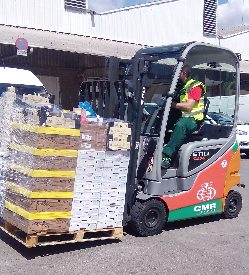
“My name’s Gary Clerk. I’m from Los Angeles, in USA, but I moved to Liverpool two years ago because I got married to my wife, Helen. I work in the company warehouse. Here we select the products that will be shipped according to the orders received. There is a pick line for every product. We use scan guns to scan the products we pick, put them on pallets and then move the pallets back and forth. Then, we take them outside the pick line where the forklift is used to move them to the replenishment area. Once there, we wrap each pallet and make sure that it’s properly secured. There is a separation between each pick line so that we can visually inspect any discrepancies that we may have with the pallets waiting to be picked.
The job is tough, but I still love it. I was doing something similar back in the US, but the relationship with my new colleagues is different. Even though we all speak the same language, there are a lot of cultural differences between America and Britain. My American colleagues were not so formal, but bit by bit I’m trying to cope, and I know I’ll get on well with them.”
| Aluminium foil (n): paper d’alumini | Milk carton (n): cartró de llet, tetrabrik |
| Beverage (n): beguda | Pack (v): empaquetar |
| Bubble envelope (n): sobre de bombolles | Package (v): embalar |
| Bulk handling (n): transport de materials industrials | Packaging (v): embalatge |
| Cardboard box (n): capsa de cartró | Packet (n): paquet |
| Cargo shipping (n): transport de mercaderies | Pallet (n): palet |
| Carton box (n): envàs de cartró | Paper cup (n): got de paper |
| Coffee capsule (n): càpsula de cafè | Railroad car (n): vagó de tren |
| Container (n): contenidor | Resaleable (adj): revendible, que es pot tornar a vendre |
| Container ship (n): vaixell de càrrega | Seal (v): segellar |
| Containerization (n): contenidorització | Shipping box (n): caixa de transport |
| Contents (pl n): contingut | Shrink wrap (n): film transparent |
| Crane (n): grua | Stevedoring company (n): empresa d’estiba |
| Damage (n): desperfecte | Storage (n): emmagatzematge |
| Disposable (adj): d’un sol ús, rebutjable | Straddle carrier (n): carretó pòrtic |
| Dock (n): moll, dàrsena | Tin can (n): llauna |
| Docker (n): estibador | Transport shipping (n): transport marítim |
| Envelop (v): envolta, embolica | Truck (n): camió |
| Export (n): exportació | Unit load (n): unitat de càrrega |
| Food (n): menjar | Unload (v): descarregar |
| Harbour (n): port | Vessel (n): embarcació, vaixell |
| Hold (v): contenir | Warehouse (n): magatzem |
| Intermodal freight transport (n): transport de mercaderies intermodal | Wooden crate (n): caixa de fusta |
| Load (v): carregar | Woven packaging bag (n): bossa de tela |
| Longshoreman (n): estibador | Zipper bag (n): bossa amb cremallera |
| Low loader (n): semitràiler |
Language in use
In this section we are going to see an example of a business transaction. Read the case study and then see Ms Gracia and Mr Geonhui’s phone conversation, where they discuss the terms of the shipment of some sport items. After the discussion there is the email that summarizes the contents of their conversation.
Case study
Anna Garcia works for the purchasing department of Keep Immer Fit, a sports company based in Barcelona. They are planning the new season and there is a high demand of training shoes for outdoor sports. The manager has prepared a list of items to order for the Chinese company Lin SportsWear.
Anna calls the company Lin SportsWear to place the order for some trainers. She requests to speak to Ms Younghi in order to discuss the terms and conditions of the transaction. Her secretary, Mr Geonhui, tells Ms Garcia that Ms Younghi is on a business trip and she will not be back till the next day, but that he can discuss the terms on her behalf. Ms Garcia agrees and goes further to place an order for a series of items. He advises her to send an email with the order. Ms Garcia discusses the terms of the shipment and a possible discount and she requests for the final price and the proforma invoice.
30/70TT is a standard form of payment. It means that 30% will be paid on the placement of the order and the remaining 70% on shipment. TT (Telegraphic Transfer) refers to the mode of payment.
Ms Younghi’s secretary: Lin SportsWear. How can I help you?
Ms Garcia: This is Dolores Garcia, from BCNfitness, Barcelona. Could I speak to Ms Younghi, please?
Ms Younghi’s secretary: Sorry, Ms Garcia. I’m afraid she’s on a business trip and she won’t be back until tomorrow.
Ms Garcia: Oh, I see.
Ms Younghi’s secretary: What does it concern, please?
Ms Garcia: Well, I would like to place an order for some sport shoes, and discuss about the trading terms.
Ms Younghi’s secretary: ok, Ms Garcia. I can handle it on Ms Younghi’s behalf. Is it a large order?
Ms Garcia: Yes, it is. We are preparing for the next season.
Ms Younghi’s secretary: Could you send an email with the order?
Ms Garcia: Certainly. When can the shoes be shipped?
Ms Younghi’s secretary: The earliest is 25th February.
Ms Garcia: Ok, and what are the conditions for the shipment?
Ms Younghi’s secretary: We use CIF terms. The payment will be done by letter of credit, and the payment terms will be 30/70 TT. The port of departure will be Qingpu, in Shangai, and the port of destination Bilbao.
Ms Garcia: All right. And is there the possibility of a discount?
Ms Younghi’s secretary: We can offer a 10% discount for a large order.
Ms Garcia: It’s ok. Will you send a proforma invoice with the final price?
Ms Younghi’s secretary: Of course, I will.
Ms Garcia: Thank you.
Ms Younghi’s secretary: Thank you for your order, Ms Garcia. Goodbye.
Ms Garcia: Goodbye.

| Business trip (n): viatge de negocis | Port of departure (n): port d’origen |
| Discount (n): descompte | Port of destination (n): port de destinació |
| Handle (v): encarregar-se de | Proforma invoice (n): factura proforma |
| Large order (n): comanda gran | Season (n): temporada |
| Letter of credit (n): carta de crèdit, crèdit documentari | Ship (v): enviar, trametre |
| On (sb’s) behalf (adv): de part (d’algú) | Shipment (n): enviament, tramesa |
| Order (n): comanda | Trading terms (pl n): condicions comercials |
| Payment terms (pl n): condicions del pagament | TT(Telegraphic Transfer) (n): transferència electrònica |
| Place an order (v): fer una comanda |
Communication: talking about time and place
The expression of time is very often materialized in the expression of dates and clock times. Dates are very often expressed in the written form (mostly in business letters) whereas clock times are more widely used in speaking.
Dates
To ask for the date, we can say:
- What’s the date (today)? - It’s 9th June.
- What date is it (today)? - It’s 9th June.
A date can also answer a question with when:
- When did you start in this company? - (I started) on 9th June 2007.
Writing the dates:
The expression of the date typically includes the day, the month and the year. The day is expressed with an ordinal number (1st, 2nd, 3rd, etc.). The date formats are different in British and American English.
| British English | American English | |
|---|---|---|
| A | The ninth of June 2007 | June the ninth, 2007 |
| B | 9th June 2007 | June 9th, 2007 |
| C | 9 June 2007 | June 9, 2007 |
| D | 9/6/2007 | 6/9/2007 |
| E | 9/6/07 | 6/9/07 |
| F | 09/06/07 | 06/09/07 |
Notice the following:
- Format A is very formal and it is mostly used in printed items, such as invitations.
- Formats D, E and F may cause misinterpretations. We can interpret the date 9/6/2007 in two ways: 9th June 2007 (in the British format) or 6th September 2007 (in the American format). In order to interpret the date correctly, it is necessary to know the context.
- Numerical formats may use a slash (/): 9/6/2007, a full stop (.): 9.6.2007 or a hyphen (-): 9-6-2007.
- The names of the months are written with an initial capital letter: June, May, April, etc.
Saying the dates:
The way in which we write and say the dates often differs. All the dates, irrespective of their written form, are pronounced like this:
- the ninth of June two thousand and seven (in British English).
- June the ninth two thousand and seven (in American English).
The years are generally pronounced like this:
There are no rules for saying the years, only generally accepted conventions based on brevity and convenience.
- 1900: nineteen hundred
- 1908: nineteen hundred eight
- 1985: nineteen eighty five
- 2000: two thousand
- 2007: two thousand and seven
- 2015: twenty fifteen
- We use the preposition on to say in which date something happens: I started on 14th May 1985 (Cat. vaig començar el 14 de maig de 1985).
- We use the preposition in when we say only the month or the year: I started in May (Cat. vaig començar el maig); I started in 1985 (Cat. vaig començar el 1985).
- Sometimes it is not necessary to say the complete date: I started on the 14th (Cat. vaig començar el dia 14).
Clock times
We can ask for the time like this:
- What’s the time? - It’s 10 (in the morning).
- What time is it? - It’s 10 (in the morning).
We can also ask about the time something happens:
- What time did you arrive? - At 6:15 (a quarter past six).
- What time does the meeting start? - At 4:30 (half past four).
The following table shows the ways in which we write and say the time in EnglisH..
| We write | We say (Formal) | (Informal) |
|---|---|---|
| 3:00 | three o’clock | |
| 3:05 | three oh five | five past three |
| 3:12 | three twelve | twelve minutes past three |
| 3:15 | three fifteen | a quarter past three |
| 3:30 | three thirty | half past three |
| 3:40 | three forty | twenty to four |
| 3:45 | three forty-five | a quarter to four |
| 3:56 | three fifty-six | four minutes to four |
| 4:00 | four o’clock |
To indicate the exact time of an action, we must use the preposition at: come at four! (Cat. vine a les quatre!). We can add about if we mean approximately: come at about four! (Cat. vine cap a les quatre!).
Ante meridian (am) means ‘before midday’: it refers to the times between 00:00 and 12:00; post meridian (pm) means ‘after midday’ and it refers to the times between 12:00 and 00:00.
In English-speaking countries, the 24-hour clock is not widely used. They prefer adding the labels ‘am’ (ante meridian) and ‘pm’ (post meridian) to indicate the part of the day. Therefore, 11:40 is 11:40 am and 23:40 is 11:40 pm.
To say the part of the day, we can use the following expressions:
- In the morning: it’s ten in the morning (Cat. són les deu del matí); it’s three in the morning (Cat. són les tres de la matinada).
- In the afternoon: it’s four in the afternoon (Cat. Són les quatre de la tarda).
- In the evening: it’s eight in the evening (Cat. Són les vuit del vespre); it’s eleven in the evening (Cat. són les onze de la nit).
The English term morning includes the idea of the Catalan terms matí and matinada (Sp. mañana/madrugada) whereas the term evening includes the idea of both vespre and nit (Sp. tarde/noche). The term night is not generally used to speak about a specific time. It refers to the dark hours of the day and it stands in opposition to the term day.
The times included in each part of the day are not clearly established. Approximately, they are the following:
- Morning: 00:00 to 12:00
- Afternoon: 12:00 to 17:00
- Evening: 17:00 to 00:00
Other expressions related to time are:
- At night (Cat. durant la nit, de nit)
- During the day (Cat. durant el dia, de dia)
- At midnight (=00:00) (Cat. a mitjanit)
- At midday (=12:00) (Cat. al migdia)
- At dawn (Cat. a la matinada)
- At sunset (Cat. a la posta del sol, al capvespre)
Grammar reference: prepositions of time and place
Prepositions are used to introduce adverbials of place and time. For example:
- In the office (adverbial of place): it indicates where the action takes place.
- In 1978 (adverbial of time): it indicates when the action takes place.
The use of English prepositions is sometimes confusing, so it is better to learn the adverbials as a whole rather than the individual meanings of the preposition.
Prepositions of time
Here are the most common prepositions of time and their use (Catalan translations availble only when there is an equivalent meaning).
- In is used with:
- Years, centuries and historical periods: in 2010, in the 19th century, in the Middle Ages
- The names of the months: in April, in September
- The names of the seasons: in spring, in summer, in autumn, in winter
- The parts of the day (except ‘night’): in the morning, in the afternoon, in the evening
- On is used with:
- The days of the week: on Mondays, on Tuesday, on Saturday morning
- Dates: on 9th June, on 4th February 2009
- At is used with:
- Clock times and nouns denoting clock times: at 4 o’clock, at 3:30 pm, at midnight, at dawn
- The names of holidays and festivals: at Christmas, at Easter
- The words ‘night’ and ‘the weekend’: at night, at the weekend
- For (Cat. durant) (it expresses the duration of an action): for five years, for three hours
- Since (Cat. des de) (it expresses the starting point of an action): since last year, since yesterday, since three, since I work here
- During (Cat. durant) (it expresses a moment within a longer period of time): during the Christmas holidays, during the class, during his convalescence
- Ago (it expresses the moment when an action took place in the past. Unlike the other prepositions, it is placed after the noun): four years ago, three hours ago
- Before (Cat. abans de): before 1997, before three o’clock, before summer, before Christmas, before he came
- After (Cat. després de): after 1997, after three o’clock, after summer, after Christmas, after I met you
- Until (Cat. fins a) (it indicates the end of an action): until midnight, until 2023, until Sunday, until I call
- From … to (Cat. des de…fins) (this double preposition indicates the beginning and the end of an action): from three to four; from April to May, from the 18th to the 20th century
Notes:
1) The prepositions since, before, after and until can also be placed in front of a sentence. For example:
- since I work here
- before he came
- after I met you
- until I call you
2) Do not confuse the meanings of for and during:
- For expresses the whole period of time: I’ll go to London for a week (Cat. aniré a Londres durant tota una setmana)
- During refers to a moment in the period of time: I’ll go to London during this week (Cat. aniré a Londres en algun moment d’aquesta setmana)
Prepositions of place
The most common prepositions and prepositional phrases of place are:
- In (Cat. a, dintre de): in the garden, in the box, in the street, in England, in the city.
- Into (Cat. cap a dintre de): into the house, into the pocket, into the forest.
- Inside (Cat. dintre de): inside the kitchen, inside the pocket.
- Outside (Cat. fora de): outside the house, outside the country.
- On (Cat. a, a sobre de): on the desk, on the shelf, on the chair, on the wall, on the floor.
- At (Cat. a): at the door, at the table, at the cinema, at the window, at the tree.
- To (Cat. a, cap a): to the cinema, to London, to work, to the street.
- Opposite (Cat. al davant de, enfront): opposite the park, opposite Sandra, opposite the school.
- In front of (Cat. davant de): in front of a man, in front of the house .
- Next to (Cat. al costat de): next to the bank, next to my friend, next to the lamp.
- Behind (Cat. al darrera de): behind the curtains, behind a bus, behind the door, behind the tree.
- Near (Cat. a prop de): near London, near the road, near the window .
- Over (Cat. per damunt de): over the bed, over my head.
- Under (Cat. a sota de): under the table, under a tree, under my jacket.
- Above (Cat. per damunt de): above the vice-president, above the house.
- Below (Cat. per sota de): below the president, below the standards.
- From (Cat. de): I’m from Barcelona, these products are from China.
- On the corner of (Cat. a la cantonada de): on the corner of the street, on the corner of London Rd and High St.
Notes:
1) Some prepositions have similar meanings. For example:
- He is in the cinema (Cat. És a dins del cinema) (meaning that he is inside the cinema, and not in the street).
- He is at the cinema (Cat. És al cinema) (in a general sense, stressing the purpose of going to the cinema rather than the location).
- The lamp is on the table (Cat. La làmpara és al damunt de la taula) (=resting on the table).
- The lamp is over the table (Cat. La làmpara és a sobre de la taula) (=hanging, with no contact with the table).
2) Above and below are used to refer to a higher or lower position in status, whereas over and under are used to refer to a physical place. For example:
- The president is above the vice-president. (Cat. El president està per damunt del vice-president)
- The plane is flying over the Alps. (Cat. L’avió està volant per damunt dels Alps).